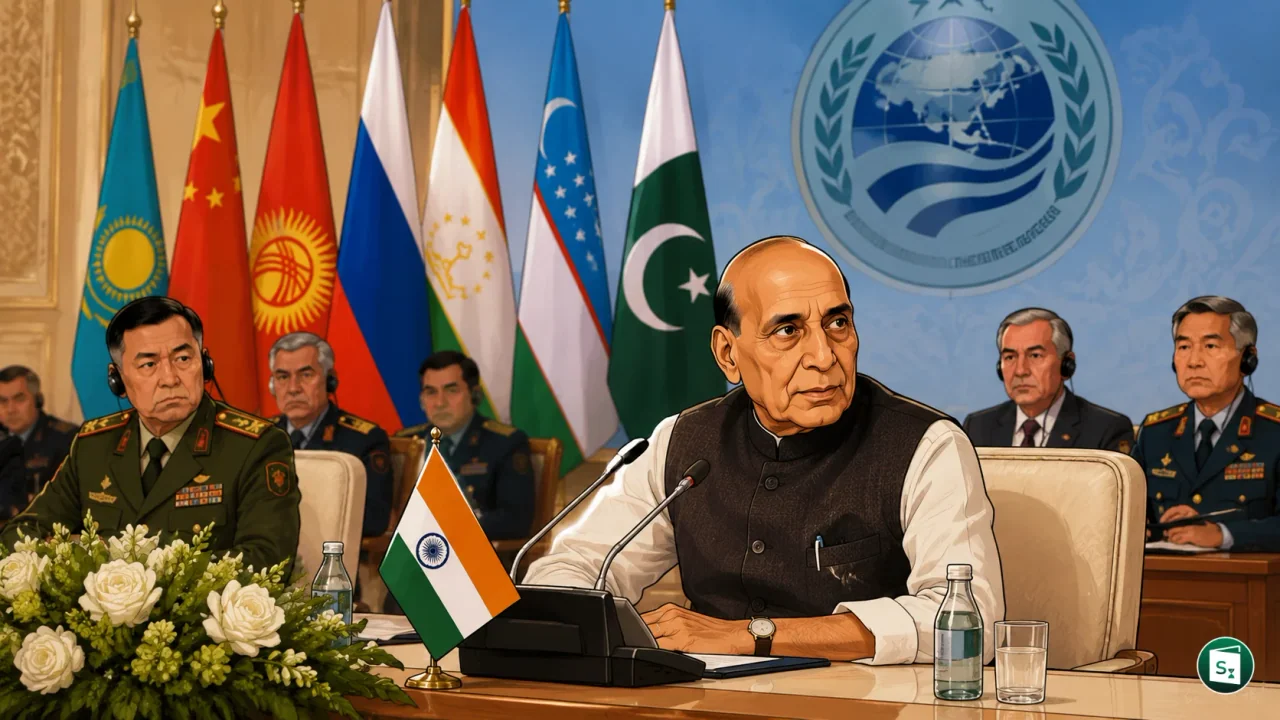
Union Defence Minister Rajnath Singh represented India at the 23rd Defence Ministers’ Meeting of the Shanghai Cooperation Organisation (SCO) in Bishkek, Kyrgyzstan, on May 9, 2026. The high-level session served as a critical platform for member states to address shared security challenges, with a particular emphasis on eradicating terrorism and radicalization from the region. During the summit, India reiterated its commitment to collective stability and called for a unified approach to ensure regional safety amidst evolving global geopolitical shifts.
Strengthening Regional Security in Bishkek
The 23rd Defence Ministers’ Meeting took place under the Kyrgyz presidency, which has adopted the theme “25 Years of the SCO: Together Towards Sustainable Peace, Development, and Prosperity.” The SCO, established in 2001 and headquartered in Beijing, China, remains one of the largest trans-regional organizations, covering nearly 40% of the world’s population and roughly 25% of the global GDP.
Defence ministers from all 10 member states (including newly joined Belarus, along with China, India, Iran, Kazakhstan, Kyrgyzstan, Pakistan, Russia, Tajikistan, and Uzbekistan) engaged in comprehensive discussions regarding the evolving security architecture in Eurasia. The primary focus of the Bishkek session was to streamline strategic coordination and intelligence sharing to counter unconventional threats, including cyber-warfare and organized crime, which have become increasingly sophisticated.
India’s Firm Stance on Counter-Terrorism
Minister Rajnath Singh emphasized India’s “zero tolerance” policy towards terrorism and extremism. He highlighted that regional peace and prosperity are inseparable from the elimination of terror safe havens and the cessation of cross-border terrorism. India called upon SCO member states to reject double standards and political exceptions when dealing with those who abet or sponsor terrorist activities.
A significant highlight of the minister’s address was the mention of “Operation Sindoor,” a recent strategic operation that underscored India’s resolve to hit the epicenters of terror. He asserted that the credibility of the SCO depends on its consistency in tackling the “three evils” of terrorism, separatism, and extremism. India also underscored the importance of the Regional Anti-Terrorist Structure (RATS), which is headquartered in Tashkent, Uzbekistan, in facilitating real-time cooperation among member nations.
The Growing Strategic Role of the SCO
Beyond counter-terrorism, the meeting addressed the broader geopolitical impact of conflicts in West Asia and their repercussions on Eurasian stability. The ministers deliberated on collective measures to mitigate risks arising from global volatility and the disruption of supply chains. India advocated for the resolution of disputes through dialogue and diplomacy rather than unrelenting force, while maintaining its uncompromising stance on national security.
The SCO’s expanded membership, with Iran and Belarus joining in recent years, has transformed it into a formidable platform for Eurasian integration. This expansion allows for better coordination on large-scale infrastructure and connectivity projects, such as the International North-South Transport Corridor (INSTC) and the development of the Chabahar Port, which are crucial for India’s strategic outreach to Central Asia.
Kyrgyzstan’s Presidency and the SCO at 25
The Kyrgyz Republic has outlined a vision that emphasizes the SCO’s 25-year journey from a regional confidence-building forum to a major global player. The current presidency focuses on enhancing the efficiency of the SCO Secretariat in Beijing and strengthening the role of the organization in international organizations like the United Nations.
As the SCO approaches its silver jubilee, the Bishkek meeting served as a precursor to the upcoming SCO Heads of State Summit. The defense ministers’ joint communique reaffirmed their commitment to the “Shanghai Spirit,” which advocates for mutual trust, equality, respect for cultural diversity, and the pursuit of common development. For India, active participation in these sessions remains vital to safeguarding its interests in the Extended Neighborhood and ensuring that Central Asia remains a zone of peace and cooperation.
Key Takeaways
- The 23rd Defence Ministers’ Meeting of the SCO was held in Bishkek, Kyrgyzstan, under the Kyrgyz presidency on May 9, 2026.
- India reiterated its “zero tolerance” policy towards terrorism and called for the elimination of safe havens for extremist groups.
- The meeting focused on the “three evils” of terrorism, separatism, and extremism as defined by the SCO charter.
- The SCO now comprises 10 member states, with Belarus being the most recent addition following the entry of Iran.
- The Regional Anti-Terrorist Structure (RATS) is a permanent organ of the SCO headquartered in Tashkent, Uzbekistan.
- The theme of the current Kyrgyz presidency is “25 Years of the SCO: Together Towards Sustainable Peace, Development, and Prosperity.”