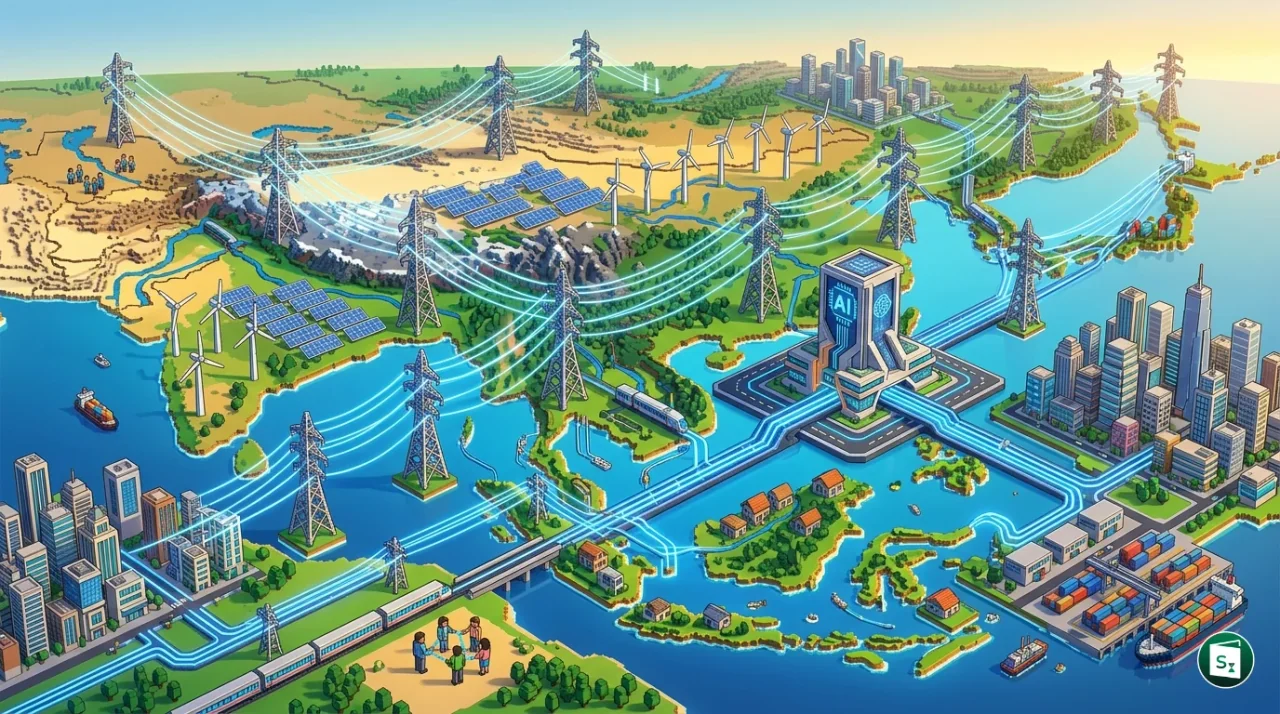
The Asian Development Bank has unveiled a landmark $70 billion connectivity roadmap to transform energy and digital infrastructure across the Asia-Pacific by 2035. Announced during the bank’s 59th Annual Meeting in Samarkand, Uzbekistan, the initiative aims to bridge the digital divide and create a unified regional power market. This massive investment focuses on integrating renewable energy and leveraging artificial intelligence to drive sustainable economic growth for millions.
The $70 Billion Connectivity Roadmap for Asia-Pacific
The Asian Development Bank (ADB), established in 1966 and headquartered in Manila, Philippines, has launched this multi-billion dollar framework to address the region’s evolving infrastructure needs. The announcement was made during the bank’s 59th Annual Meeting held in Samarkand, Uzbekistan, a historic trade hub on the ancient Silk Road. Under the leadership of President Masato Kanda, the ADB is positioning itself to lead the region’s transition toward a more integrated and greener future.
The $70 billion roadmap is split into two primary pillars designed to complement each other. The first is a $50 billion power integration project, while the second is a $20 billion digital infrastructure programme. By combining energy and digital connectivity, the ADB aims to ensure that the rapid growth driven by the fourth industrial revolution is both sustainable and inclusive across its 69 member countries.
Pan-Asia Power Grid: Building a Green Energy Corridor
The Pan-Asia Power Grid Initiative is the cornerstone of this plan, with a total outlay of $50 billion. Its primary objective is to move away from isolated, bilateral energy links toward a comprehensive regional power trade framework. This will allow countries with surplus renewable energy to export it to regions with high demand, optimizing resource use across the continent. The ADB has committed to financing $25 billion, which accounts for half of the total project cost.
By the target year of 2035, the initiative aims to achieve several ambitious milestones:
- Integration of 20 Gigawatts (GW) of renewable energy into regional grids.
- Construction of 22,000 circuit-km of new high-voltage transmission lines.
- A 15% reduction in regional power sector emissions compared to current levels.
- Improved electricity access and reliability for over 200 million people.
This expansion of physical infrastructure will be supported by a $10 million technical assistance pool to help member nations align their regulations and adopt common technical standards for cross-border energy trade.
Asia-Pacific Digital Highway: Bridging the Technological Divide
The second pillar, the Asia-Pacific Digital Highway, involves a $20 billion investment to ensure that no nation is left behind in the digital era. This initiative focuses on building high-speed internet infrastructure, including subsea fiber-optic cables, terrestrial networks, and satellite links. The ADB will provide $15 billion in direct financing, with the remaining $5 billion expected from private sector partners and other international donors.
The programme sets clear targets for expanding connectivity by 2035:
- Providing high-speed broadband access to 200 million people for the first time.
- Upgrading existing digital services for an additional 450 million users.
- Reducing the cost of data and connectivity by 40% in remote and landlocked regions.
By lowering the cost of digital access, the ADB hopes to stimulate the growth of digital economies and create roughly 4 million new jobs across the region.
Regional Focus and AI Innovation in Seoul
A critical component of the digital initiative is the establishment of the Centre for AI Innovation and Development in Seoul, South Korea. This specialized facility is backed by a $20 million contribution from the South Korean government. The centre will serve as a regional hub for promoting the ethical and inclusive adoption of Artificial Intelligence (AI). It aims to train approximately 3 million people in advanced digital and AI skills by 2035, helping to future-proof the regional workforce.
In addition to the Seoul centre, Uzbekistan will play a central role as a regional gateway for Central Asia. A new regional coordination center for the Digital Highway is set to be established in Tashkent. This reflects the host nation’s growing importance in regional trade and connectivity, supported by a newly signed $12 billion cooperation program between Uzbekistan and the ADB.
Strategic Importance and Economic Impact
The $70 billion roadmap, themed “Crossroads of Progress,” represents one of the largest coordinated infrastructure pushes in the history of the ADB. By integrating power and digital networks, the bank is addressing two of the most significant barriers to development in the Asia-Pacific. The shift toward a regional power grid is expected to de-risk investments in renewable energy and accelerate the transition toward Net Zero targets.
The economic ripple effects are substantial, with the ADB estimating the creation of nearly 5 million jobs in total across the energy and technology sectors. Furthermore, the 15% reduction in regional emissions will play a vital role in meeting global climate commitments under the Paris Agreement.
| Feature | Pan-Asia Power Grid | Asia-Pacific Digital Highway |
|---|---|---|
| Total Outlay | $50 Billion | $20 Billion |
| New Users | 200 Million (Improved Access) | 200 Million (First-time Access) |
| Job Creation | 840,000 | 4 Million |
| Infrastructure | 22,000 circuit-km lines | Subsea fiber, Satellites |
| Key Target | 20 GW Renewable Energy | 40% Cost Reduction |
Key Takeaways
- The Asian Development Bank (ADB) announced a massive $70 billion connectivity initiative during its 59th Annual Meeting in Samarkand, Uzbekistan.
- The Pan-Asia Power Grid Initiative aims to invest $50 billion by 2035 to create a regional power trade framework and integrate 20 Gigawatts (GW) of renewable energy.
- The Asia-Pacific Digital Highway is a $20 billion programme designed to provide broadband access to 200 million new users and reduce connectivity costs by 40%.
- A new Centre for AI Innovation and Development will be established in Seoul, South Korea, to train 3 million people in digital skills.
- The ADB, founded in 1966 and headquartered in Manila, currently has 69 member countries working toward regional social and economic development.
- The initiative is expected to create nearly 5 million jobs and reduce regional power sector emissions by 15% over the next decade.