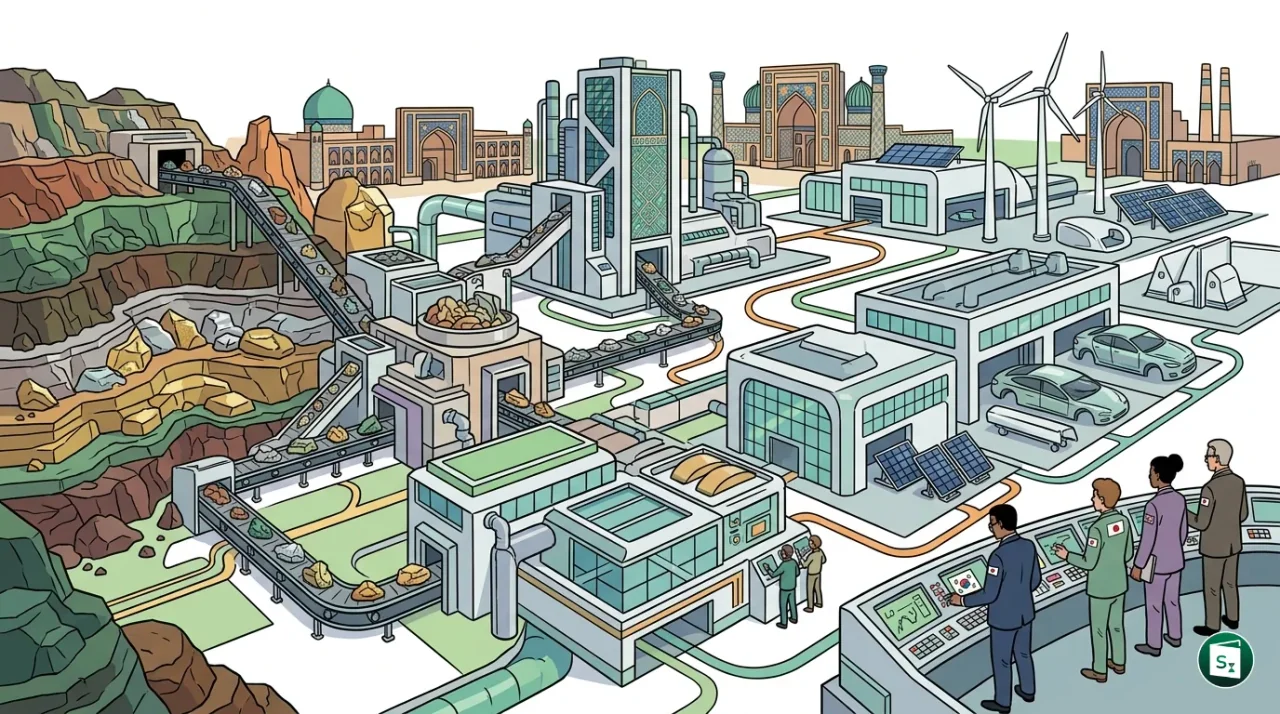
The Asian Development Bank (ADB) has officially launched the Critical Minerals-to-Manufacturing (CMM) Financing Partnership Facility during its 59th Annual Meeting in Samarkand, Uzbekistan. This initiative aims to help developing countries in the Asia-Pacific region transform from raw material exporters into high-value manufacturing hubs for clean energy technologies. By securing sustainable supply chains for minerals like lithium and cobalt, the facility will accelerate the region’s transition toward a net-zero future.
Shaping the Future of Critical Minerals in Asia-Pacific
The global push for a clean energy transition has triggered an unprecedented demand for critical minerals. These materials, which include lithium, cobalt, nickel, graphite, and rare earth elements, are essential for producing solar panels, wind turbines, and electric vehicle batteries. However, while many developing member countries of the ADB are rich in these resources, they often lack the infrastructure and investment needed to process them into finished goods.
The Critical Minerals-to-Manufacturing (CMM) Financing Partnership Facility addresses this gap by creating a structured framework for investment. By focusing on the entire supply chain, the ADB intends to move away from the traditional model where countries only export raw ores. Instead, the goal is to develop localized industries that can handle everything from mineral extraction to the final manufacturing of green technologies.
Two-Pronged Financing Strategy for Project Development
To ensure the success of the CMM facility, the ADB has established two distinct financing windows designed to support projects at different stages of their lifecycle. These windows provide the necessary capital and technical expertise to bridge the gap between resource identification and industrial production.
The Grant Window: Building Foundations
The CMM Trust Fund, or the Grant Window, focuses on early-stage project preparation. This includes conducting feasibility studies, performing environmental and social impact assessments, and providing technical assistance to governments. Initial funding for this window includes $20 million from Japan and $1.6 million from the United Kingdom. These grants are crucial for ensuring that projects are bankable and adhere to international standards before they seek larger investments.
The Catalytic Finance Window: Scaling Up Investment
The Catalytic Finance Window acts as a platform for co-financing and partnership coordination. It aims to mobilize larger pools of capital for midstream and downstream activities. During the Samarkand meeting, the Export-Import Bank of Korea (KEXIM) and the Korea Trade Insurance Corporation (K-SURE) signed memoranda for $500 million each. This significant commitment underscores the role of international financial institutions in derisking large-scale critical mineral projects.
Strengthening the Entire Value Chain
The CMM facility is comprehensive in its scope, targeting every major segment of the critical minerals value chain. This end-to-end approach ensures that the benefits of mineral wealth are retained within the region.
| Segment | Activities Covered |
|---|---|
| Upstream | Exploration, extraction, and sustainable mining practices |
| Midstream | Processing, smelting, and refining of raw minerals |
| Downstream | Manufacturing of batteries, electric vehicles, and renewable energy systems |
| Circular Economy | Development of recycling infrastructure to recover minerals from waste |
In addition to financing, the ADB has introduced a Critical Minerals Database. This tool will provide transparent information on supply chains, helping policy coordinators and investors make informed decisions. By standardizing data across the Asia-Pacific, the database aims to reduce supply chain bottlenecks and improve market efficiency.
Strategic Importance for the Region and India
The launch of this facility comes at a time when the Asia-Pacific region is striving to secure its energy sovereignty. For many developing nations, the transition to green energy is not just an environmental necessity but an economic opportunity. By moving up the value chain, these countries can create high-skilled jobs and boost their industrial output.
For India, this development aligns perfectly with the national Critical Minerals Mission. India has been actively seeking to secure its supply of minerals like lithium and copper to support its domestic electric vehicle (EV) manufacturing and semiconductor ambitions. The ADB’s new financing framework could provide additional avenues for Indian industries to partner with global leaders in mineral processing and high-tech manufacturing, further strengthening the Make in India initiative in the green energy sector.
About the Asian Development Bank (ADB)
The Asian Development Bank (ADB) is a regional development bank established in 1966 to promote social and economic development in Asia and the Pacific. Headquartered in Mandaluyong, Metro Manila, Philippines, the bank assists its members and partners by providing loans, technical assistance, grants, and equity investments.
As of 2026, the ADB has 68 members, of which 49 are from within the Asia-Pacific region. The bank is currently led by President Masatsugu Asakawa. The Annual Meeting of the Board of Governors is the bank’s highest policy-making body and serves as a major forum for discussing economic and social issues affecting the region. The 59th Annual Meeting held in Samarkand marks the first time Uzbekistan has hosted this prestigious event.
Key Takeaways
- The Critical Minerals-to-Manufacturing (CMM) Financing Partnership Facility was launched by the ADB during its 59th Annual Meeting in Samarkand.
- The facility aims to support the entire supply chain, including the extraction, processing, and manufacturing of clean energy technologies.
- The CMM Trust Fund (Grant Window) received initial contributions of $20 million from Japan and $1.6 million from the UK.
- Korea Eximbank and K-SURE committed a total of $1 billion ($500 million each) toward the facility’s Catalytic Finance Window.
- The Asian Development Bank (ADB), established in 1966, is headquartered in Manila, Philippines, and has 68 members.
- A new Critical Minerals Database will be created to improve transparency and coordination in regional mineral supply chains.