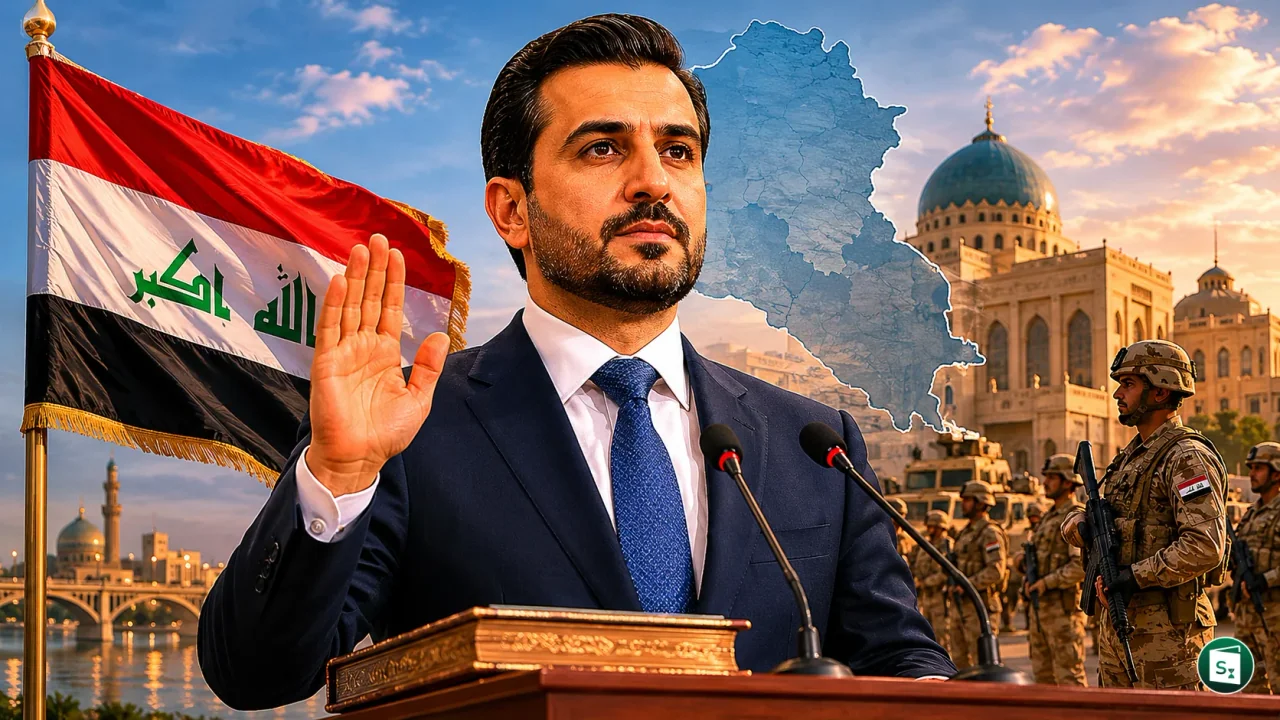
Ali Falih Kadhim al-Zaidi was officially sworn in as the Prime Minister and Commander-in-Chief of Iraq on May 22, 2026, marking a significant generational shift in the country’s leadership. Nominated by the influential Coordination Framework, the 40-year-old businessman becomes the youngest individual to hold the premiership in Iraq’s modern history. He succeeds Mohammed Shia al-Sudani, taking office at a time when Iraq seeks to balance complex regional dynamics and accelerate its domestic economic reconstruction.
Who is Ali Falih Kadhim al-Zaidi?
Ali Falih Kadhim al-Zaidi enters the Prime Minister’s office as a notable outsider to Iraq’s traditional political establishment. A prominent businessman, banker, and attorney by profession, al-Zaidi built a successful career in the private sector before his elevation to the country’s highest executive office. He holds advanced degrees in law and finance, providing him with a technocratic foundation that many observers hope will translate into effective economic governance.
His appointment is viewed as a strategic move by the Iraqi leadership to present a fresh, non-partisan face capable of navigating the intense rivalries within the Council of Representatives (Iraq’s parliament). Unlike many of his predecessors, al-Zaidi does not belong to the old guard of political exiles or established militia-linked parties. Instead, his background in investment and banking is expected to be leveraged to tackle Iraq’s pressing fiscal challenges and high unemployment rates.
The Coordination Framework and Iraq’s Political Landscape
The nomination of Ali al-Zaidi was spearheaded by the Coordination Framework, a powerful umbrella coalition that represents the majority of Shiite political factions in Iraq. The coalition emerged as a dominant force following the November 2025 parliamentary elections, where no single party secured an absolute majority. While the Reconstruction and Development Coalition, led by outgoing Prime Minister Mohammed Shia al-Sudani, won a significant number of seats, the broader Coordination Framework eventually reached a consensus on al-Zaidi to break a persistent political deadlock and avoid further fragmentation.
Iraq’s political system operates under a confessionalist power-sharing arrangement where the Prime Minister is typically a Shiite, the President is a Kurd, and the Speaker of the Parliament is a Sunni. Al-Zaidi was formally invited to form the government by President Nizar Amidi, who was elected by the parliament in April 2026. This transition reflects a delicate balancing act to maintain internal stability while addressing the demands of various ethnic and religious groups within the country’s multi-layered governance structure.
Governance Challenges and Regional Stability
Prime Minister al-Zaidi faces the formidable task of governing a nation that is still grappling with the scars of conflict and deep-seated structural issues. Internally, the new administration must address a significant budget deficit exacerbated by fluctuating global hydrocarbon revenues and a bloated public sector payroll. Furthermore, the fragmented nature of the parliament means that securing legislative approval for critical reforms, particularly in the energy and banking sectors, will require constant and careful negotiation with various rival political blocs.
On the international front, al-Zaidi must navigate the complex regional rivalry between Iran and the United States, both of whom maintain significant strategic interests in Iraq. Maintaining a balanced foreign policy is essential for Iraq to secure continued international support for its reconstruction efforts while ensuring that its territory does not become a focal point for external conflicts. Additionally, the government faces persistent pressure to improve the efficiency of state institutions and combat corruption, which has been a primary driver of public discontent and social unrest in recent years.
India-Iraq Strategic Relations: Beyond Oil
The leadership transition in Baghdad is of significant interest to India, as Iraq remains one of its most critical strategic partners in West Asia. In recent years, Iraq has consistently ranked as India’s 7th largest trading partner globally, with bilateral trade valued at approximately $33.3 billion during the 2025–26 period. Iraq is also a vital pillar of India’s energy security, supplying nearly 20% of its total crude oil requirements, a relationship that has remained resilient despite shifts in the global oil market and increased competition from other suppliers.
Under the new administration, the partnership is expected to expand beyond traditional hydrocarbon exports into sectors such as infrastructure, healthcare, and renewable energy. Iraq has recently signaled its intention to join the India-headquartered International Solar Alliance (ISA), reflecting a mutual commitment to climate goals and sustainable development. Additionally, Indian companies have been actively involved in Iraq’s post-war reconstruction, securing major contracts in power generation and transmission, which further solidifies the economic and developmental ties between the two nations.
Key Takeaways
- Ali Falih Kadhim al-Zaidi was officially sworn in as the Prime Minister and Commander-in-Chief of Iraq on May 22, 2026.
- At 40 years of age, al-Zaidi has become the youngest Prime Minister in the modern history of Iraq, succeeding Mohammed Shia al-Sudani.
- The new Prime Minister was nominated by the Coordination Framework, which is the largest coalition of Shiite political factions in the Iraqi parliament.
- Iraq is currently India’s 7th largest trading partner globally, with bilateral trade valued at approximately $33.3 billion in the 2025–26 fiscal period.
- Iraq is a vital pillar of India’s energy security, consistently supplying nearly 20% of India’s total crude oil requirements.
- The new Iraqi administration is seeking to diversify its energy portfolio and has signaled its intention to join the India-headquartered International Solar Alliance (ISA).