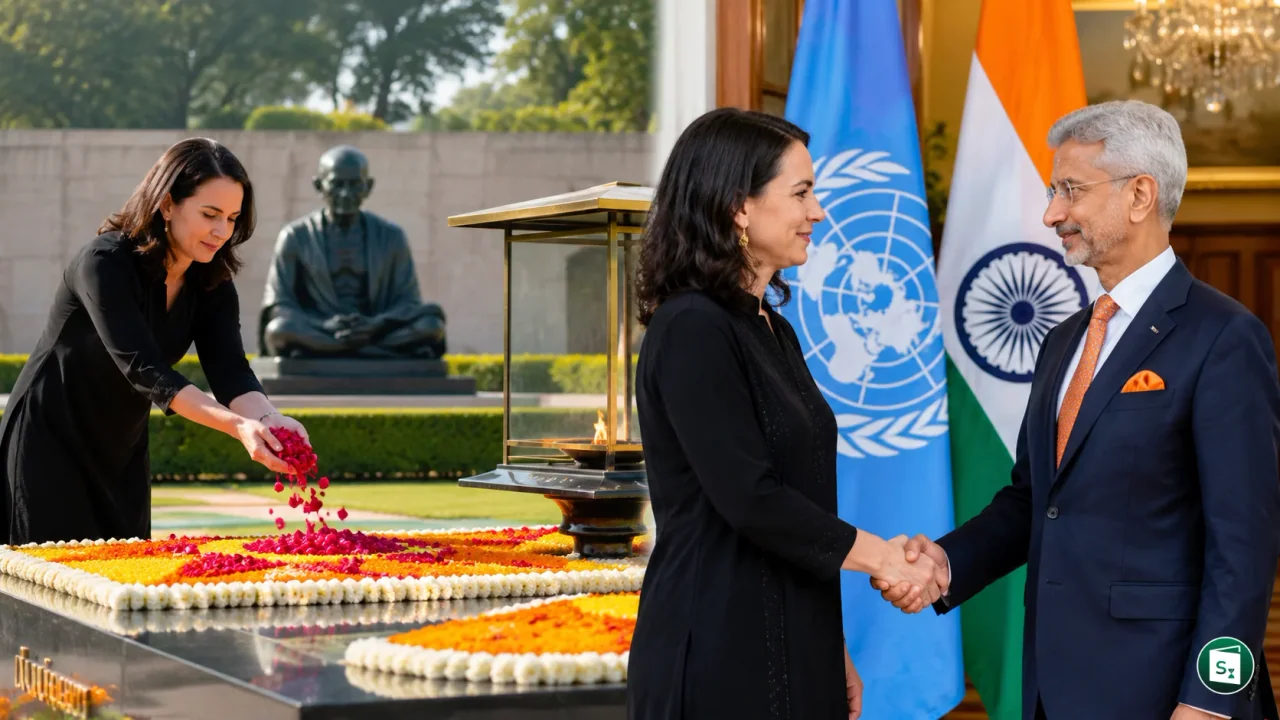
Annalena Baerbock, the 80th President of the United Nations General Assembly (UNGA), arrived in India on May 9, 2026, for a high-level visit at the invitation of External Affairs Minister S Jaishankar. The visit underscores India’s growing influence within the United Nations and its commitment to advancing multilateral solutions for global challenges. During her stay, the President engaged in bilateral discussions to strengthen cooperation on international peace, security, and sustainable development.
Diplomatic Engagements and Tribute at Rajghat
The President’s visit began with a solemn tribute to Mahatma Gandhi at Rajghat, the memorial dedicated to the Father of the Nation. This gesture, a customary part of high-level diplomatic visits to India, signifies the global recognition of Gandhi’s principles of non-violence and peace, which align with the core values of the United Nations. Following the visit to Rajghat, the UNGA President proceeded to Hyderabad House for formal bilateral discussions.
Hyderabad House, a historic venue in New Delhi, serves as the primary setting for high-level meetings between Indian leaders and visiting dignitaries. The meeting with Minister Jaishankar focused on reinforcing the strategic partnership between India and the UN, particularly as the 80th session of the General Assembly addresses critical global issues.
Bilateral Discussions on Global Multilateralism
The high-level meeting at Hyderabad House covered a wide range of global concerns, with both leaders emphasizing the need for a more inclusive and effective multilateral system. A primary focus of the discussion was the reform of the UN Security Council (UNSC), where India has long advocated for a permanent seat to reflect contemporary geopolitical realities. Baerbock acknowledged India’s leadership as a voice for the Global South and its role in bridging the gap between developed and developing nations.
Both sides also deliberated on the progress of the Sustainable Development Goals (SDGs) and the importance of climate action. India’s initiatives, such as the International Solar Alliance (ISA) and the Coalition for Disaster Resilient Infrastructure (CDRI), were highlighted as significant contributions to the global environmental agenda. The discussions also touched upon emerging technologies, including the governance of Artificial Intelligence (AI), ensuring that its benefits are equitably shared across the globe.
Strengthening India’s Voice in the United Nations
India’s engagement with the United Nations is built on a foundation of proactive contribution to global governance and peacekeeping. As a founding member of the UN, India has consistently supported the organization’s mandate, providing the largest cumulative number of troops to UN Peacekeeping missions. This visit by the UNGA President reaffirms India’s position as a “net security provider” and a reliable partner in maintaining international order.
During the discussions, the significance of Digital Public Infrastructure (DPI) was underscored. India’s success in implementing digital solutions for inclusive development is being viewed as a model for other member states. The UNGA President expressed interest in how India’s digital transformations, such as the Aadhaar system and the Unified Payments Interface (UPI), can be adapted to accelerate the achievement of the SDGs globally. This alignment of national success with international goals highlights the deepening synergy between India and the United Nations.
The Significance of the 80th UNGA Presidency
The United Nations General Assembly (UNGA) is one of the six principal organs of the UN and serves as the main deliberative, policymaking, and representative body. Each year, the General Assembly elects a President to preside over its sessions. The President of the UNGA represents the collective will of the 193 member states and plays a crucial role in setting the assembly’s agenda and facilitating consensus on complex international issues.
Annalena Baerbock’s tenure as the President of the 80th session of the UNGA (2025-2026) comes at a time of significant global volatility. Her visit to India highlights the importance of the country in the current international landscape. The presidency follows a rotation system among five geographic groups: Africa, Asia-Pacific, Eastern Europe, Latin America and the Caribbean, and Western European and Other States (WEOG). As a representative of the WEOG, Baerbock’s focus on multilateral reform and sustainable development aligns closely with India’s foreign policy priorities, paving the way for enhanced cooperation during her term.
Key Takeaways
- Annalena Baerbock, the President of the 80th session of the UN General Assembly, visited India on May 9, 2026.
- The visit included a tribute to Mahatma Gandhi at Rajghat and a high-level bilateral meeting at Hyderabad House.
- Discussions focused on the reform of the UN Security Council (UNSC) and India’s role as a leader of the Global South.
- India’s Digital Public Infrastructure (DPI), including systems like Aadhaar and UPI, was highlighted as a model for global sustainable development.
- The UNGA President is elected annually and represents the collective interests of all 193 member states.
- The presidency follows a rotation system among five geographic groups, with Baerbock representing the Western European and Other States (WEOG).