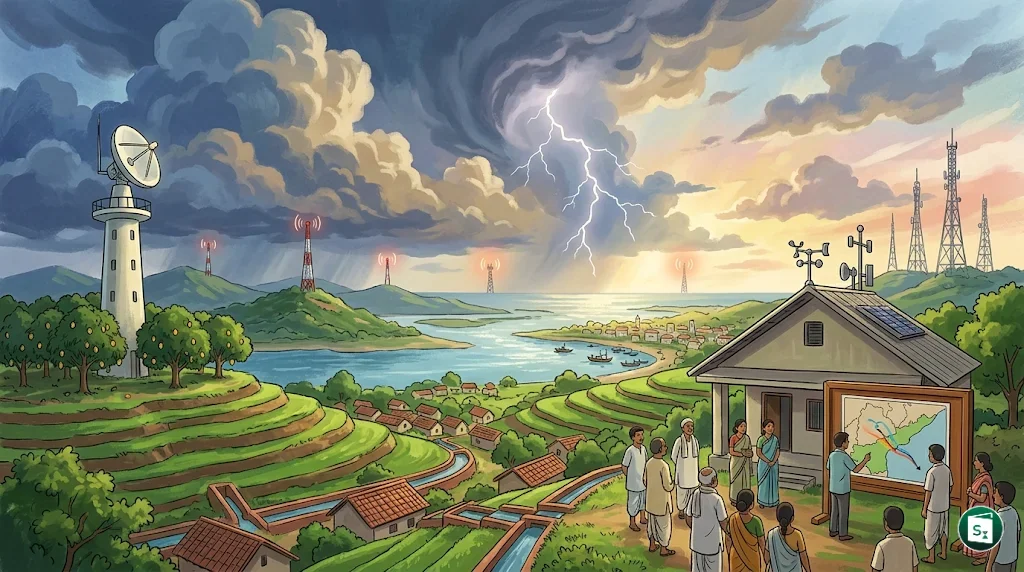
The Government of Andhra Pradesh has partnered with the National Remote Sensing Centre (NRSC) of ISRO to strengthen its lightning forecasting and early warning capabilities. This collaboration aims to minimize lightning-related fatalities and enhance the overarching disaster management framework within the state through advanced satellite technology. By integrating real-time data analysis, the state seeks to provide timely alerts to vulnerable rural communities, significantly improving public safety during extreme weather events.
Strengthening Lightning Mitigation in Andhra Pradesh
The Andhra Pradesh State Disaster Management Authority (APSDMA) formalised this partnership by signing a Memorandum of Understanding (MoU) with the National Remote Sensing Centre (NRSC). The agreement was signed by Prakhar Jain, Managing Director of APSDMA, and Dr. Aparna, Deputy Director of NRSC, in the presence of senior state officials. This move follows directives from the state government to leverage cutting-edge space technology to safeguard citizens from natural calamities, particularly in lightning-prone regions.
The primary objective of this collaboration is to upgrade the state’s existing disaster response mechanisms. By utilizing NRSC’s expertise in satellite-based monitoring, Andhra Pradesh aims to build a more resilient infrastructure that can predict and communicate lightning threats with higher precision. The initiative specifically targets rural populations, including farmers and cattle grazers, who are most vulnerable to sudden lightning strikes during the monsoon season.
Advanced Satellite Technology for Early Warning
A major component of the partnership is the implementation of an advanced lightning detection system developed by the Indian Space Research Organisation (ISRO). This system utilizes satellite data, including Outgoing Longwave Radiation (OLR) and Land Surface Temperature (LST), to monitor atmospheric instability. This technological breakthrough, pioneered by NRSC in April 2025, allows for an early warning lead time of approximately 2.5 hours before a lightning event occurs.
Previously, ground-based sensors provided much shorter warning windows, often leaving little time for evacuation or protective measures. The integration of satellite-driven predictive models ensures that authorities can disseminate alerts through various platforms, such as the SACHET portal and the Common Alerting Protocol (CAP). These tools enable the delivery of location-specific warnings directly to mobile devices, ensuring that even the most remote hamlets are informed in real-time.
Strategic Impact: Mapping Vulnerability and Safeguarding Rural Communities
Lightning remains one of the deadliest natural hazards in India, frequently causing more fatalities than floods or earthquakes in certain regions. In Andhra Pradesh, the impact is particularly severe in agricultural districts where outdoor work is a necessity. To address this, the MoU mandates a collaborative effort to map lightning hotspots across the state. By analyzing historical strike data alongside geographic features, the NRSC will help identify specific Mandals and villages that are at the highest risk.
Mapping these vulnerabilities allows the APSDMA to implement targeted prevention strategies. This includes the installation of lightning arresters in high-risk zones, community-based awareness programmes, and the strengthening of safety protocols for schools and public buildings. The goal is to move from a reactive post-disaster response to a proactive mitigation strategy that emphasizes preparedness and informed community action.
Institutional Framework for Disaster Resilience
The National Remote Sensing Centre (NRSC), headquartered in Hyderabad, is one of the primary centres of the Indian Space Research Organisation (ISRO). It is responsible for ground station management, data reception from remote sensing satellites, and creating specialized applications for natural resource management and disaster support. Under the leadership of ISRO Chairman S. Somanath, the agency has increasingly focused on providing real-time technical support to state governments for disaster risk reduction.
On the other hand, the Andhra Pradesh State Disaster Management Authority (APSDMA) serves as the nodal agency for all disaster-related activities in the state. Established to ensure a coordinated and prompt response to emergencies, it operates under the Revenue (Disaster Management) Department. This partnership reflects a broader national trend where scientific institutions and administrative bodies collaborate to localize high-tech solutions, ensuring that space-based insights translate into life-saving actions on the ground.
The Global and National Perspective on Lightning Hazards
The collaboration between Andhra Pradesh and NRSC is a vital component of the Lightning Resilient India Campaign, a national initiative aimed at reducing lightning-related deaths. Historically, lightning has been often overlooked compared to other high-profile disasters. However, with the increasing frequency of extreme weather events due to climate change, it has become a priority for scientific bodies like the India Meteorological Department (IMD) and the Indian Institute of Tropical Meteorology (IITM).
Currently, applications like ‘Damini’ provide critical location-specific alerts, but the integration of more advanced satellite data from ISRO’s INSAT-3D series adds another layer of accuracy. By standardizing these alerts through the Common Alerting Protocol (CAP), the government ensures that the warning delivery system is uniform across different states. This systematic approach not only sets a precedent for other lightning-prone states such as Odisha and Bihar but also aligns with India’s broader disaster management goals under the National Disaster Management Act, 2005.
Key Takeaways
- The Andhra Pradesh government and ISRO’s National Remote Sensing Centre (NRSC) signed an MoU to enhance lightning forecasting and early warning systems.
- The new system utilizes satellite data to provide approximately 2.5 hours of advance warning before a lightning strike occurs.
- The NRSC, a primary unit of ISRO headquartered in Hyderabad, is responsible for receiving and processing satellite data for disaster management.
- The partnership aims to map specific lightning hotspots across Andhra Pradesh to prioritize safety measures in high-risk rural areas.
- Alerts will be disseminated through standard platforms like the SACHET portal and the Common Alerting Protocol (CAP).
- Lightning mitigation efforts in the state are being synchronized with the national Lightning Resilient India Campaign.