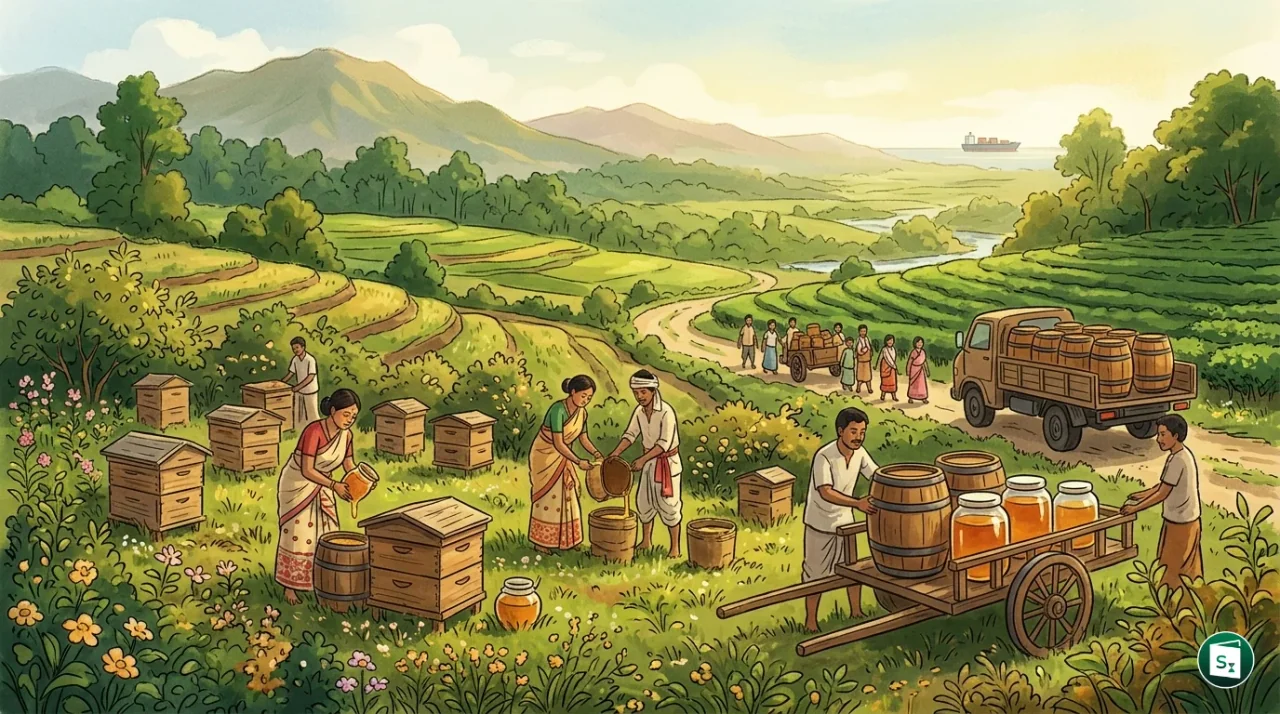
The Agricultural and Processed Food Products Export Development Authority (APEDA) has successfully facilitated the first-ever shipment of 20 metric tons (MT) of natural honey from the Baksa district of Assam to the USA. This inaugural export, part of the One District One Product (ODOP) initiative, represents a significant milestone in promoting local agricultural products from India’s North Eastern region on the global stage. The consignment was flagged off from Guwahati, marking a major step towards enhancing the livelihoods of rural beekeepers in the state.
A Milestone for Assam’s Apiculture Sector
The honey consignment, totaling approximately 20 metric tons, originated from the Baksa district, a region recognized for its rich floral diversity and eco-friendly environment. This high-quality honey is known for its natural purity and near-organic characteristics, largely due to the pesticide-free cultivation practices followed in the local landscape. The shipment was undertaken by Salt Range Foods Pvt. Ltd., an APEDA-registered exporter based in Assam.
The official flagging-off ceremony took place in Guwahati, attended by senior state officials including Aruna Rajoria, the Commissioner and Secretary of the Agriculture Department. This development underscores the growing potential of Assam’s beekeeping sector to meet stringent international food safety and quality standards.
Strategic Role of APEDA and ODOP Initiative
The Agricultural and Processed Food Products Export Development Authority (APEDA) played a pivotal role in ensuring that the shipment met international requirements. Established in 1986 under the Ministry of Commerce and Industry, APEDA is headquartered in New Delhi and is responsible for promoting the export of scheduled agricultural and processed food products. For this initiative, APEDA strengthened the local infrastructure by providing essential testing and laboratory equipment at the processing facility in Guwahati, ensuring the honey complied with global health and safety protocols.
This export was carried out under the One District One Product (ODOP) initiative. The ODOP program aims to transform every district in India into an export hub by identifying and promoting a unique product from that specific region. By focusing on Baksa honey, the government is leveraging regional specialties to build a brand identity for Indian products in competitive markets like the United States.
Boosting Economic Growth in Baksa
The inaugural shipment is expected to bring direct economic benefits to the local farming community in Baksa. Producers are estimated to receive approximately 43 percent higher price realization compared to the prevailing local farm-gate prices. This significant increase in income serves as a powerful incentive for more rural households to adopt scientific beekeeping as a viable supplementary livelihood.
Traditionally, beekeeping in Assam has been a small-scale activity involving the native Indian honey bee (Apis cerana indica). However, with the government’s push for the Sweet Revolution, there is a concerted effort to scale up production and improve quality through modern techniques. By providing a direct link to the international market, this initiative reduces the dependence of local producers on intermediaries, ensuring that a larger share of the export value reaches the grassroots level.
India’s Honey Export Landscape and Quality Standards
India has emerged as one of the world’s leading exporters of natural honey, with the United States being its largest market. In the 2024-25 financial year, India exported over 100,000 metric tons of honey, valued at more than USD 200 million. To maintain this momentum, the government is implementing the National Beekeeping and Honey Mission (NBHM), a central sector scheme with an outlay of ₹500 crore. This mission focuses on the holistic development of beekeeping through three Mini Missions that cover quality production, post-harvest management, and research and development.
To compete in premium international markets, India has significantly upgraded its quality testing protocols. High-tech testing facilities, including those using Nuclear Magnetic Resonance (NMR) technology, have been established to detect adulteration and ensure the purity of exported honey. The success of the Baksa shipment demonstrates how strengthening the value chain, from hive to shipment, can help Indian agricultural products penetrate high-value global markets and contribute to the country’s objective of doubling farmers’ incomes.
Key Takeaways
- The inaugural shipment of 20 metric tons (MT) of honey from Baksa district, Assam, to the USA was flagged off in May 2026.
- The export initiative was facilitated by APEDA under the One District One Product (ODOP) program to promote regional agricultural specialties.
- Producers in Baksa are expected to receive a 43 percent higher price for their honey compared to local market rates.
- APEDA was established in 1986 under the Ministry of Commerce and Industry and is headquartered in New Delhi.
- The National Beekeeping and Honey Mission (NBHM) is a central sector scheme with a budget of ₹500 crore aimed at promoting the Sweet Revolution.
- India is a major global exporter of honey, with the United States serving as its top destination.