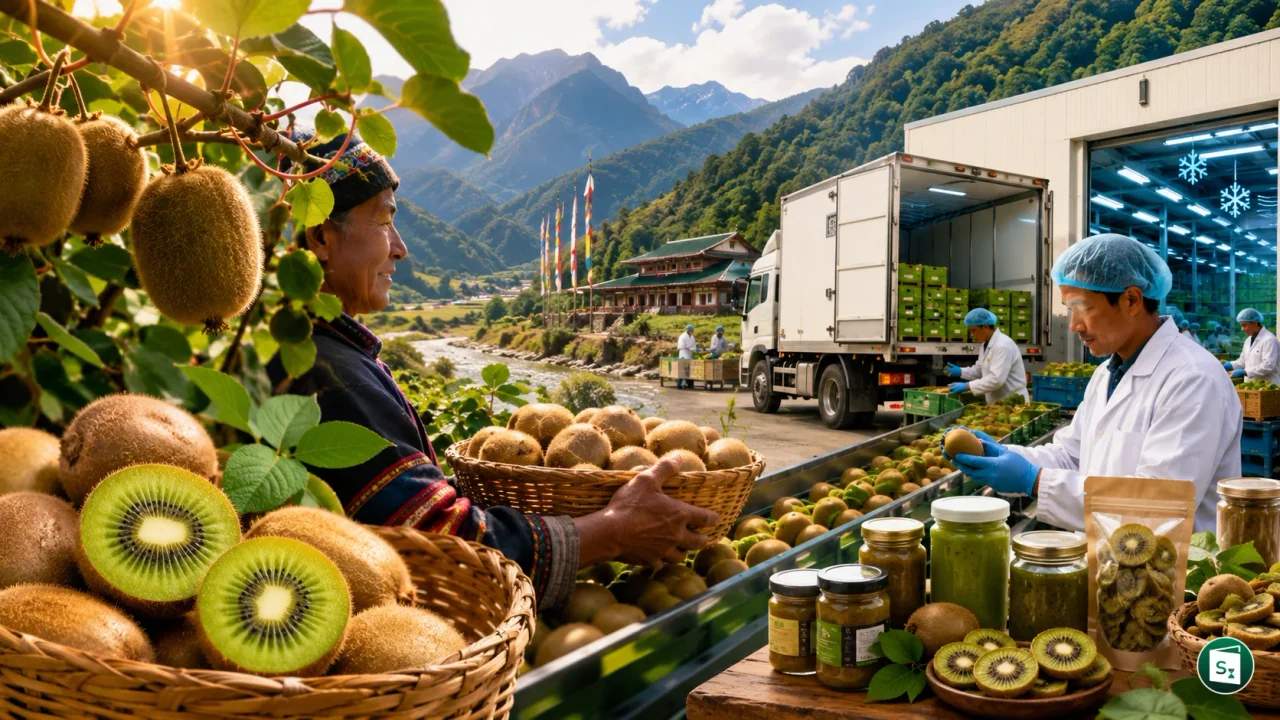
Union Minister Jyotiraditya M. Scindia launched the mission “Arunachal Kiwi: The USP of Arunachal Pradesh” in New Delhi on May 22, 2026. This ₹167 crore initiative aims to establish the state as a premium, single-origin global hub for organic kiwis by the end of the 2027-28 fiscal year. The mission focuses on creating a robust value chain to move farmers away from low-value distress sales toward high-value international markets.
Transforming Arunachal into a Global Kiwi Hub
Arunachal Pradesh is currently the largest producer of kiwi in India, contributing over 50% of the national output. Despite this dominant position, local farmers often face significant challenges due to the short shelf life of the fruit, which typically lasts only 7 to 10 days. This limitation frequently leads to “distress sales,” where high-quality produce is sold at throwaway prices to avoid spoilage.
The Mission Arunachal Kiwi aims to solve these systemic issues by establishing a “premium, traceable, and single-origin” global brand. By focusing on cluster-based cultivation, the government plans to consolidate production and streamline the supply chain. The mission is part of the broader “Brand North East” strategy, where specific states are identified with unique products to boost regional economic growth and global competitiveness.
The Ministry of Development of North Eastern Region (MDoNER), which oversees the mission, has designed it to ensure that Arunachal Pradesh becomes a recognized name in the international organic market by FY2027-28. The initiative seeks to replicate the success of other regional brands while leveraging the state’s unique agro-climatic conditions that are ideal for high-quality kiwi cultivation.
Key Pillars of the Mission
The mission is built upon four strategic pillars designed to address every aspect of the kiwi value chain, from the farm to the global market. These pillars are:
- Convergence: Adopting a “whole-of-government” approach by aligning schemes from the Ministries of Agriculture, Rural Development, and Food Processing. This ensures that different government resources work together to support the farmers.
- Value Addition: Transforming raw kiwis into premium sub-products such as juices, candies, and freeze-dried snacks. This is particularly important for Grade C kiwis, which were previously sold at very low prices.
- Branding: Developing the “Arunachal Organic Kiwi” brand to signify quality, organic purity, and geographical identity. This includes securing the Geographical Indication (GI) tag and maintaining international organic certifications.
- Market Integration: Establishing strong links with domestic retailers and international exporters to ensure that farmers have a steady and profitable market for their produce.
The North Eastern Regional Agricultural Marketing Corporation (NERAMAC), headquartered in Guwahati, plays a central role as the implementing agency. NERAMAC works alongside other bodies like APEDA (Agricultural and Processed Food Products Export Development Authority) and NABARD to provide technical support, marketing expertise, and financial credit to local farmers.
Infrastructure and Logistics Support
A critical component of the mission is the development of modern infrastructure to overcome the geographical challenges of the region. The program involves an investment of ₹167 crore to set up six integrated cluster-level Post-Harvest Management Hubs. These hubs will be strategically located in major kiwi-growing regions to ensure easy access for farmers:
- Ziro Valley in the Lower Subansiri district
- Dirang and Kalaktang in the West Kameng district
- Shi Yomi
- Dibang Valley
One of the most ambitious targets of the mission is to establish a cold-chain logistics network with a total capacity of 2,000 Metric Tonnes (MT). This infrastructure is expected to extend the shelf life of kiwis from the current 7 to 10 days to nearly 45 days. By maintaining the freshness of the fruit for a longer period, the state can reach distant domestic markets in metro cities and even target export destinations in Southeast Asia and the Middle East without the risk of heavy post-harvest losses.
The hubs will also feature advanced grading and sorting facilities. This allows for the categorization of kiwis based on their quality, ensuring that only the finest Grade A fruits are sent for premium exports, while other grades are diverted for local consumption or further processing.
Economic Impact on Farmer Livelihoods
The primary objective of the mission is to significantly enhance the income of local farmers by moving them up the value chain. Currently, Grade A kiwis often fetch around ₹120 per kg in local markets. Under the new mission, the focus on branding and export quality is expected to push these prices to premium global levels, potentially doubling or tripling the realization for top-tier produce.
For lower-quality produce, the mission introduces a dedicated processing strategy. Previously, Grade C kiwis were sold at minimal rates of ₹20 to ₹40 per kg or often left to rot. The mission aims to upcycle these fruits into high-value sub-products:
| Fruit Grade | Current Realization | Future Strategy |
|---|---|---|
| Grade A | ₹120 per kg | Premium Global Export |
| Grade B | Medium Prices | National Retail Markets |
| Grade C | ₹20–₹40 per kg | Upcycling into Candies, Juices, and Snacks |
By utilizing the entire crop through value addition, the government expects to minimize waste and provide farmers with multiple revenue streams. The transformation of Arunachal Pradesh into a “single-origin organic hub” will also attract agri-tourism and investment in food processing units, further stimulating the local economy. This holistic approach ensures that the state’s agricultural USP (Unique Selling Proposition) translates into tangible financial benefits for the rural population.
Key Takeaways
- The mission “Arunachal Kiwi: The USP of Arunachal Pradesh” was launched by Union Minister Jyotiraditya M. Scindia with an outlay of ₹167 crore.
- The program aims to transform Arunachal Pradesh into a premium, single-origin global hub for organic kiwis by FY2027-28.
- Arunachal Pradesh is the largest producer of kiwi in India, accounting for more than 50% of the national production.
- The mission targets increasing the shelf life of kiwis from 7–10 days to 45 days through a 2,000 MT cold-chain capacity.
- Six integrated cluster-level hubs will be established in key regions like Ziro Valley, Dirang, and Shi Yomi.
- The North Eastern Regional Agricultural Marketing Corporation (NERAMAC), headquartered in Guwahati, is the nodal agency for implementing the mission.
- The initiative follows a “whole-of-government” approach, converging schemes from the Ministries of Agriculture, Rural Development, and Food Processing.