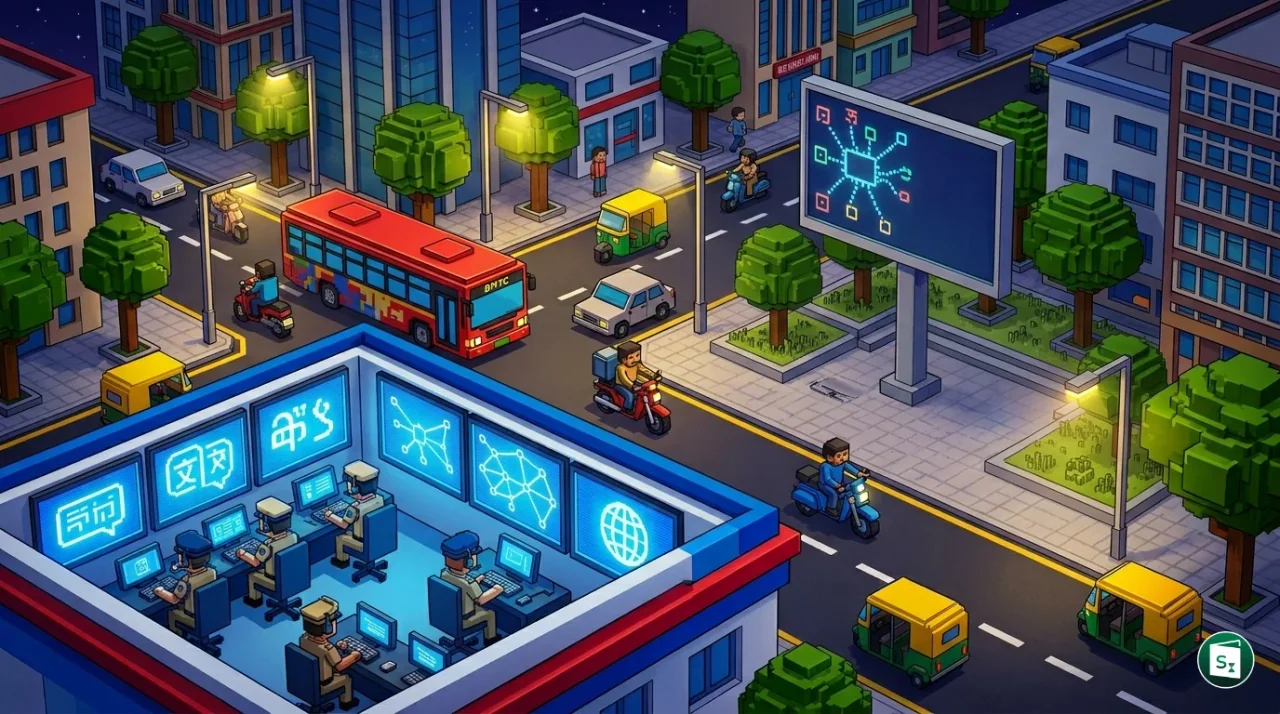
The Bengaluru City Police has launched a groundbreaking multilingual artificial intelligence system called VANKI to enhance its Namma 112 emergency response helpline. This first-of-its-kind initiative in India allows call handlers to communicate in real-time with distressed citizens who speak different regional or international languages. By bridging linguistic gaps, the integration ensures that immediate assistance is accessible to the city’s diverse population, including migrants, students, and tourists.
What is the VANKI AI System?
The VANKI system, which stands for Voice AI for Nationwide Key Interventions, is an advanced technological solution developed through a strategic collaboration between the Bengaluru City Police and two technical partners, Monday Ventures and Aeos. It is designed to function as a digital interpreter within the Emergency Response Support System (ERSS), commonly known as 112. The system leverages sophisticated speech-to-text and machine translation algorithms to process incoming calls in various languages.
When a person calls the Namma 112 helpline and speaks in a language unfamiliar to the police personnel, the VANKI system intervenes automatically. It listens to the caller, interprets the distress message, and provides a real-time translation to the operator in a language they understand, such as Kannada or English. This capability allows the police to gather critical details like the nature of the emergency and the caller’s location without any delay caused by language barriers.
Bridging Language Barriers in Emergency Response
Bengaluru is a cosmopolitan hub that attracts people from across India and the globe. This diversity often creates linguistic challenges during emergencies, especially when a caller is unable to speak the local language, Kannada, or the commonly used English. The VANKI system addresses this by supporting more than 10 languages in its initial phase, covering both domestic regional dialects and major international languages.
| Language Category | Specific Languages Supported |
|---|---|
| Regional Indian Languages | Bengali, Gujarati, Odia, Manipuri, Malayalam, Kashmiri, Nepali, and Assamese |
| International Languages | Spanish, French, and Arabic |
The integration of these languages is particularly significant for Bengaluru, which serves as a major centre for the IT industry, higher education, and medical tourism. By providing a platform where a caller can express their distress in their native tongue, the police can ensure a more empathetic and accurate response. The system is expected to be expanded in subsequent phases to include more languages, further widening its inclusive reach.
Strategic Significance for Bengaluru Policing
The implementation of VANKI is a major step in the modernization of the Bengaluru City Police under the Safe City Project, which is funded through the Nirbhaya Fund. The city’s 112 command centre handles a massive volume of communication, receiving between 9,000 and 10,000 calls daily. Out of these, approximately 2,000 calls require immediate field intervention. In such a high-pressure environment, the ability to quickly understand a caller’s needs is vital for maintaining the 8 to 10-minute response time targeted by the Hoysala patrol vehicles.
This AI integration builds upon Bengaluru’s reputation as a leader in tech-enabled policing. In 2023, the city became the first in India to integrate live body-worn camera feeds into its emergency workflow. The addition of multilingual AI further reduces the “Calls for Service” (CFS) processing time. By automating the translation process, the police can dispatch the nearest emergency vehicle more accurately, potentially saving lives in critical situations like medical emergencies or accidents where every second counts.
The Evolution of Namma 112 and ERSS in India
The Emergency Response Support System (ERSS) is a pan-India initiative under the Ministry of Home Affairs (MHA) to provide a single emergency number, 112, for all types of distress calls, including police, fire, and health services. Launched as part of the government’s efforts to streamline emergency services after the 2012 Nirbhaya case, the 112 system was inspired by international standards like 911 in the United States and 999 in the United Kingdom. It effectively replaced earlier separate helplines such as 100 (police), 101 (fire), and 102 (ambulance).
The Safe City Project, a centrally sponsored scheme, plays a crucial role in empowering urban police departments with advanced technology. Bengaluru is one of the eight cities initially selected for the project, along with Ahmedabad, Chennai, Delhi, Hyderabad, Kolkata, Lucknow, and Mumbai. The project focuses on creating a safe and secure environment for women and other vulnerable groups in public places through various interventions like AI-enabled CCTV surveillance, emergency call boxes, and now, multilingual voice AI.
Key Takeaways
- VANKI, which stands for Voice AI for Nationwide Key Interventions, is India’s first multilingual AI integration for an emergency response system.
- The system enables real-time translation for over 10 languages, including regional Indian languages like Bengali, Gujarati, and Malayalam, as well as international ones like Spanish and French.
- The initiative was developed by the Bengaluru City Police in collaboration with technical partners Monday Ventures and Aeos.
- The integration is part of the Safe City Project, which is supported by the central government’s Nirbhaya Fund.
- ERSS 112 is a pan-India initiative under the Ministry of Home Affairs that provides a unified emergency response number for police, fire, and ambulance services.
- The Bengaluru command centre handles nearly 10,000 calls per day, and the AI system aims to improve efficiency by bridging linguistic gaps for its diverse population.