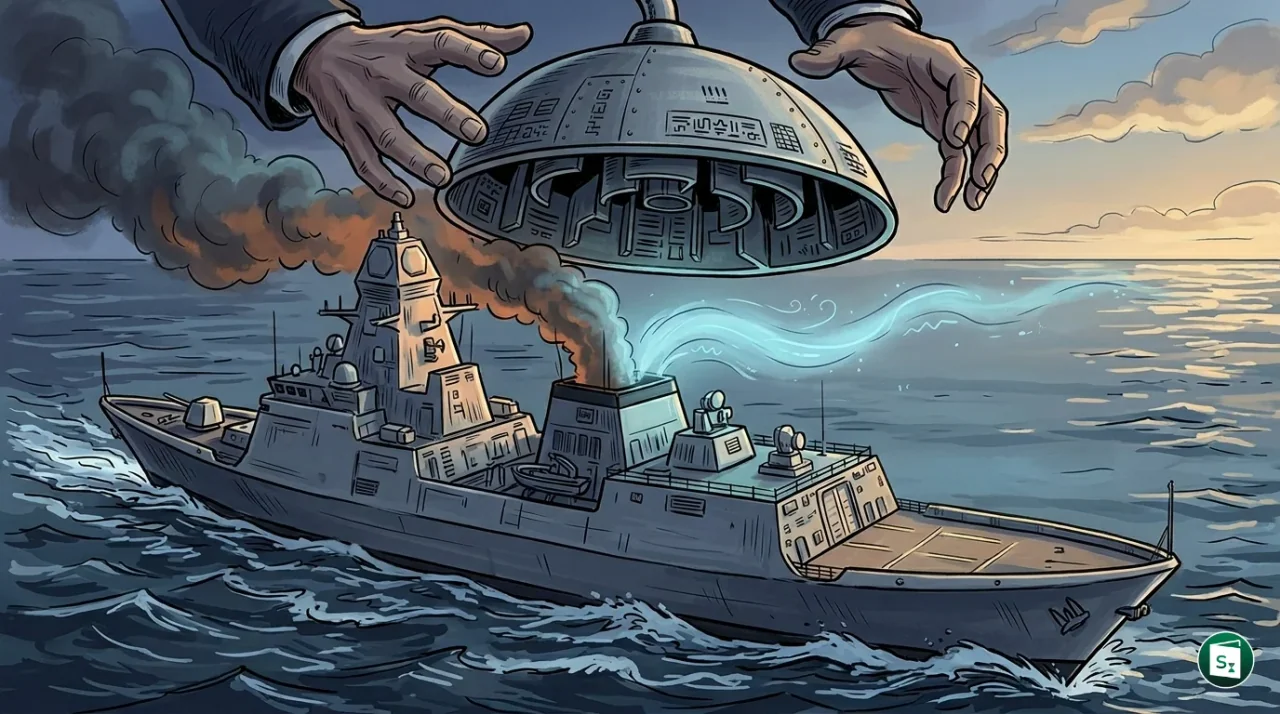
Bharat Heavy Electricals Limited signed a Licensing Agreement for Transfer of Technology with the Naval Science and Technological Laboratory on May 4, 2026. This partnership focuses on the production of the Gas Turbine-Infrared Suppression System (GT-IRSS) for LM2500 gas turbines, which are essential for the propulsion of modern warships. By suppressing the heat signature of naval vessels, this technology significantly enhances their stealth and survivability in contested maritime environments.
Technological Leap in Naval Stealth: The GT-IRSS
The Gas Turbine-Infrared Suppression System (GT-IRSS) is a sophisticated technology designed to reduce the infrared or heat signature of a ship’s exhaust. In modern naval warfare, ships are increasingly vulnerable to heat-seeking missiles that home in on the thermal radiation emitted by a vessel’s engines. By cooling the exhaust gases and shielding the hot engine components, the GT-IRSS makes it significantly harder for enemy sensors and missiles to detect and track the ship.
This technology, indigenously developed by the Naval Science and Technological Laboratory (NSTL), is specifically tailored for the LM2500 gas turbines. The system works by mixing cold ambient air with hot exhaust gases before they leave the ship’s funnel. This process lowers the overall temperature of the plume, thereby shrinking the thermal footprint of the vessel. Enhancing stealth is not just about radar invisibility but also about managing acoustic, magnetic, and thermal signatures to ensure multi-dimensional survivability.
The Strategic Role of LM2500 Gas Turbines
The LM2500 is a world-renowned marine gas turbine produced by General Electric (GE). It serves as the primary propulsion plant for many of the Indian Navy’s frontline warships. These turbines are assembled and tested in India by Hindustan Aeronautics Limited (HAL) at its Industrial and Marine Gas Turbine Division in Bengaluru. The integration of indigenous stealth components like the GT-IRSS into these high-performance engines is a critical requirement for modern naval operations.
Major Indian Navy platforms powered by LM2500 gas turbines include:
| Platform Category | Specific Examples |
|---|---|
| Aircraft Carriers | INS Vikrant, India’s first indigenous aircraft carrier |
| Stealth Frigates | Project 17A (Nilgiri-class) and Project 17 (Shivalik-class) |
| Future Vessels | Next-Generation Missile Vessels (NGMV) |
By equipping these vessels with the GT-IRSS, the Indian Navy ensures that its most valuable assets are better protected against advanced thermal-imaging threats. This is particularly important for ships operating in the Indian Ocean Region (IOR), where regional competition and the proliferation of anti-ship missiles necessitate superior defensive capabilities.
Strengthening Indigenous Defence Manufacturing
The transfer of GT-IRSS technology from DRDO to BHEL is a landmark event in India’s journey toward Atmanirbhar Bharat (Self-reliant India) in the defence sector. Historically, such specialized naval technologies were often imported, leading to high costs and long maintenance cycles. By indigenising the fabrication and installation of these systems, India reduces its reliance on foreign suppliers and ensures a more resilient supply chain for its naval programmes.
This agreement also highlights BHEL’s strategic pivot toward the defence and aerospace sectors. As a Maharatna Public Sector Undertaking (PSU), BHEL is leveraging its extensive engineering and manufacturing infrastructure to support the Make in India initiative. The company is already involved in producing other critical naval systems, such as Super Rapid Gun Mounts (SRGM), and this new agreement further diversifies its high-tech defence portfolio.
The Licensing Agreement for Transfer of Technology (LAToT) model allows public and private sector companies to manufacture products developed by government laboratories. This synergy ensures that the fruits of national research and development reach the production line, ultimately benefiting the armed forces with cutting-edge, made-in-India solutions.
Institutional Synergy: BHEL and NSTL-DRDO
The partnership between BHEL and the DRDO represents a collaboration between two of India’s most significant public institutions. Bharat Heavy Electricals Limited (BHEL), established in 1964, is one of India’s largest engineering and manufacturing companies. Headquartered in New Delhi, it is a Maharatna enterprise that has traditionally dominated the power sector but is now expanding rapidly into defence, rail, and renewable energy.
The technology was developed by the Naval Science and Technological Laboratory (NSTL), located in Visakhapatnam, Andhra Pradesh. Established in 1969, NSTL is a premier laboratory under the Defence Research and Development Organisation (DRDO). It is primarily dedicated to the research and development of underwater weapons, such as torpedoes and mines, as well as the enhancement of naval platforms and marine systems.
| Organisation | Founded | Headquarters | Parent Body |
|---|---|---|---|
| BHEL | 1964 | New Delhi | Ministry of Heavy Industries |
| NSTL | 1969 | Visakhapatnam | DRDO (Ministry of Defence) |
| DRDO | 1958 | New Delhi | Ministry of Defence |
The collaboration ensures that the Indian Navy has access to the latest technological advancements while fostering a domestic ecosystem for high-end military equipment. This model of transferring laboratory-developed technology to industrial partners is a key pillar of India’s strategy to become a global hub for defence manufacturing.
Key Takeaways
- Bharat Heavy Electricals Limited (BHEL) signed a Licensing Agreement for Transfer of Technology (LAToT) with the Naval Science and Technological Laboratory (NSTL) on May 4, 2026.
- The agreement facilitates the production and installation of the Gas Turbine-Infrared Suppression System (GT-IRSS) for LM2500 gas turbines used in naval warships.
- The GT-IRSS technology significantly enhances the stealth capabilities of vessels by suppressing their infrared or thermal signatures to evade heat-seeking missiles.
- The LM2500 gas turbines are the primary propulsion systems for major Indian Navy platforms, including INS Vikrant and the Project 17A (Nilgiri-class) frigates.
- NSTL, which indigenously developed the technology, is a DRDO laboratory established in 1969 and headquartered in Visakhapatnam.
- BHEL is a Maharatna Public Sector Undertaking founded in 1964, currently focusing on diversifying into high-tech defence manufacturing under the Make in India initiative.