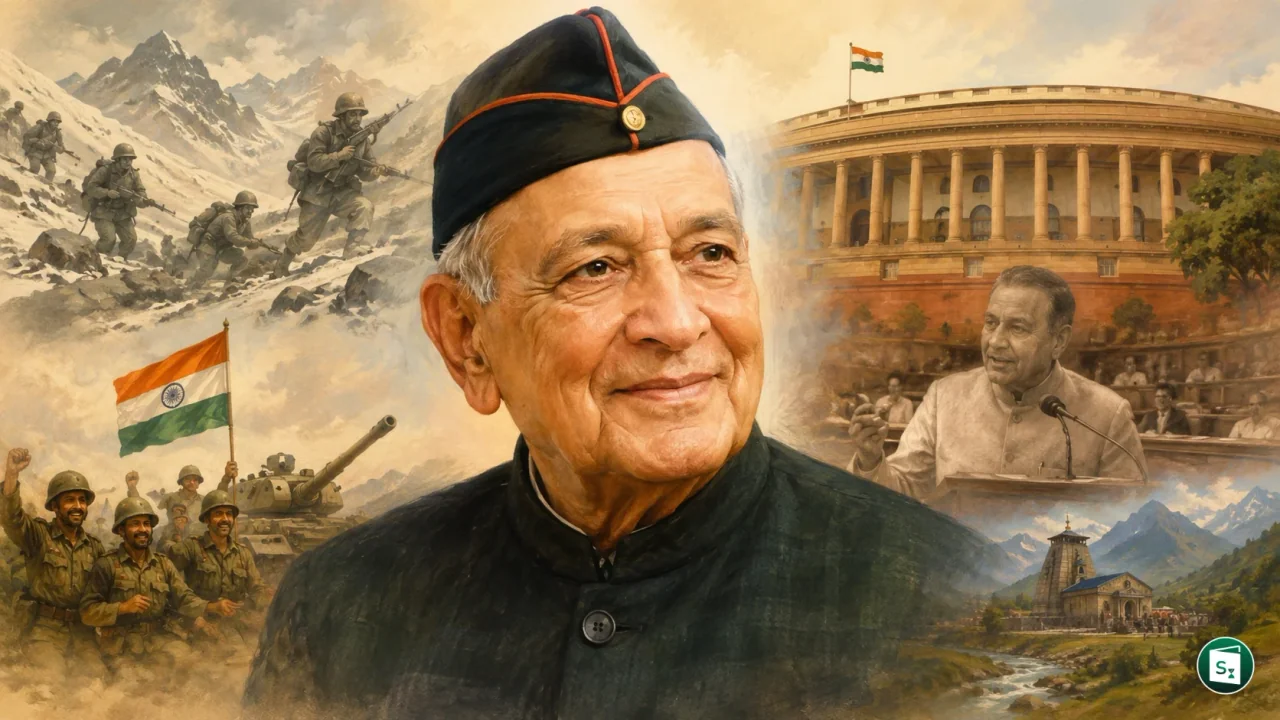
Major General Bhuvan Chandra Khanduri (Retd), a veteran of three major wars and former Chief Minister of Uttarakhand, passed away on May 21, 2026, at the age of 91. A highly decorated military officer and a senior leader of the Bharatiya Janata Party (BJP), he was widely respected for his integrity and administrative discipline. His passing marks the end of a significant chapter in both India’s military history and Uttarakhand’s political journey.
Military Service and War Contributions
Major General Khanduri served in the Corps of Engineers of the Indian Army for 37 years, from 1954 to 1991. His military career was defined by his active participation in all three major conflicts that India fought during those decades: the 1962 Sino-Indian War, the 1965 Indo-Pakistani War, and the 1971 Indo-Pakistani War. His technical expertise as a civil engineer from the College of Military Engineering, Pune, was instrumental in various strategic operations.
During the 1971 War, which led to the liberation of Bangladesh, he commanded an Engineer Regiment in the Samba sector. His leadership and distinguished service were recognized in 1982 when he was awarded the Ati Vishisht Seva Medal (AVSM) by the President of India. Before his retirement, he also served as the Additional Director General in the Engineer-in-Chief’s branch at the Army Headquarters in New Delhi.
Political Leadership and Governance in Uttarakhand
After retiring from the Army, B.C. Khanduri joined the Bharatiya Janata Party (BJP) in 1991. He quickly rose to prominence and was elected to the Lok Sabha five times from the Garhwal constituency. His political career was marked by his unwavering commitment to the development of his home state, which was carved out of Uttar Pradesh in November 2000.
Khanduri served as the Chief Minister of Uttarakhand during two critical phases. His first tenure, from 2007 to 2009, followed the state’s first assembly elections. He returned to the helm in 2011, serving until 2012. During his second term, he famously introduced a robust Lokayukta Bill, which was hailed as one of the strongest anti-corruption laws in the country at the time. His tenure is remembered for bringing a sense of “military-style” discipline and transparency to the state’s administration.
Modernizing India’s Infrastructure: The Road Transport Legacy
At the national level, Major General Khanduri’s most enduring legacy lies in the transformation of India’s road network. Serving as the Union Minister of State (Independent Charge) for Road Transport and Highways from 2000 to 2004 in the cabinet of Prime Minister Atal Bihari Vajpayee, he oversaw the execution of the ambitious National Highways Development Project (NHDP).
He was the key administrative force behind the Golden Quadrilateral project, which connected the four major metropolitan cities of Delhi, Mumbai, Chennai, and Kolkata. He also managed the development of the North-South and East-West Corridors. His background in the Corps of Engineers proved invaluable in ensuring that these massive infrastructure projects were executed with precision and within stipulated timelines, earning him a reputation as one of the most efficient ministers in the Vajpayee government.
Key Takeaways
- Major General Bhuvan Chandra Khanduri (Retd) passed away on May 21, 2026, at the age of 91.
- He served in the Indian Army’s Corps of Engineers for 37 years and was a veteran of the 1962, 1965, and 1971 wars.
- He was awarded the Ati Vishisht Seva Medal (AVSM) in 1982 for his distinguished military service.
- Khanduri served as the Chief Minister of Uttarakhand for two terms between 2007 and 2012.
- As the Union Minister for Road Transport and Highways (2000 to 2004), he played a pivotal role in the Golden Quadrilateral project.
- He represented the Garhwal constituency in the Lok Sabha five times and introduced a strong Lokayukta Bill in Uttarakhand.