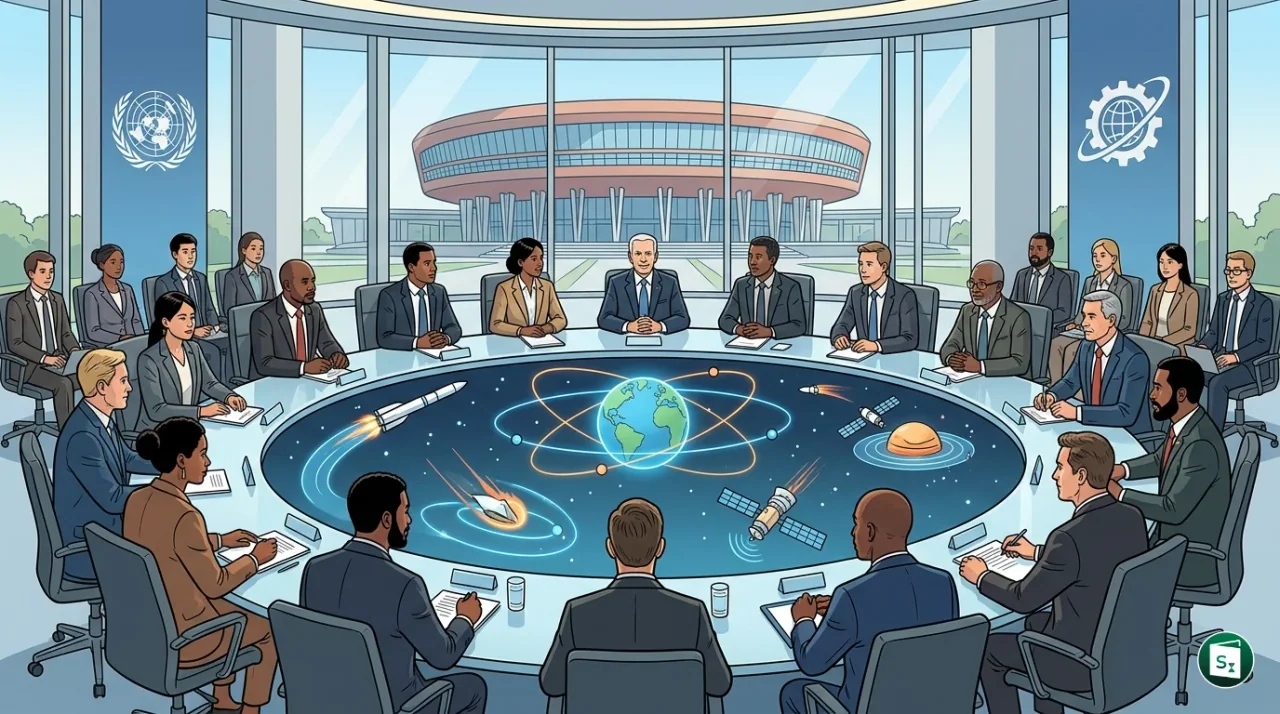
India hosted the 35th Plenary and Working Groups meetings of the ISO subcommittee on Space Systems and Operations from 4 May to 8 May 2026 at Bharat Mandapam, New Delhi. Organized by the Bureau of Indian Standards (BIS), this marks the first time India has convened this crucial international gathering. With the rapid expansion of satellite constellations, the meeting brought global experts together to formulate standards ensuring the long-term safety, sustainability, and interoperability of orbital missions.
Developing Global Standards for Space
The event witnessed the participation of 131 international delegates representing 13 countries, alongside experts from national standards bodies, global space agencies like ISRO, private industry, and academia. The primary agenda was to deliberate on the work of the ISO Technical Committee (TC) 20 / Subcommittee (SC) 14, which holds the global mandate to formulate international standards covering the complete lifecycle of space systems. This includes everything from initial concept and design engineering to production, launch, operations, and eventual space debris management.
Focus Areas: Sustainability and Mission Safety
As commercial space activity surges globally, the Earth’s orbital environment is becoming increasingly crowded. The working groups during the New Delhi plenary focused heavily on space sustainability and debris mitigation, proposing regulatory measures and technical guidelines to safely de-orbit end-of-life satellites and manage existing space junk. Another critical focus area was mission safety and interoperability. By creating harmonized international standards, different space agencies and private aerospace companies can ensure their systems are compatible, allowing them to work seamlessly together during complex multinational missions or emergency rescue scenarios.
What It Means for India’s Private Space Sector
Hosting this major international meeting reflects India’s growing influence in global space governance. Following the sweeping reforms that established the Indian National Space Promotion and Authorization Centre (IN-SPACe), India has been actively pushing to integrate its burgeoning private space sector with the global economy. By aligning Indian domestic standards with the ISO frameworks developed at this plenary, the BIS aims to make indigenous space technologies and launch services more competitive, safe, and acceptable on the world stage.
About BIS and ISO
The International Organization for Standardization (ISO) is an independent, non-governmental international body headquartered in Geneva, Switzerland. It brings together experts to share knowledge and develop voluntary, consensus-based international standards. Representing India at the ISO is the Bureau of Indian Standards (BIS). Established as the National Standards Body of India, BIS operates under the Ministry of Consumer Affairs, Food & Public Distribution and is headquartered in New Delhi. Its core function is the harmonious development of the activities of standardization, marking, and quality certification of goods.
Key Takeaways
- India hosted the 35th Plenary of the ISO/TC 20/SC 14 on Space Systems and Operations from 4 May to 8 May 2026 at Bharat Mandapam, New Delhi.
- This marked the first time India hosted this specific ISO subcommittee meeting on space standards.
- The event was organized by the Bureau of Indian Standards (BIS) and saw participation from 131 delegates across 13 countries.
- The primary focus of the meeting was developing international standards for space sustainability, debris mitigation, and mission interoperability.
- The ISO is an independent international standards body headquartered in Geneva, Switzerland.
- The BIS is India’s National Standards Body, operating under the Ministry of Consumer Affairs, Food & Public Distribution.