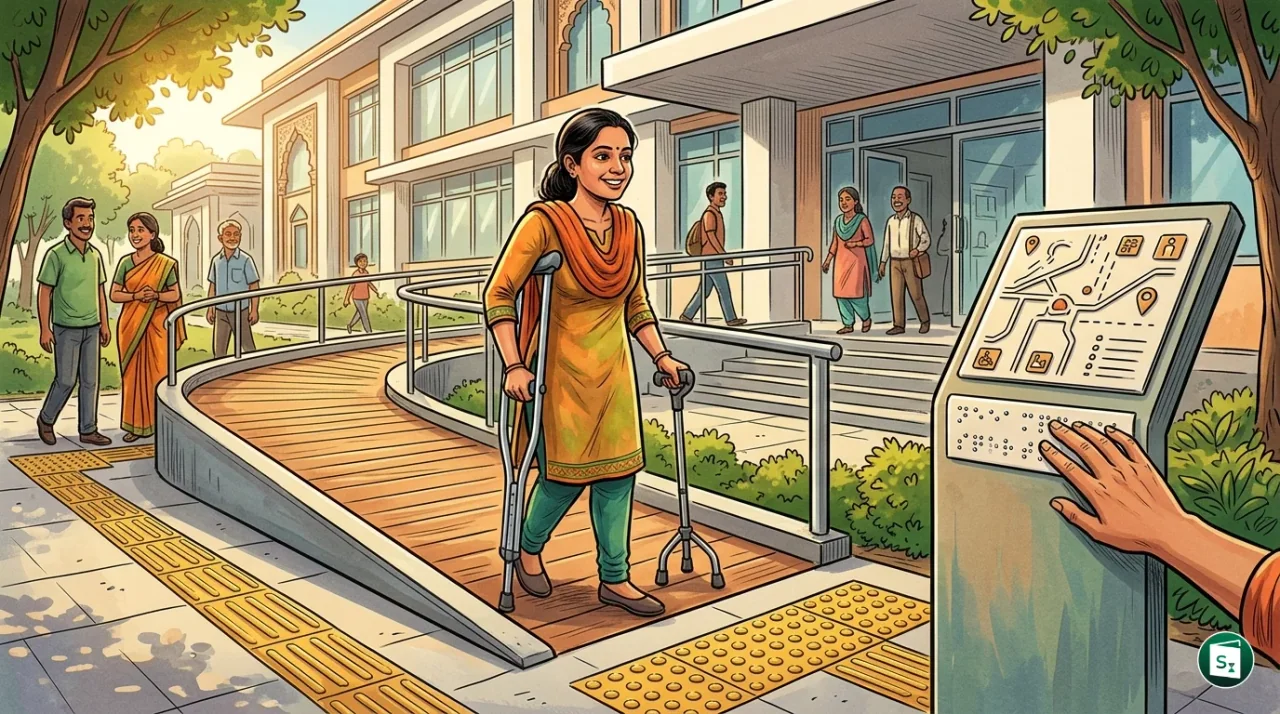
The Bureau of Indian Standards (BIS) has published six new Indian Standards for priority assistive technologies to enhance the quality of life for persons with disabilities and the elderly. These standards, developed under the framework of the National List of Essential Assistive Products (NLEAP), cover essential mobility and accessibility aids such as elbow crutches and Braille signage. This initiative marks a strategic effort to standardize assistive products in India and align them with international quality benchmarks.
New Standards for Mobility and Accessibility Aids
The new standards address critical needs in the domains of mobility and sensory accessibility. These guidelines ensure that products manufactured in India meet specific criteria for safety, performance, and durability. The standards are divided into mobility aids and accessibility aids, providing a comprehensive framework for manufacturers and service providers.
| Standard Number | Focus Area | Description |
|---|---|---|
| IS 18558 | Elbow Crutches | Specifies requirements for safety, ergonomics, and performance, including handgrip and tip specifications. |
| IS 5145 | Multi-leg Walking Sticks | Sets benchmarks for walking sticks with three or more legs to provide enhanced stability for users. |
| IS 19631 | Portable Ramps | Establishes requirements for portable ramps used to navigate steps and transportation systems. |
| IS 19189 | Tactile Guide Maps | Defines display methods and information content for tactile maps to aid visually impaired individuals. |
| IS 19190 | Braille on Signage | Sets uniform requirements for applying Braille on signage, equipment, and public infrastructure. |
These standards were formulated by the BIS Technical Committee on Assistive Products (MHD 09). The committee included experts from medical institutions, government bodies like the Artificial Limbs Manufacturing Corporation of India (ALIMCO), and social organizations dedicated to rehabilitation.
The National List of Essential Assistive Products (NLEAP)
The National List of Essential Assistive Products (NLEAP) is a pioneering initiative led by the Indian Council of Medical Research (ICMR). Launched in September 2023, the list was developed after extensive consultations with healthcare professionals, industry stakeholders, and end-users. The primary objective of NLEAP is to identify and prioritize assistive products that are essential for the health and well-being of the Indian population.
NLEAP currently prioritizes 21 essential assistive products across seven functional domains, including locomotor, visual, hearing, and cognition. By creating a standardized list, the government aims to ensure universal accessibility, affordability, and quality of these devices. The integration of NLEAP with BIS standards ensures that the products distributed through various government schemes meet rigorous safety and performance benchmarks.
The development of NLEAP was influenced by the World Health Organization (WHO) Priority Assistive Products List, but it was tailored to meet the specific socio-economic and demographic needs of India. It serves as a reference for policymakers to focus on local manufacturing and health system integration.
Institutional Support: BIS and ICMR
The Bureau of Indian Standards (BIS) and the Indian Council of Medical Research (ICMR) play complementary roles in India’s assistive technology ecosystem. BIS, established in 1987 and headquartered in New Delhi, is the national standards body of India operating under the Ministry of Consumer Affairs, Food and Public Distribution. It is responsible for the harmonious development of the activities of standardization, marking, and quality certification of goods.
The ICMR, one of the oldest medical research bodies in the world, was established in 1911 and is headquartered in New Delhi. It operates under the Department of Health Research within the Ministry of Health and Family Welfare. ICMR’s role in the NLEAP initiative highlights its focus on translating medical research into accessible health solutions for the masses.
Together, these institutions provide a robust quality assurance framework. While ICMR identifies the essential products through research and stakeholder feedback, BIS develops the technical specifications and testing methods to ensure these products are safe for public use.
Enhancing Accessibility for Divyangjan
The introduction of these standards directly supports the Sugamya Bharat Abhiyan (Accessible India Campaign), which was launched in December 2015. The campaign aims to make the built environment, transportation system, and information and communication ecosystem more accessible for Divyangjan.
Standardizing products like tactile maps and Braille signage is crucial for implementing the Rights of Persons with Disabilities (RPwD) Act, 2016. This legislation mandates that all public buildings and services must be accessible to individuals with disabilities. By ensuring that assistive devices are standardized, the government reduces the risk of sub-standard products and promotes the dignity and independence of millions of citizens.
Key Takeaways
- The Bureau of Indian Standards (BIS) has published six new Indian Standards for priority assistive technologies under the NLEAP framework.
- The National List of Essential Assistive Products (NLEAP) is an initiative led by the ICMR, launched in September 2023.
- New standards for mobility aids include IS 18558 (elbow crutches), IS 5145 (multi-leg walking sticks), and IS 19631 (portable ramps).
- New standards for accessibility aids include IS 19189 (tactile guide maps) and IS 19190 (Braille on signage).
- The BIS was established in 1987 and is headquartered in New Delhi under the Ministry of Consumer Affairs, Food and Public Distribution.
- The Indian Council of Medical Research (ICMR) was established in 1911 and operates under the Ministry of Health and Family Welfare.
- These standards align with the goals of the Sugamya Bharat Abhiyan (Accessible India Campaign) launched in December 2015.