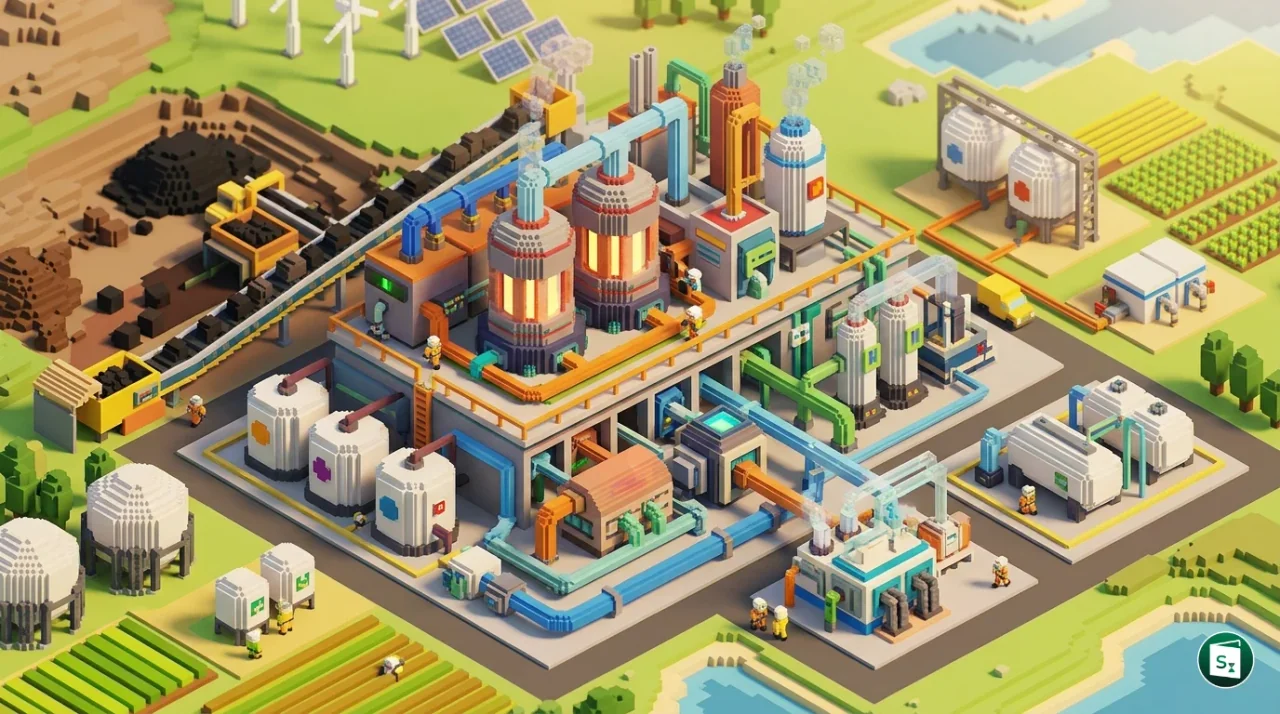
The Union Cabinet approved a new incentive scheme with a financial outlay of ₹37,500 crore to promote surface coal and lignite gasification projects across India. Structured under the National Coal Gasification Mission, this initiative aims to accelerate clean energy production and reduce the country’s dependence on high-value energy and chemical imports. The framework provides financial assistance for setting up gasification plants and extends fuel supply security through long-term coal linkage auctions.
What is the Scheme for Promotion of Coal Gasification Projects?
The Scheme for Promotion of Surface Coal/Lignite Gasification Projects is a landmark financial intervention designed to catalyze clean energy infrastructure. The program operates under the National Coal Gasification Mission, which the government launched in 2021 to outline a pathway for utilizing India’s abundant domestic coal reserves in a cleaner manner. The Ministry of Coal, which serves as the nodal ministry, oversees the execution of this mission.
The primary goal of the mission is to achieve 100 million tonnes (MT) of coal and lignite gasification capacity by 2030. The newly approved scheme, which features a substantial financial commitment of ₹37,500 crore, is projected to directly facilitate the gasification of 75 MT of coal. The remaining 25 MT target will be met through direct public sector investments and market-driven commercial developments.
This initiative builds upon a preliminary financial incentive program of ₹8,500 crore that the Union Cabinet approved in January 2024. The expanded funding aims to attract private sector participation and accelerate the deployment of high-capacity gasification plants across the country.
Understanding Surface Coal Gasification and Syngas
The Gasification Process and Syngas Composition
Surface coal gasification is a thermochemical process that converts solid coal or lignite into gaseous fuel. Unlike direct combustion, which burns coal in the presence of excess oxygen to generate heat and electricity, gasification reacts coal with steam and a controlled, limited amount of oxygen at high temperatures and pressures. This partial oxidation breaks down the carbonaceous material into a mixture called synthesis gas, or syngas.
Syngas serves as a versatile chemical building block. It is primarily composed of carbon monoxide (CO) and hydrogen (H2), which typically make up more than 85% of the gas mixture by volume. The remaining portion consists of carbon dioxide, water vapor, methane, and minor impurities like hydrogen sulfide. Depending on the desired end product, operators can adjust the hydrogen-to-carbon monoxide ratio using chemical reactions like the water-gas shift reaction, where carbon monoxide reacts with steam to produce additional hydrogen and carbon dioxide (CO + H2O -> CO2 + H2).
Environmental Advantages Over Direct Combustion
Gasification offers significant environmental benefits compared to conventional coal combustion. In traditional power plants, coal is burned directly, producing large volumes of low-pressure flue gas. Removing pollutants like sulfur oxides and nitrogen oxides from these massive exhaust streams requires complex and expensive scrubbing equipment at the end of the stack.
In contrast, gasification processes clean the syngas before it is burned or processed further. Because the gas is at high pressure and in a concentrated state, impurities like sulfur can be captured with an efficiency of more than 99% as elemental sulfur or hydrogen sulfide. Additionally, gasification yields a highly concentrated stream of carbon dioxide, which reduces the cost and energy requirements for Carbon Capture, Utilization, and Storage (CCUS) technologies compared to capturing dilute emissions from conventional smokestacks.
Strategic Importance and Energy Security for India
Reducing Import Dependency
India is the world’s second-largest consumer of coal, and it also imports significant volumes of natural gas, urea, and petrochemical feedstocks. By converting domestic coal and lignite into syngas, the country can produce synthetic natural gas, urea, methanol, and ammonia locally. This transition reduces reliance on imports of Liquefied Natural Gas (LNG) and critical chemical fertilizers, insulating the domestic economy from global price volatility and supply chain disruptions.
Long-term Policy Certainty via Coal Linkages
A major hurdle for capital-intensive gasification projects has been the long-term availability of feedstock. To address this, the government has extended the coal linkage tenure to a maximum of 30 years under the Non-Regulated Sector (NRS) linkage auction framework. This extension applies specifically to the newly designated sub-sector, Production of Syngas leading to Coal Gasification.
Guaranteed fuel supply for three decades provides long-term certainty to project developers and financial institutions. By bridging the feedstock risk, the policy change makes it easier for projects to secure debt financing and achieve financial closure, laying a stable foundation for the domestic gasification industry.
Key Financial Incentives and Capping Structure
The scheme uses a structured incentive model designed to minimize initial capital barriers for project developers. Financial assistance is capped at 20% of the total cost of plant and machinery. To ensure transparency and project progress, the incentives are disbursed in four equal installments, each directly tied to the completion of specific project milestones.
To promote competitive diversity and prevent the concentration of state support within a few entities, the central government has imposed strict caps on the maximum financial incentives that can be claimed under the scheme. These caps are structured as follows:
| Cap Level | Financial Limit | Applicability and Exceptions |
|---|---|---|
| Single Project | ₹5,000 crore | Maximum incentive permitted for any individual gasification plant. |
| Single Product Category | ₹9,000 crore | Maximum incentive for a specific product class, excluding Synthetic Natural Gas (SNG) and urea. |
| Single Entity Group | ₹12,000 crore | Combined maximum limit across all projects owned by a single conglomerate or business group. |
Key Takeaways
- The Scheme for Promotion of Surface Coal/Lignite Gasification Projects has been approved with a total financial outlay of ₹37,500 crore.
- The initiative is structured under the National Coal Gasification Mission, which was launched in 2021 with a target to gasify 100 million tonnes (MT) of coal and lignite by 2030.
- The scheme provides financial assistance of up to 20% of the cost of plant and machinery, disbursed in four equal installments linked to project milestones.
- The government has extended the coal linkage tenure to a maximum of 30 years under the Non-Regulated Sector (NRS) linkage auction framework.
- Financial incentives under the scheme are capped at ₹5,000 crore per project, ₹9,000 crore per product category (excluding SNG and urea), and ₹12,000 crore per entity group.
- The Ministry of Coal serves as the nodal ministry overseeing the implementation of the gasification mission.