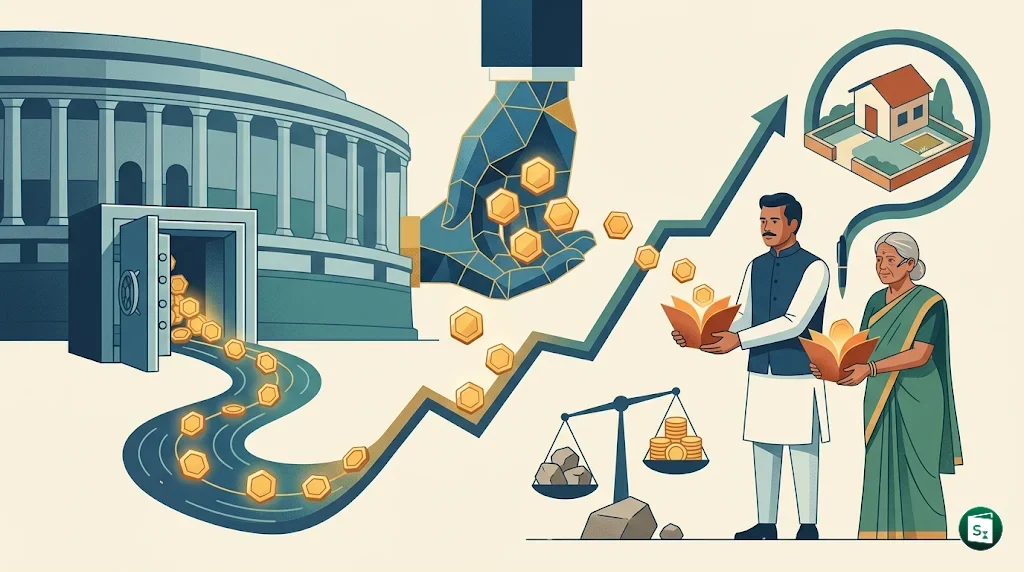
The Union Cabinet, chaired by Prime Minister Narendra Modi, approved an additional 2% installment of Dearness Allowance (DA) and Dearness Relief (DR) on April 18, 2026. This increase, effective retrospectively from January 1, 2026, raises the total allowance to 60% of the basic pay or pension. The move is designed to provide financial relief to over 1.18 crore central government employees and pensioners against the rising cost of living.
Key Highlights of the DA and DR Revision
The recent revision marks a 2% increase over the previous rate of 58% of the basic salary or pension. This adjustment is part of a regular bi-annual exercise where the central government modifies these allowances to protect the real income of its workforce and retirees from the eroding effects of inflation. As the announcement was made in April 2026, eligible individuals will receive arrears for the three-month period from January to March 2026.
This periodic revision is typically implemented twice a year, with the first installment effective from January 1st and the second from July 1st. The 2% hike is based on the trend of price increases in essential commodities as reflected in the consumer price index data over the preceding twelve months.
How Dearness Allowance is Calculated
The calculation of Dearness Allowance is strictly data-driven, following the recommendations of the 7th Central Pay Commission. The primary benchmark used for this purpose is the All-India Consumer Price Index for Industrial Workers (AICPI-IW). This index is compiled and released every month by the Labour Bureau, an attached office of the Ministry of Labour and Employment.
The percentage of DA is determined by taking the 12-month average of the AICPI-IW. For calculations under the current pay structure, the index values are adjusted using a linking factor of 2.88 to align the 2016 base year data with earlier series. Once the index average exceeds the base level of 261.41 set by the 7th Pay Commission, the government notifies the increase in increments of whole numbers.
The Financial Impact and Beneficiaries
The decision to increase the allowances will have a significant impact on the national exchequer. The annual financial implication for the government is estimated to be ₹6,791.24 crore. Since the hike is effective from January, the total outgo for the financial year 2026 to 2027 will be slightly higher as it accounts for the full transition to the 60% rate.
The revision benefits a massive base of central government personnel and retirees as shown below:
| Beneficiary Category | Approximate Number |
|---|---|
| Central Government Employees | 50.46 Lakh |
| Central Government Pensioners | 68.27 Lakh |
| Total Beneficiaries | 118.73 Lakh |
While Dearness Allowance (DA) is paid to active employees as a part of their monthly salary, Dearness Relief (DR) is provided to retired employees as a component of their monthly pension. Both serve the same fundamental purpose of maintaining the purchasing power of the recipients.
Background: The 7th Central Pay Commission
The current framework for revising salaries and allowances is based on the recommendations of the 7th Central Pay Commission (CPC). Constituted in 2014 under the chairmanship of Justice Ashok Kumar Mathur, the commission submitted its report in 2015. The government implemented its recommendations with effect from January 1, 2016, which led to a major overhaul of the pay structure and grading system for central government personnel.
The 7th CPC recommended that the Dearness Allowance should be revised twice a year based on indices that track the cost of living. It also introduced the Pay Matrix, which simplified the process of salary calculation by replacing the old system of Pay Bands and Grade Pay. Central Pay Commissions are typically set up by the government every ten years to review and recommend changes to the pay structure, benefits, and retirement rewards for its employees.
Significance of the Periodic Revision
The primary objective of the dearness allowance is to hedge the salaries of government employees against inflation. As prices of essential goods and services rise, the purchasing power of a fixed salary decreases. By linking the allowance to the consumer price index, the government ensures that its employees can maintain a stable standard of living despite market fluctuations.
Beyond individual relief, such hikes also have broader economic implications. The additional disposable income in the hands of millions of employees and pensioners often translates into increased consumer spending, which can provide a slight stimulus to the economy. However, it is important to note that the Dearness Allowance is fully taxable under the head Salaries in the Income Tax Act for the employees, which slightly moderates the net increase in their take-home pay.
Key Takeaways
- The Union Cabinet approved a 2% increase in Dearness Allowance (DA) and Dearness Relief (DR) with effect from January 1, 2026.
- The overall rate of DA and DR has been raised from 58% to 60% of the basic pay or pension.
- The total number of beneficiaries from this decision includes approximately 50.46 lakh employees and 68.27 lakh pensioners.
- The calculated total financial impact on the national exchequer is estimated at ₹6,791.24 crore per annum.
- The revision is based on the 12-month average of the All-India Consumer Price Index for Industrial Workers (AICPI-IW) published by the Labour Bureau.
- The current system of bi-annual revisions follows the recommendations of the 7th Central Pay Commission, which was chaired by Justice Ashok Kumar Mathur.