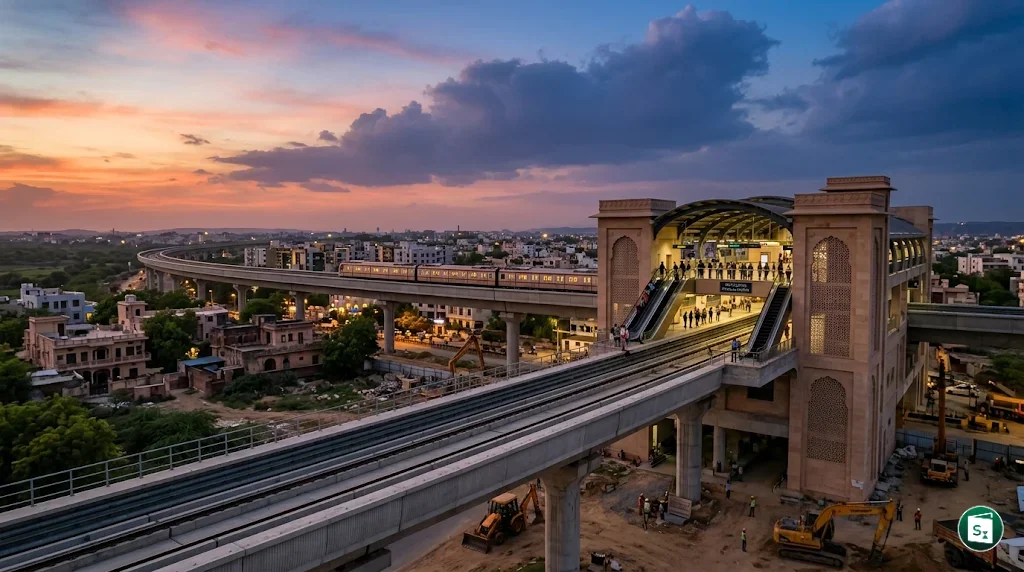
The Union Cabinet, led by Prime Minister Narendra Modi, has approved the development of the 41 km long Jaipur Metro Phase-2 and a significant cost revision for the HPCL Rajasthan Refinery Limited. These decisions represent a combined investment of over ₹92,000 crore, aimed at modernising Rajasthan’s urban transit and energy infrastructure. The initiatives are expected to foster industrial growth and improve the quality of life for millions in the state by providing cleaner transport and enhancing petrochemical self-reliance.
Connecting Jaipur: The Expansion of Phase-2 Metro
The Jaipur Metro Phase-2 project is a major expansion of the city’s rapid transit network, designed to provide seamless north-south connectivity. Spanning approximately 41 kilometres, the corridor will link Prahladpura to Todi Mod, passing through several critical economic and residential hubs. This phase is being developed at an estimated cost of ₹13,037.66 crore and is expected to be completed by September 2031.
The Rajasthan Metro Rail Corporation Limited (RMRCL), a 50:50 joint venture between the Central and State governments, will oversee the project’s execution. To ensure wide-scale urban mobility, the line will feature 36 stations, most of which will be elevated. However, specific sections near the Jaipur International Airport will be built underground to meet safety and operational requirements. The project follows the Rajasthan Transit-Oriented Development (TOD) Policy-2025, which focuses on high-density development along transit corridors.
| Feature | Details |
|---|---|
| Route Length | 41 Kilometres |
| Origin Point | Prahladpura |
| Destination Point | Todi Mod |
| Total Stations | 36 Stations |
| Project Cost | ₹13,037.66 Crore |
| Target Completion | September 2031 |
Strategic Route and Multi-Modal Connectivity
The planned route is strategically designed to touch major activity centres in Jaipur. It will provide easier access to the Sitapura Industrial Area, the Vishwakarma Industrial Area (VKIA), and the Sawai Mansingh (SMS) Hospital and Stadium. By connecting areas like Ambabari, Vidhyadhar Nagar, and Tonk Road, the metro aims to significantly shift the passenger load from private vehicles to public transport, thereby reducing vehicular emissions and urban heat.
The Jaipur Metro Rail Corporation Limited (JMRC), headquartered in Jaipur, was established on January 1, 2010, to provide a world-class metro system to the city. The first phase of the metro, connecting Mansarovar to Badi Chaupar, has already significantly reduced traffic congestion in the heritage areas. The new Phase-2 will integrate with this existing network through interchanges, creating a comprehensive grid that supports the city’s growing population and tourism.
HPCL Rajasthan Refinery: Scaling Up India’s Petrochemical Ambition
In a move to strengthen India’s self-reliance in the energy sector, the Union Cabinet has sanctioned a revised project cost for the HPCL Rajasthan Refinery Limited (HRRL). The total financial outlay has been increased from the initial estimate of ₹43,129 crore to ₹79,459 crore. This escalation is primarily attributed to inflationary pressures on raw materials, expanded project scope to include advanced integrated units, and global supply chain disruptions. Commissioning of the refinery is currently scheduled for July 1, 2026.
The HRRL project is a flagship joint venture, with Hindustan Petroleum Corporation Limited (HPCL) holding a 74% stake and the Government of Rajasthan holding the remaining 26%. To support the revised cost, the Cabinet has authorised an additional equity infusion of ₹8,962 crore by HPCL, bringing its total equity contribution to approximately ₹19,600 crore. Located in Pachpadra, in the newly formed Balotra district (formerly part of Barmer), this is the first project in India to integrate a refinery with a petrochemical complex.
| Aspect | Details |
|---|---|
| Project Type | Greenfield Refinery-cum-Petrochemical Complex |
| Location | Pachpadra, Balotra District, Rajasthan |
| Capacity | 9 Million Metric Tonnes Per Annum (MMTPA) |
| Revised Cost | ₹79,459 Crore |
| Stakeholders | HPCL (74%) and Govt of Rajasthan (26%) |
| Start Date | July 1, 2026 (Commercial Operations) |
From Barmer to Balotra: The Mega-Petrochemical Project
The HRRL complex is designed with a high degree of complexity, capable of processing both locally produced Mangala crude from the Rajasthan fields and imported crude. It will produce a wide range of petroleum products, including high-quality BS-VI fuels, and essential petrochemicals such as polypropylene, polyethylene, benzene, and butadiene. These materials are critical inputs for various industries, including pharmaceuticals, packaging, and manufacturing, helping to reduce India’s dependence on imports.
Beyond fuel production, the refinery is expected to have a profound economic impact on the region. Once fully operational, it is estimated to contribute approximately ₹21,000 crore annually to the central and state exchequers. Furthermore, the project is acting as a catalyst for the development of a petrochemical hub in the vicinity, attracting ancillary industries and generating significant direct and indirect employment opportunities for the local population.
Key Takeaways
- The Union Cabinet has approved Jaipur Metro Phase-2, featuring a 41 km corridor connecting Prahladpura to Todi Mod at an estimated cost of ₹13,037.66 crore.
- The project will be implemented by Rajasthan Metro Rail Corporation Limited (RMRCL), a 50:50 joint venture between the Government of India and the Government of Rajasthan.
- The HPCL Rajasthan Refinery Limited (HRRL) project’s total cost has been revised upward from ₹43,129 crore to ₹79,459 crore, with commercial operations set to begin on July 1, 2026.
- Located in Pachpadra, Balotra district, HRRL is India’s first integrated refinery-cum-petrochemical complex with a capacity of 9 MMTPA.
- The Jaipur Metro Rail Corporation Limited (JMRC) was established on January 1, 2010, and is headquartered in Jaipur.
- Hindustan Petroleum Corporation Limited (HPCL) holds a 74% stake in the refinery project, while the Government of Rajasthan holds the remaining 26% stake.