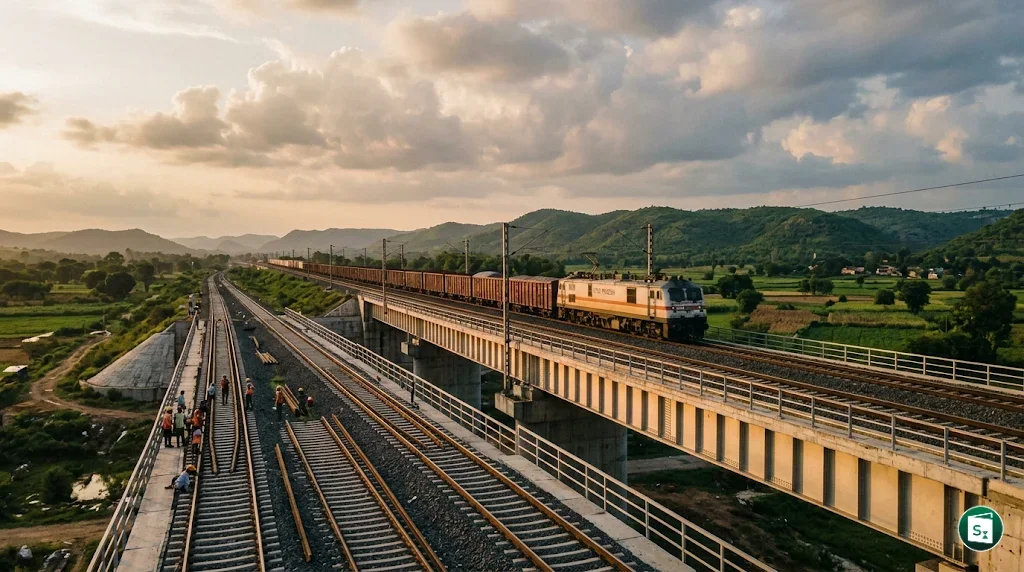
The Cabinet Committee on Economic Affairs, chaired by Prime Minister Narendra Modi, has approved two major multi-tracking railway projects with a total estimated investment of ₹24,815 crore. These projects involve an expansion of the Indian Railways network by 601 km, covering a total track length of 1,317 km across 15 districts in Uttar Pradesh and Andhra Pradesh. Scheduled for completion by FY 2030-31, the initiative aims to decongest high-density corridors and enhance logistics efficiency under the PM Gati Shakti National Master Plan.
Project Overview: Strengthening High-Density Networks
The newly approved projects focus on capacity expansion along some of India’s most congested railway routes. By adding 3rd and 4th lines, the Ministry of Railways aims to improve the punctuality of passenger trains and the reliability of freight services. These sections are part of the High Density Network (HDN), which carries a disproportionately large share of the country’s rail traffic.
The total scope of work includes the development of 601 km of new tracks, which will effectively increase the operational track length by 1,317 km once multi-tracking is complete. The projects are split between two key industrial and agricultural regions:
| Project Section | State | Distance | Estimated Cost |
|---|---|---|---|
| Ghaziabad - Sitapur | Uttar Pradesh | 403 km | ₹14,926 crore |
| Rajahmundry - Visakhapatnam | Andhra Pradesh | 198 km | ₹9,889 crore |
| Total | 601 km | ₹24,815 crore |
These projects are fundamental to the PM Gati Shakti National Master Plan, which provides a transformative approach for integrated planning and synchronized implementation of multi-modal connectivity. The development will utilize the latest engineering standards to ensure high-speed and safe operations.
Regional Impact: Developing the Ghaziabad–Sitapur Corridor
The Ghaziabad - Sitapur multi-tracking project is a critical component of the Delhi-Guwahati High Density Network (HDN-4). Spanning 403 km, this section serves as a vital artery for passenger and freight movement between the national capital and Northeast India. The project will bridge existing capacity gaps, allowing for a higher volume of traffic and reducing the heavy congestion currently experienced on this route.
The expansion will directly benefit nine districts in Uttar Pradesh, including Ghaziabad, Hapur, Amroha, Moradabad, Rampur, Bareilly, Shahjahanpur, Lakhimpur Kheri, and Sitapur. The lines fall under the jurisdiction of the Northern Railway (NR) and North Eastern Railway (NER) zones. This development is expected to boost local economies by improving access to major industrial hubs and agricultural mandis across the state.
Enhancing Connectivity in Coastal Andhra Pradesh
The second project involves the multi-tracking of the Rajahmundry (Nidadavolu) - Visakhapatnam (Duvvada) section in Andhra Pradesh. Part of the Howrah-Chennai High Density Network, this 198 km stretch is vital for moving freight from India’s eastern ports to various parts of the country. The project will facilitate smoother operations under the South Central Railway (SCR) and East Coast Railway (ECoR) jurisdictions.
Focusing on the coastal districts of East Godavari, Konaseema, Kakinada, Anakapalle, and Visakhapatnam, the expansion will support the burgeoning industrial activity in the region. Improved rail infrastructure will provide better connectivity to major ports such as Visakhapatnam Port, Gangavaram Port, and the upcoming greenfield port at Kakinada Gateway.
Strategic Significance and Multi-modal Alignment
Beyond industrial utility, these projects carry immense strategic and cultural significance. By improving the throughput of the railway network, the government aims to reduce the overall logistics cost in India, which currently stands higher than the global average. This is a central objective of the National Logistics Policy and the PM Gati Shakti National Master Plan.
The projects also emphasize the “last mile” connectivity to important religious and tourist destinations. Better rail access will facilitate easier travel to sites such as:
- Dudheshwarnath Temple in Ghaziabad
- Naimisharanya in Sitapur
- Annavaram, Antarvedi, and Draksharamam in Andhra Pradesh
This holistic approach ensures that infrastructure investment serves multiple purposes: boosting industrial growth, enhancing civilian mobility, and promoting domestic tourism.
Economic and Environmental Implications
The expansion of these corridors is projected to add significant freight capacity, facilitating the movement of essential commodities across the country. The Indian Railways expects to handle additional traffic comprising coal, cement, foodgrains, steel, and fertilizers. By shifting freight from road to rail, the projects will significantly lower the country’s energy consumption and logistics footprints.
From an environmental standpoint, rail transport is considerably more efficient than road transport. The Ministry of Railways estimates that these projects will contribute to a cumulative reduction in carbon emissions equivalent to planting over seven crore trees. This aligns with India’s global climate commitments to achieve Net Zero emissions by 2070.
Key Takeaways
- The Cabinet Committee on Economic Affairs (CCEA) has approved two multi-tracking railway projects with a total outlay of ₹24,815 crore.
- The projects involve the expansion of the Indian Railways network by 601 km, covering 15 districts in Uttar Pradesh and Andhra Pradesh.
- The Ghaziabad - Sitapur project (403 km) is part of the Delhi-Guwahati High Density Network.
- The Rajahmundry - Visakhapatnam project (198 km) is part of the Howrah-Chennai High Density Network.
- These initiatives are aligned with the PM Gati Shakti National Master Plan to improve multi-modal connectivity and logistics efficiency.
- The infra development is scheduled for completion by Financial Year 2030-31.
- The projects are expected to reduce carbon emissions by an amount equivalent to planting over seven crore trees.