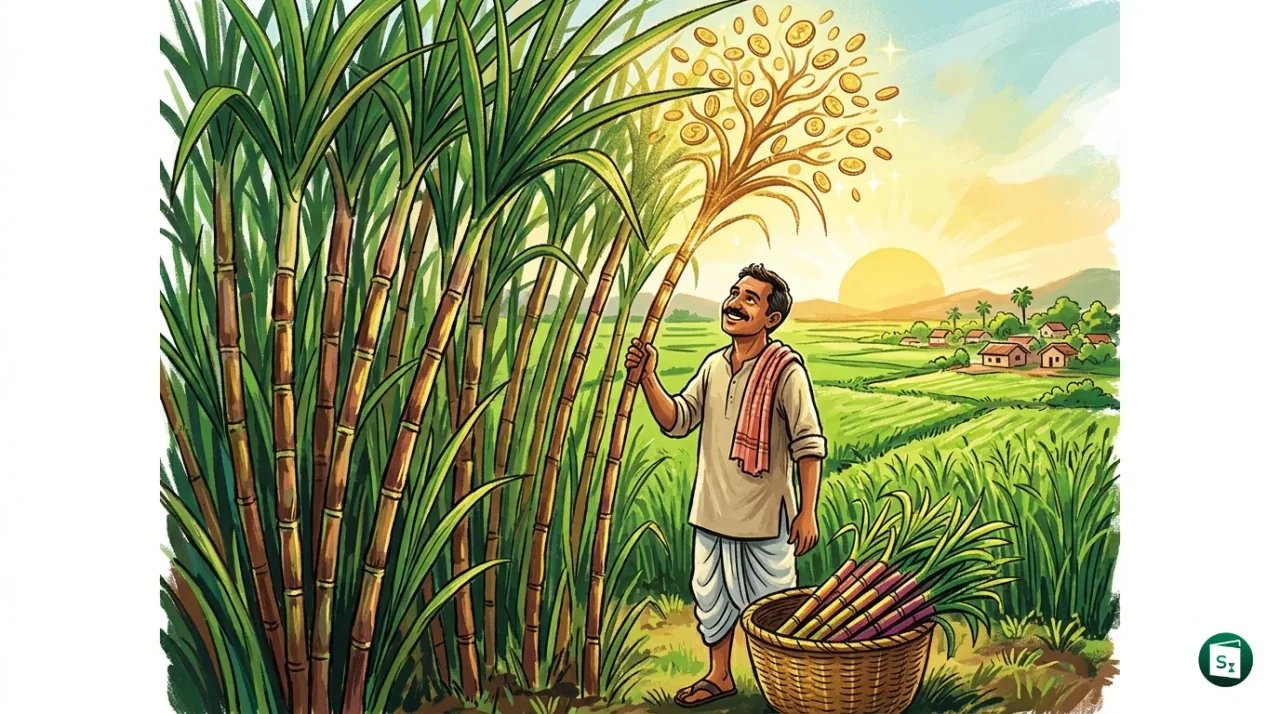
The Cabinet Committee on Economic Affairs (CCEA) has approved a hike in the Fair and Remunerative Price (FRP) of sugarcane to ₹365 per quintal for the 2026-27 sugar season. This decision, effective from October 2026, represents a 2.81% increase over the previous season’s rate of ₹355 per quintal. The move aims to ensure fair returns for over five crore sugarcane farmers and support the continued growth of India’s sugar and ethanol industries.
CCEA Increases Sugarcane FRP to ₹365 per Quintal
The Cabinet Committee on Economic Affairs (CCEA), chaired by Prime Minister Narendra Modi, has fixed the FRP for the 2026-27 sugar season (October to September) at ₹365 per quintal. This price is linked to a basic recovery rate of 10.25%. For every 0.1% increase in sugar recovery above this threshold, farmers will receive a premium of ₹3.56 per quintal.
To protect the interests of farmers supplying to mills with lower yields, the government has mandated that no deduction will be made for recovery rates below 9.5%. In such cases, farmers are guaranteed a minimum price of ₹338.3 per quintal. The approved FRP is significantly higher than the estimated production cost of ₹182 per quintal, providing a margin of over 100% to the growers.
Sugarcane FRP Structure for 2026-27
| Parameter | Details |
|---|---|
| FRP for 2026-27 | ₹365 per quintal |
| Basic Recovery Rate | 10.25% |
| Premium for Recovery | ₹3.56 per quintal (per 0.1% increase) |
| Minimum Price (at 9.5% recovery) | ₹338.3 per quintal |
| Estimated Production Cost | ₹182 per quintal |
| Effective Date | October 1, 2026 |
The Mechanism Behind Sugarcane Price Determination
The pricing of sugarcane in India is governed by the Sugarcane (Control) Order, 1966, issued under the Essential Commodities Act, 1955. Unlike other crops that receive a Minimum Support Price (MSP), sugarcane is regulated through the FRP, which is the minimum price that sugar mills are legally obligated to pay to farmers. This price is determined based on the recommendations of the Commission for Agricultural Costs and Prices (CACP).
The CACP, an advisory body under the Ministry of Agriculture and Farmers Welfare, considers several factors before recommending the FRP. These include the cost of production, the return to growers from alternative crops, the general trend of prices of agricultural commodities, and the availability of sugar to consumers at a fair price. Furthermore, the realization from by-products like molasses, bagasse, and press mud is also factored into the final calculation. While the Central Government fixes the FRP, some states like Uttar Pradesh and Maharashtra often announce a State Advised Price (SAP), which is generally higher than the FRP.
Linking Sugar Recovery to Farmer Income
Sugar recovery refers to the amount of sugar extracted from a given quantity of sugarcane. It is a critical metric because it directly impacts the profitability of sugar mills and the earnings of farmers. A 10.25% recovery rate means that for every 100 kg of sugarcane crushed, 10.25 kg of sugar is produced. By linking the FRP to this recovery rate, the government incentivizes farmers to adopt better agricultural practices and cultivate high-yielding varieties.
The premium of ₹3.56 per quintal for every 0.1% increase in recovery ensures that efficient farmers are rewarded for the quality of their produce. This system also encourages sugar mills to modernize their technology to maximize extraction. In regions with naturally lower recovery rates due to climatic conditions, the government’s decision to cap deductions at the 9.5% level provides a necessary safety net, ensuring that even the most vulnerable farmers receive a remunerative price.
Significance of the Decision for the Indian Economy
The sugar industry is the second-largest agro-based industry in India, after cotton. It provides a livelihood for approximately five crore farmers and their families, along with several lakh workers employed in over 500 sugar mills across the country. The hike in FRP to ₹365 per quintal is expected to inject billions into the rural economy, boosting purchasing power and fostering overall development in key sugarcane-growing states like Uttar Pradesh, Maharashtra, Karnataka, Tamil Nadu, and Gujarat.
Moreover, the FRP ensures a predictable and stable income for farmers, which is crucial for maintaining national food security. By setting the FRP at more than 100% over the cost of production, the government aims to double farmers’ income and reduce the financial stress in the agrarian sector. This stability also benefits the sugar mills by ensuring a steady supply of raw material, which is essential for maintaining production levels and meeting both domestic and international demand for sugar.
Future Outlook for the Sugar and Ethanol Sector
The health of the sugarcane industry is intrinsically linked to India’s energy goals through the Ethanol Blending Programme (EBP). India has already achieved its 20% ethanol blending target in December 2025, five years ahead of the original 2030 schedule. Sugarcane remains a primary feedstock for ethanol production, and the increased FRP will ensure that farmers continue to see sugarcane as a viable and profitable crop.
Looking forward, the government is focusing on diversifying feedstocks to include maize and other food grains to stabilize supply and reduce water intensity. Plans are also underway to introduce higher blending grades like E85 and E100 to support the adoption of flex-fuel vehicles. The continued success of the EBP not only reduces India’s dependence on imported crude oil but also helps in lowering the country’s carbon footprint, making the sugar sector a vital pillar of India’s green energy transition.
Key Takeaways
- The Cabinet Committee on Economic Affairs (CCEA) has increased the Fair and Remunerative Price (FRP) for sugarcane to ₹365 per quintal for the 2026-27 season.
- The new price is linked to a basic sugar recovery rate of 10.25%, with a premium of ₹3.56 per quintal for every 0.1% increase in recovery.
- Farmers are protected from deductions for recovery levels below 9.5%, ensuring a minimum price of ₹338.3 per quintal.
- The FRP is determined based on the recommendations of the Commission for Agricultural Costs and Prices (CACP) under the Sugarcane (Control) Order, 1966.
- India’s sugar industry is the second-largest agro-based sector and achieved a 20% ethanol blending target in December 2025.
- The major sugarcane-producing states in India include Uttar Pradesh, Maharashtra, and Karnataka.