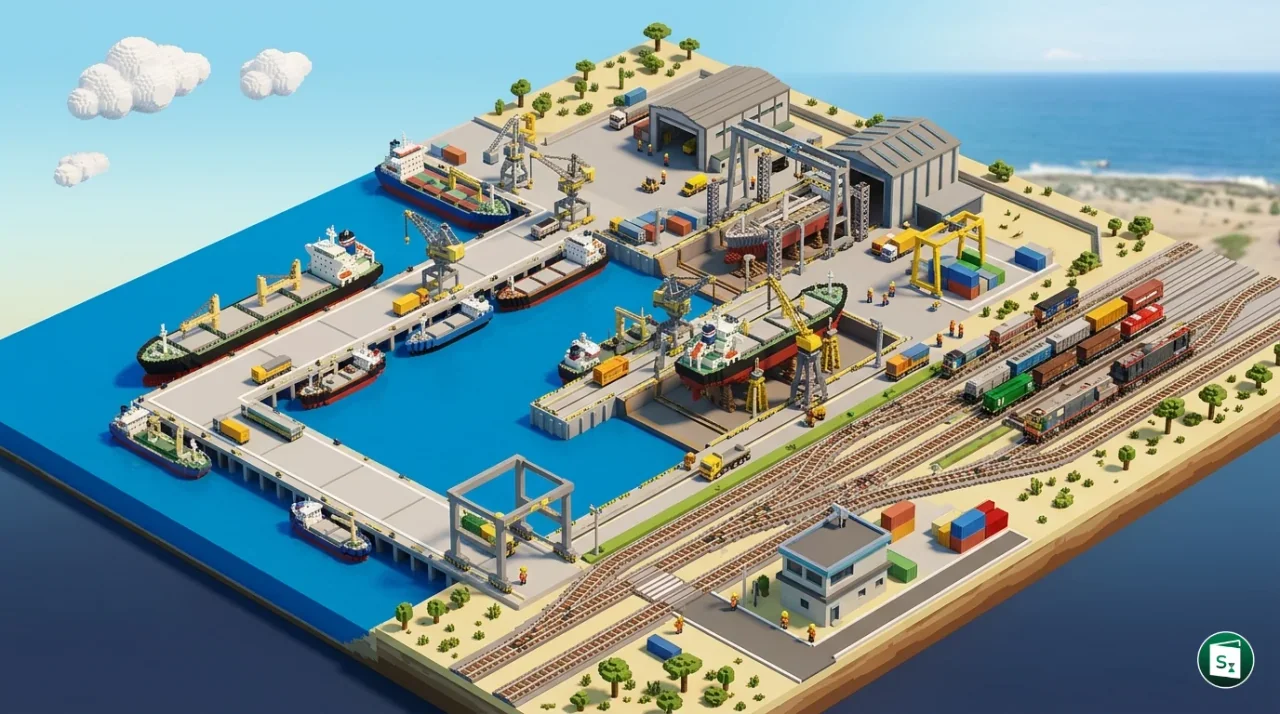
The Cabinet Committee on Economic Affairs approved the development of a state of the art ship repair facility at Vadinar, Gujarat, and sanctioned three major railway multi-tracking projects on May 13, 2026. These initiatives, involving a combined investment of approximately ₹25,000 crore, aim to bolster India’s maritime capacity and enhance the efficiency of high density railway corridors. The projects are aligned with the PM Gati Shakti National Master Plan and India’s long term vision for self reliance in critical infrastructure sectors.
Development of Brownfield Ship Repair Facility at Vadinar
Vadinar is located in the Kutch district of Gujarat and operates under the jurisdiction of the Deendayal Port Authority (DPA). The DPA, which was formerly known as Kandla Port, was established in 1952 and formally declared a major port of India in 1955. This new initiative is a brownfield development, which means it will leverage and expand existing infrastructure to create a state of the art ship repair hub. With an estimated investment of ₹1,570 crore, the project is a strategic move to address the shortage of large scale ship repair facilities in India.
Currently, the Indian ship repair industry accounts for less than 1% of the global market share. A significant number of large Indian vessels are required to travel to foreign shipyards in nations such as Singapore or the United Arab Emirates for routine maintenance and major repairs. By developing high capacity domestic facilities, the government aims to reduce this dependence, curb the outflow of foreign exchange, and position India as a preferred destination for global ship repair services.
Infrastructure and Technical Specifications
The proposed infrastructure at Vadinar includes a 650-meter jetty and specialized marine infrastructure such as workshops and storage areas. One of the standout features of this facility is its ability to accommodate vessels up to 300 meters in length. Most existing ship repair docks in India are limited to handling vessels shorter than 230 meters. By breaking this barrier, the Vadinar facility will be able to service larger commercial tankers and cargo ships that currently have no choice but to go abroad.
The facility will also be equipped with floating dry docks, which offer greater flexibility and efficiency in repair operations. These docks can be moved and adjusted to suit different vessel types, making them ideal for a high traffic port environment like Vadinar. The project is expected to generate approximately 290 direct jobs and around 1,100 indirect employment opportunities, providing a significant boost to the local economy in Gujarat.
Joint Implementation by DPA and Cochin Shipyard
The project will be executed through a joint collaboration between the Deendayal Port Authority (DPA) and Cochin Shipyard Limited (CSL). CSL, which was incorporated in 1972 and is headquartered in Kochi, Kerala, is the largest shipbuilding and maintenance facility in India. As a Miniratna Category I company, CSL has a proven track record of handling complex maritime projects, including the construction of India’s first indigenous aircraft carrier, INS Vikrant.
This partnership combines DPA’s strategic location and port management expertise with CSL’s technical prowess in ship repair and maintenance. The joint execution model ensures that the facility will adhere to international standards of safety and efficiency. This collaboration also aligns with the broader goals of the Maritime India Vision 2030, which seeks to position India among the top ten shipbuilding and repair nations globally.
CCEA Sanctions Massive Investment for Railway Multi-tracking
In a parallel move to strengthen the country’s logistics backbone, the CCEA has sanctioned three major railway multi-tracking projects with a total financial outlay of ₹23,437 crore. These projects involve the construction of third and fourth railway lines across high density corridors to alleviate congestion and improve the movement of both passenger and freight traffic. The initiatives are part of the PM Gati Shakti National Master Plan, which focuses on integrated planning and coordinated implementation of infrastructure connectivity projects.
The expansion projects cover approximately 901 kilometers of the Indian Railways network, spanning 19 districts across six states: Madhya Pradesh, Rajasthan, Uttar Pradesh, Karnataka, Andhra Pradesh, and Telangana. By adding these extra lines, the railways will be able to handle an additional 60 million tonnes of freight per annum, significantly enhancing the operational efficiency of some of the busiest sections of the national rail network.
Strategic Corridors and Connectivity Benefits
The multi-tracking work will be undertaken on three vital sections of the railway network. The details of these sections and their strategic importance are summarized below:
| Railway Section | Type of Work | Significance |
|---|---|---|
| Nagda-Mathura | 3rd and 4th Line | Connects major industrial and tourism hubs |
| Guntakal-Wadi | 3rd and 4th Line | Crucial for South to North freight movement |
| Burhwal-Sitapur | 3rd and 4th Line | Enhances connectivity in Uttar Pradesh |
Beyond industrial benefits, these projects will improve access to several major tourist and religious destinations, such as the Mahakaleshwar temple in Ujjain, the religious circuit of Mathura and Vrindavan, and the spiritual site of Naimisharanya. The projects are targeted for completion by the 2030-31 financial year, contributing to the government’s objective of reducing logistics costs and meeting the growing demand for rail transport in India.
Economic Impact and Employment Opportunities
The combined impact of the Vadinar ship repair facility and the railway multi-tracking projects is expected to be transformative for the Indian economy. By improving the efficiency of both maritime and rail logistics, these projects will help reduce the overall cost of doing business in India. The maritime project alone is set to create over 1,300 jobs, while the large scale railway construction will generate thousands of man days of employment across six states.
These infrastructure investments are key components of the Maritime Amrit Kaal Vision 2047, which aims to transform India into a global maritime powerhouse. By focusing on domestic capacity building and multi-modal connectivity, the government is laying the foundation for a more resilient and self reliant economy. The strategic placement of these projects ensures that they serve as catalysts for regional development, particularly in the Kutch region of Gujarat and the high traffic railway corridors of Central and North India.
Key Takeaways
- The CCEA approved a ₹1,570 crore brownfield ship repair facility at Vadinar, Gujarat, designed to handle vessels up to 300 meters in length.
- The project will be jointly implemented by the Deendayal Port Authority (DPA) and Cochin Shipyard Limited (CSL).
- Deendayal Port Authority, formerly known as Kandla Port, was established in 1952 and is a major port located in the Kutch district of Gujarat.
- Three railway multi-tracking projects worth ₹23,437 crore were sanctioned under the PM Gati Shakti National Master Plan.
- These railway initiatives cover 901 kilometers across six states and aim to increase freight capacity by 60 million tonnes per year.
- Cochin Shipyard Limited, incorporated in 1972, is the largest shipbuilding and repair facility in India and holds Miniratna Category I status.