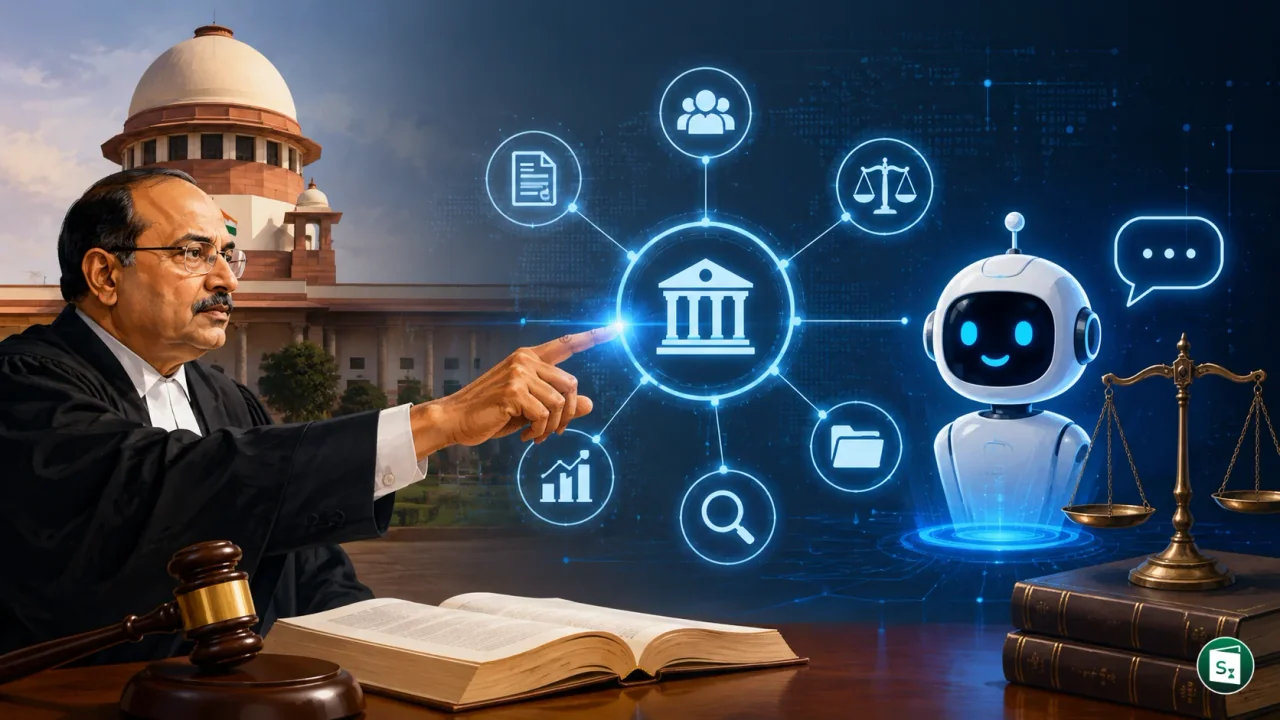
Chief Justice of India (CJI) Surya Kant launched two landmark digital initiatives for the Indian judiciary on May 11, 2026: the ‘One Case One Data’ programme, which integrates case information across all tiers of the court system into a single unified database, and ‘Su Sahay’, an artificial intelligence-powered chatbot that guides litigants and citizens through court services on the Supreme Court of India’s website. Both tools were developed by the National Informatics Centre (NIC) in collaboration with the Supreme Court Registry. Together, they mark a significant push toward a more transparent and technologically connected justice delivery system.
India’s Judiciary and the Data Fragmentation Problem
India’s court system is one of the largest in the world by volume. As of May 2026, over 93,700 cases were pending before the Supreme Court alone, while the national tally across all courts stood at more than 55 million cases. District and subordinate courts bore the heaviest burden, accounting for roughly 47.6 million of those pending matters, with the 25 High Courts collectively holding around 6.37 million more.
One of the structural reasons that cases stagnate is the lack of a seamlessly connected data architecture. When a case moves from a district court to a High Court, or from a High Court to the Supreme Court, its records have historically been managed by separate systems with little cross-talk between them. This creates gaps in tracking, increases the risk of errors, and forces litigants to repeatedly gather documents that courts at different levels should already have access to. The ‘One Case One Data’ initiative directly targets this fracture in the system.
What ‘One Case One Data’ Does
The ‘One Case One Data’ programme establishes a unified, integrated judicial database that links case information from the lowest tier of the court system all the way to the Supreme Court. From taluka and district courts to High Courts and the apex court, case data is now meant to flow through a common, interconnected architecture rather than being stored in separate, siloed systems.
The core principle is the creation of a single source of truth for every case. Once a case is registered anywhere in the judicial hierarchy, its complete data trail, including filings, orders, hearings, and outcomes, becomes accessible across tiers through authorised channels. This eliminates the need for manual record-gathering when a case moves up the ladder. High Courts and government departments will also have reciprocal access to relevant case information, allowing for faster coordination and reducing duplication of effort.
The initiative automates the retrieval of information from multiple court databases simultaneously. This allows near real-time verification of case status and judicial history, a function that previously required significant administrative effort or the assistance of a court official. The result is a more accurate, tamper-resistant record of every case, improving both data integrity and the ability of court administrators to manage caseloads systematically.
‘Su Sahay’: The AI Chatbot for Court Access
The second initiative, ‘Su Sahay’, is an AI-powered judicial assistance chatbot integrated directly into the official website of the Supreme Court of India. The tool was developed by the National Informatics Centre (NIC) in partnership with the Supreme Court Registry and operates as a 24/7 digital help desk for citizens, litigants, advocates, and law students.
The chatbot responds to user queries on a wide range of court-related topics, including:
- Case status and tracking across matters before the Supreme Court
- Cause list information, indicating when a case is scheduled for hearing
- Orders and judgments, helping users locate specific rulings
- Filing guidelines and procedural information, explaining how to navigate the court’s administrative processes
The name ‘Su Sahay’ draws from Sanskrit, with su meaning good or auspicious and sahay meaning assistance or support, reflecting its purpose as a friendly digital aide for navigating a system that can often feel inaccessible to ordinary citizens. By providing front-end guidance without requiring users to approach a court counter or seek a lawyer’s help for basic information, the chatbot substantially lowers the threshold for accessing judicial services.
The eCourts Project: The Bigger Digital Transformation Drive
Both ‘One Case One Data’ and ‘Su Sahay’ are components of a wider national effort to digitize the Indian judiciary through the eCourts Project, which operates under the e-Committee of the Supreme Court of India and is implemented in close collaboration with the National Informatics Centre (NIC). The eCourts Project was conceptualized following the National Policy and Action Plan for Implementation of ICT in the Indian Judiciary (2005) and has since evolved through three distinct phases.
Phase I (2007 to 2015) focused on the basic computerisation of district and subordinate courts, setting up hardware, local area network connectivity, and a Case Information Software (CIS) to provide foundational services to litigants and lawyers. Phase II (2015 to 2023) expanded this foundation by connecting courts to the National Judicial Data Grid (NJDG) and introducing citizen-centric services such as e-filing and e-payment. Phase III (2023 onwards) is the current mission, approved by the Union Cabinet in September 2023 with an outlay of ₹7,210 crore, and focused on “access and inclusion.” Its aim is to build a unified, paperless, and intelligent technology platform that uses artificial intelligence, machine learning, and natural language processing to assist with case analysis and simplify judicial language for ordinary users.
Both new launches sit firmly within the Phase III framework, which also includes the digitisation of approximately 3,100 crore documents from legacy court records and the expansion of e-Sewa Kendras (one-stop physical centres for digital court access in rural areas).
National Judicial Data Grid (NJDG): The Foundation Beneath
The infrastructure underpinning ‘One Case One Data’ builds upon the National Judicial Data Grid (NJDG), a flagship component of the eCourts Project that has been operational since Phase II. The NJDG functions as a centralized national repository for judicial data, integrating information from the Supreme Court, all High Courts, and thousands of district and subordinate courts into a single portal.
It uses Elastic Search technology developed by the NIC, which enables rapid searching and deep-dive analytics of massive judicial datasets. The grid has already been integrated with land records data from 26 states to specifically track and analyze land dispute cases, which constitute a significant portion of the overall national caseload. The ‘One Case One Data’ initiative enhances this grid’s core function by ensuring that the data flowing into it is seamlessly connected across all court levels in real time, not just available as an aggregate statistic.
About Chief Justice Surya Kant
Justice Surya Kant is the 53rd Chief Justice of India, having assumed office on November 24, 2025. He was born on February 10, 1962, in Boharwani village in Hisar district, Haryana, and completed his LL.B. from Maharshi Dayanand University, Rohtak, in 1984, followed by an LL.M. from Kurukshetra University, where he stood first in his batch.
He began his legal career at the District Court in Hisar in 1984 and was elevated as a permanent judge of the Punjab and Haryana High Court on January 9, 2004. He served as Chief Justice of the Himachal Pradesh High Court from October 2018 before being elevated to the Supreme Court of India on May 24, 2019. He is scheduled to retire on February 9, 2027, giving him roughly 15 months as Chief Justice to push his reform agenda forward.
Since assuming charge, Justice Surya Kant has placed judicial modernization, reduction of case pendency, and improved public access to justice at the centre of his agenda. The launch of ‘One Case One Data’ and ‘Su Sahay’ is consistent with his stated priority of deploying technology to strengthen the judiciary’s case management framework and make courts less opaque for ordinary citizens.
Key Takeaways
- CJI Surya Kant launched the ‘One Case One Data’ initiative on May 11, 2026, creating a unified judicial database linking case records from taluka courts to the Supreme Court.
- ‘Su Sahay’ is an AI-powered chatbot integrated into the Supreme Court website, developed by the National Informatics Centre (NIC) with the Supreme Court Registry, to guide users on case status, cause lists, orders, and filing procedures.
- The initiatives are part of eCourts Phase III, approved in September 2023 with an outlay of ₹7,210 crore, focused on building an inclusive, paperless, and AI-enabled judiciary.
- India has over 55 million pending cases across all courts, with the Supreme Court alone holding 93,700+ cases as of May 2026.
- The National Judicial Data Grid (NJDG), the foundational data platform that ‘One Case One Data’ builds upon, uses Elastic Search technology developed by NIC and is integrated with land records from 26 states.
- Justice Surya Kant is the 53rd CJI, having assumed office on November 24, 2025, and is scheduled to retire on February 9, 2027.