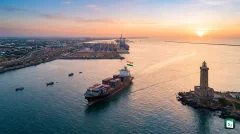
The Centre for Maritime Economy and Connectivity (CMEC) and the University of Delhi (DU) signed a Memorandum of Understanding on April 24, 2026, to advance maritime education and research in India. Exchanged in the presence of Union Minister Sarbananda Sonowal, the partnership aims to bridge the gap between academic theory and the practical requirements of the maritime industry. This collaboration marks a significant step toward developing a skilled workforce for India’s expanding Blue Economy and maritime logistics sectors.
Strengthening India’s Maritime Academic Landscape
The agreement was formalised during a seminar titled Blue Economy: Its Imperatives for a Viksit Bharat, held at the Delhi School of Economics. This partnership reflects a strategic shift toward integrating maritime studies into mainstream higher education in India. By combining the academic excellence of the University of Delhi with the policy research expertise of CMEC, the initiative seeks to create a robust talent pipeline for the nation’s port and shipping infrastructure.
Key Objectives and Areas of Collaboration
The collaboration focuses on several interdisciplinary areas critical to the modern maritime sector. Key focus areas include maritime logistics, green shipping, and supply chain management. The institutions will work together to develop academic frameworks that align with current industry standards and global best practices.
The MoU outlines a comprehensive roadmap for joint activities, including:
- Joint Research Projects: Investigating emerging trends in maritime connectivity and trade.
- Skill Development: Designing training programmes to ‘future-proof’ the skills of Indian maritime professionals.
- Knowledge Sharing: Facilitating the exchange of data and policy insights between academia and industry.
- Professional Counselling: Providing students with career guidance and internships within the maritime ecosystem.
Strategic Alignment with National Maritime Visions
This partnership is deeply rooted in India’s long-term maritime goals, specifically the Maritime Amrit Kaal Vision 2047 and the Sagarmala Programme. The government aims to increase India’s contribution to the global maritime workforce from the current 12 percent to 20 percent by 2030. By fostering academia-industry synergy, this MoU directly supports the objective of creating world-class maritime professionals.
The initiative also aligns with the Maritime India Vision 2030, which emphasises port-led industrialisation and sustainable development. As India pushes for a Viksit Bharat (Developed India) by 2047, the maritime sector is expected to play a pivotal role in driving economic growth, regional connectivity, and trade efficiency.
Institutional Background: CMEC and RIS
The Centre for Maritime Economy and Connectivity (CMEC) is a specialized research body established as a joint initiative between the Indian Ports Association (IPA) and RIS. It serves as a knowledge resource centre dedicated to providing evidence-based policy inputs to the Ministry of Ports, Shipping and Waterways (MoPSW).
The Research and Information System for Developing Countries (RIS), the parent organization of CMEC, was established in 1983 as an autonomous policy research institute under the Ministry of External Affairs. Headquartered in New Delhi, RIS was founded by G. Parthasarathi and focuses on issues related to international economic cooperation and social development. The integration of CMEC within RIS allows for a multidisciplinary approach to maritime research, connecting it with broader economic and geopolitical strategies.
The Blue Economy Context for Viksit Bharat
The Blue Economy refers to the sustainable use of ocean resources for economic growth, improved livelihoods, and jobs while preserving the health of the ocean ecosystem. India’s vast coastline of over 7,500 kilometres and its strategic position in the Indian Ocean Region make the Blue Economy a vital pillar of its national development strategy.
During the event, Union Minister Sarbananda Sonowal emphasised that a robust maritime sector is essential for India to become a leading global power. The collaboration between the University of Delhi and CMEC is expected to contribute significantly to this goal by generating high-quality research on maritime public policy and promoting sustainable practices like green shipping and decarbonisation in the maritime sector.
Key Takeaways
- The Centre for Maritime Economy and Connectivity (CMEC) and the University of Delhi signed an MoU on April 24, 2026, to strengthen maritime education and research.
- The Research and Information System for Developing Countries (RIS), which hosts CMEC, is an autonomous body under the Ministry of External Affairs established in 1983.
- The partnership focuses on emerging fields such as green shipping, maritime logistics, and supply chain management.
- India aims to increase its share in the global maritime workforce to 20 percent by 2030 from the current 12 percent.
- The initiative aligns with national programmes like the Sagarmala Programme and the Maritime Amrit Kaal Vision 2047.
- CMEC is a joint initiative of the Indian Ports Association (IPA) and RIS, serving as a policy advisory body for the maritime sector.