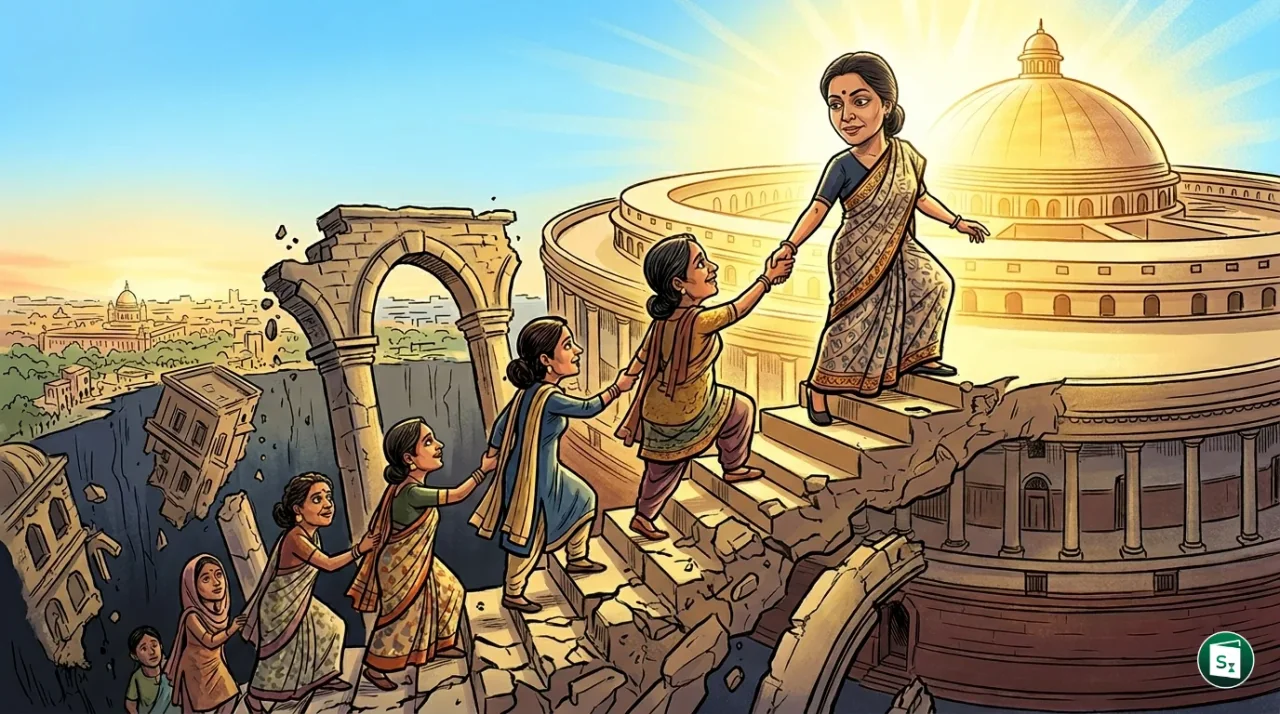
Lok Sabha Speaker Om Birla reconstituted the Joint Parliamentary Committee on Empowerment of Women for the 2026-27 legislative session, effective from April 21, 2026. Senior Bharatiya Janata Party leader and Member of Parliament Dr. Daggubati Purandeswari has been appointed as the Chairperson of the panel. The reconstitution of this panel underscores India’s legislative commitment to reviewing policy frameworks and securing gender equality across national programs.
Reconstitution of the Committee on Empowerment of Women
The annual reconstitution of the parliamentary Committee on Empowerment of Women is a critical legislative process that ensures continuous parliamentary oversight over policies and schemes designed for the welfare of women. For the 2026-27 term, the newly formed committee is headed by Dr. Daggubati Purandeswari, the President of the Bharatiya Janata Party in Andhra Pradesh and the Member of Parliament representing the Rajahmundry Lok Sabha constituency.
Dr. Purandeswari brings a wealth of administrative and legislative experience to the committee. She served as a Union Minister of State for Human Resource Development and later as the Minister of State for Commerce and Industry during her previous parliamentary terms. Her career includes representing the Bapatla constituency from 2004 to 2009 and the Visakhapatnam constituency from 2009 to 2014. Her appointment is expected to provide strong direction to the panel as it addresses key social, educational, and economic issues affecting women across the country.
Composition and Structural Framework
The Committee on Empowerment of Women functions as a Joint Parliamentary Committee, drawing members from both the Upper and Lower Houses of the Indian Parliament. This joint composition ensures that legislative oversight is balanced and representative of both direct and indirect public representation.
| Parameter | Details |
|---|---|
| Total Membership | 30 members |
| Lok Sabha Representation | 20 members nominated by the Lok Sabha Speaker |
| Rajya Sabha Representation | 10 members nominated by the Rajya Sabha Chairman |
| Tenure | Not exceeding one year (reconstituted annually) |
| Eligibility Restrictions | Ministers are ineligible; members must step down if appointed to the Union Cabinet |
To maintain the independent supervisory nature of the committee, Union Ministers cannot be nominated to the panel. If an active member of the committee is later inducted into the Union Council of Ministers, their membership on the committee automatically terminates from the date of their ministerial appointment. This rule safeguards the principle of executive accountability to the legislature.
Historical Origin and Statutory Evolution
The origin of the Committee on Empowerment of Women dates back to March 8, 1996, when identical resolutions were introduced in both the Lok Sabha and the Rajya Sabha. The resolutions called for the creation of a dedicated parliamentary forum to focus on improving the socio-economic status of women and eliminating gender-based discrimination.
Following recommendations by the Rules Committee of the Lok Sabha, the panel was formally constituted for the first time on April 29, 1997, during the tenure of the 11th Lok Sabha. The rules governing the committee’s procedure, mandate, and conduct of business are incorporated within the Rules of Procedure and Conduct of Business in Lok Sabha. Over the decades, it has evolved into a key statutory committee that provides a collaborative, bicameral platform to address women’s developmental issues beyond party lines.
Mandate and Operational Role of the Committee
The primary mandate of the committee is to review the measures taken by the Union Government to secure equal status, dignity, and safety for women. This includes assessing the implementation of central welfare programs and monitoring whether legislative provisions are effectively safeguarding women’s rights across states and Union Territories.
A significant responsibility of the panel is the examination of statutory reports submitted by the National Commission for Women (NCW). The NCW was established in 1992 as a statutory body under the National Commission for Women Act, 1990, and is headquartered in New Delhi. The committee analyzes the recommendations made by the NCW, evaluates their feasibility, and reports to Parliament on the necessary legislative or executive steps the government should take. By acting as a bridge between statutory bodies and the national legislature, the committee helps ensure that ground-level issues receive high-level political attention and structured legislative responses.
Key Takeaways
- The parliamentary Committee on Empowerment of Women for the 2026-27 session has been reconstituted effective from April 21, 2026.
- Lok Sabha Speaker Om Birla appointed senior BJP Member of Parliament Dr. Daggubati Purandeswari as the Chairperson of the committee.
- The committee functions as a Joint Parliamentary Committee with a total of 30 members, including 20 nominated from the Lok Sabha and 10 nominated from the Rajya Sabha.
- The tenure of the committee is restricted to a period not exceeding one year, requiring annual reconstitution of its members.
- Originally constituted on April 29, 1997, the panel is mandated to evaluate welfare programs and examine statutory reports submitted by the National Commission for Women.
- The National Commission for Women was established in 1992 under the National Commission for Women Act, 1990, with its headquarters in New Delhi.