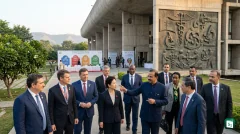
The Council of Scientific and Industrial Research-National Institute of Science Communication and Policy Research (CSIR-NIScPR) signed a Memorandum of Understanding (MoU) with the Research and Information System for Developing Countries (RIS) on May 6, 2026, in New Delhi. This strategic partnership aims to enhance cooperation in science, technology, and innovation (STI) policy research and science diplomacy, particularly focusing on the needs of the Global South. By combining their expertise, the two institutions intend to build a more robust framework for addressing global challenges through scientific collaboration and evidence-based policy advocacy.
Objectives of the Strategic Partnership
The collaboration between CSIR-NIScPR and RIS is built upon a multi-faceted agenda designed to strengthen India’s scientific and policy ecosystems. One of the primary goals is to conduct joint research and policy analysis on critical issues related to science and technology. This includes identifying and addressing emerging global challenges that require a coordinated scientific and diplomatic response.
Both institutions have committed to fostering capacity building through the organization of workshops, policy dialogues, and specialized training programs. These initiatives are aimed at developing a cadre of experts who can navigate the complex intersection of science and international relations. Furthermore, the partnership emphasizes collaborative outreach, which will involve joint publications and projects designed to promote inclusive and sustainable development.
Strengthening Science Diplomacy for the Global South
A key pillar of this MoU is the advancement of science diplomacy, which serves as a vital tool for building trust and fostering international cooperation. The partnership specifically targets the Global South, aiming to ensure that developing nations have a stronger voice in global scientific governance. By leveraging scientific expertise, the institutions seek to address pressing issues such as climate change, health inequities, and the widening technology gaps between nations.
The agreement also highlights the importance of Traditional Knowledge Systems. Both organizations will work together to document and validate traditional knowledge, integrating it as a core component of South-South cooperation. This effort is intended to recognize the unique contributions of developing nations and ensure that their traditional wisdom is utilized in modern scientific and policy frameworks.
Leveraging Complementary Institutional Strengths
The partnership brings together the distinct yet complementary capabilities of two of India’s leading policy and research organizations. RIS contributes its extensive expertise in international economic relations and its leadership in initiatives such as the Forum for Indian Science Diplomacy (FISD) and the DAKSHIN/IBSA fellowships. These platforms have been instrumental in training diplomats and policy researchers from across the developing world.
On the other hand, CSIR-NIScPR provides a robust foundation in science communication and policy research. The institute manages 15 open-access research journals and spearheads initiatives like SVASTIK (Scientifically Validated Traditional Knowledge-related Indian Knowledge Systems). By integrating RIS’s policy outreach with CSIR-NIScPR’s research depth, the collaboration is poised to create a significant impact on both domestic and international STI landscapes.
Alignment with National STI Policy Frameworks
The MoU aligns closely with India’s Science, Technology, and Innovation Policy (STIP) 2020, which prioritizes international engagement and science diplomacy. The policy emphasizes building equitable partnerships within the Global South to tackle shared socio-economic challenges. This collaboration strengthens the institutional linkages between scientific research and foreign policy, a key goal of India’s broader diplomatic strategy.
During the signing ceremony, the institutions released several critical documents that reflect the breadth of their shared interests. These include reports on India-Republic of Korea S&T cooperation, the development of India’s semiconductor ecosystem, and research into particulate pollution from road transportation. These publications serve as immediate deliverables of the partnership, providing evidence-based insights for policymakers.
Institutional Profiles: CSIR-NIScPR and RIS
The CSIR-National Institute of Science Communication and Policy Research (CSIR-NIScPR) is a premier laboratory under the Council of Scientific and Industrial Research (CSIR). It was established on April 1, 2021, through the merger of two existing CSIR institutes: NISCAIR and NISTADS. Headquartered in New Delhi, the institute serves as a think tank for STI policy and a major hub for science communication in India.
The Research and Information System for Developing Countries (RIS) is an autonomous policy research institute under the Ministry of External Affairs (MEA). Established in 1983 following a recommendation by the Non-Aligned Movement (NAM), RIS is dedicated to promoting South-South cooperation and addressing international economic issues. It is also based in New Delhi and plays a crucial role in providing analytical support to the Indian government on multilateral negotiations.
Key Takeaways
- CSIR-NIScPR and RIS signed an MoU on May 6, 2026, to strengthen cooperation in STI policy and science diplomacy.
- The partnership focuses on the Global South to address challenges such as climate change, health inequities, and technology gaps.
- CSIR-NIScPR was formed on April 1, 2021, by merging NISCAIR and NISTADS, and is headquartered in New Delhi.
- RIS is an autonomous think tank under the Ministry of External Affairs, established in 1983 to promote South-South cooperation.
- The initiative aligns with India’s Science, Technology, and Innovation Policy (STIP) 2020, which emphasizes international S&T engagement.
- Key deliverables of the MoU include joint research, capacity building, and documentation of Traditional Knowledge Systems.