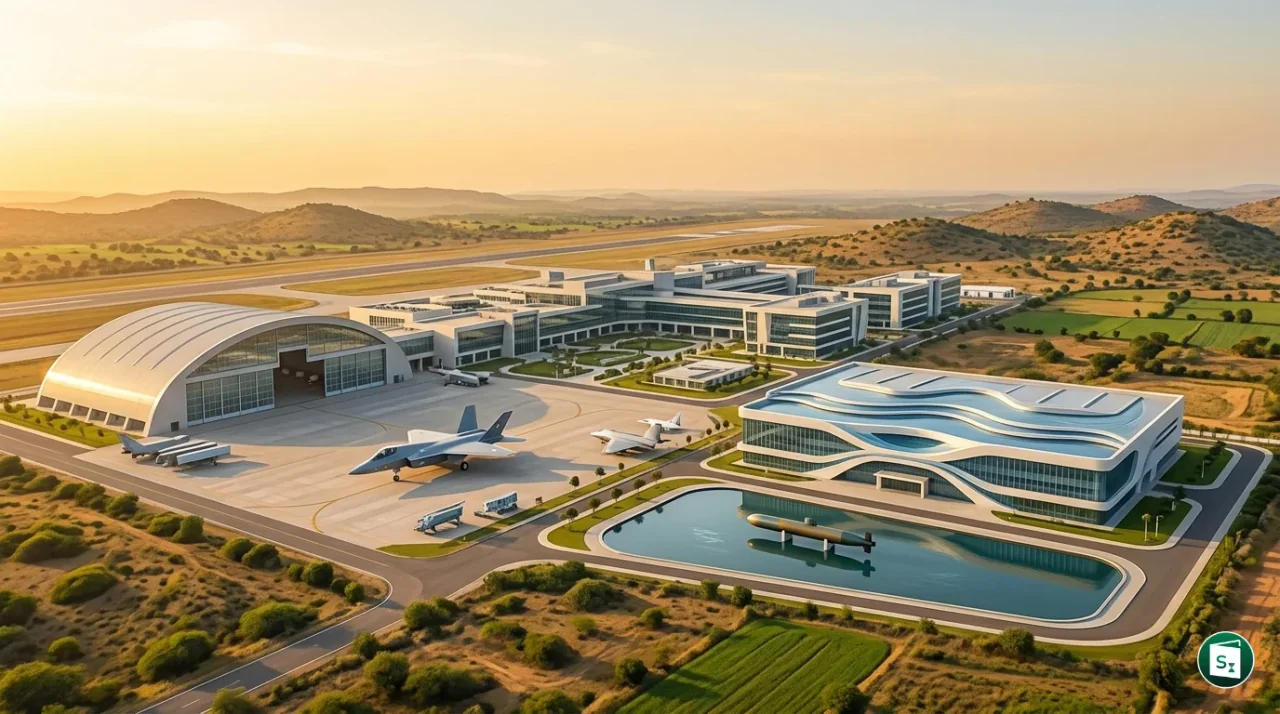
Union Defence Minister Rajnath Singh and Andhra Pradesh Chief Minister N. Chandrababu Naidu laid the foundation stone for the Advanced Medium Combat Aircraft (AMCA) development infrastructure in the Sri Sathya Sai district of Andhra Pradesh on May 16, 2026. The ceremony marked the launch of a new Core Integration and Flight Testing Centre at Puttaparthi alongside a specialized Naval Systems Manufacturing Facility to support underwater combat readiness. This dual development represents a major step in expanding India’s domestic aerospace and maritime defense manufacturing corridors.
Setting Up the Infrastructure for India’s Stealth Fighter: The Puttaparthi Integration Centre
The newly launched infrastructure project in the Sri Sathya Sai district is a foundational element in India’s quest for self-reliance in cutting-edge military aviation. Union Defence Minister Rajnath Singh and Chief Minister N. Chandrababu Naidu inaugurated the Core Integration and Flight Testing Centre at Puttaparthi as a centralized hub to coordinate all design, assembly, and test operations. Set up at an estimated infrastructure cost of ₹2,000 crore, this advanced testing complex is designed to accelerate the developmental timeline of India’s fifth-generation fighter aircraft and various future indigenous aerospace platforms.
Puttaparthi was selected due to its unique geographic and atmospheric suitability for aerospace testing. The region features stable weather conditions, minimal commercial air traffic congestion, and flat terrain, which are ideal for high-precision flight testing operations. The complex will house state-of-the-art telemetry systems, computational labs, and mock-up integration bays where engineers can test the complex systems of the stealth aircraft before actual flight trials begin.
The Aeronautical Development Agency (ADA) will lead the integration efforts at the Puttaparthi facility. ADA operates as an autonomous body under the Department of Defence Research and Development of the Ministry of Defence. Established in 1984 and headquartered in Bengaluru, Karnataka, ADA is the nodal agency for designing India’s light combat aircraft. The agency will work in close coordination with the Defence Research and Development Organisation (DRDO), which was founded in 1958 and is headquartered in New Delhi, to implement advanced testing procedures.
Understanding the Advanced Medium Combat Aircraft (AMCA) Programme
The Advanced Medium Combat Aircraft (AMCA) is India’s premier military aviation programme. It is designed to develop a fifth-generation, twin-engine, multirole stealth fighter jet. Led by the Aeronautical Development Agency (ADA), this 25-tonne class aircraft represents a huge technological leap, aiming to position India among a select group of nations capable of indigenously manufacturing advanced stealth platforms.
The AMCA is engineered to perform a wide array of combat missions, including air superiority, deep ground strikes, suppression of enemy air defences, and electronic warfare. By serving as a modern replacement for older fighter fleets, the AMCA will become the main strike platform of the Indian Air Force.
Key Technical Features of India’s Fifth-Generation Jet
A fifth-generation fighter jet is defined by its ability to operate in high-threat environments where traditional aircraft would be detected and destroyed. The AMCA incorporates several advanced technologies to achieve this capability:
- Stealth and Radar Evasion: The aircraft features a special geometric design optimized for a low radar cross-section. This is complemented by the use of advanced radar-absorbent materials and a diverterless supersonic inlet that conceals the engine fan blades from radar waves. It also uses an internal weapons bay to carry payloads, ensuring that missiles and bombs do not reflect radar signals.
- Twin-Engine Configuration: The AMCA will be developed in two distinct versions. The AMCA Mk1 will be powered by twin GE-F414 engines, which belong to the 90 kilonewton class. The subsequent AMCA Mk2 is planned to feature a more powerful, indigenously co-developed 110 kilonewton engine to support enhanced flight capabilities.
- Advanced Avionics and Sensor Fusion: The aircraft will be equipped with an indigenous Active Electronically Scanned Array (AESA) radar, providing long-range detection and tracking. A multi-sensor data fusion system will merge data from the radar, infrared sensors, and electronic warfare suites into a single, comprehensive tactical picture.
- Supercruise Capability: The AMCA is designed with supercruise capability, which allows it to sustain supersonic flight without using fuel-heavy afterburners, significantly extending its combat range and speed during missions.
Development Phases and the Role of Private Industry
The development of the AMCA is structured to minimize delay and build a strong domestic manufacturing base. The entire development programme is projected to require a total expenditure of approximately ₹15,000 crore. Rather than relying solely on public sector units, the government is adopting a Special Purpose Vehicle (SPV) model that partners public agencies with private defence manufacturers to share design, manufacturing, and financial responsibilities.
Under this joint development model, private consortia will lead the prototype manufacturing and assembly processes. The program targets the rollout of the first prototype by 2027-2028, followed by the initial flight test in the 2028-2029 period. Once testing is complete, full-scale production and induction into active military service are projected to begin around 2034-2035, marking a critical transition toward a fully self-reliant defence sector.
Securing the Seas: BDL’s Naval Systems Manufacturing Facility in Anakapalli
Alongside the aerospace developments, India is strengthening its maritime security through the establishment of a Naval Systems Manufacturing Facility. Union Defence Minister Rajnath Singh laid the foundation stone for this state-of-the-art facility at T. Sirasapalli village in the Anakapalli district of Andhra Pradesh. The facility is being established by Bharat Dynamics Limited (BDL), a premier defence Public Sector Undertaking under the administrative control of the Ministry of Defence. BDL was established on July 16, 1970, and is headquartered in Hyderabad, Telangana.
This new naval manufacturing hub is spread across approximately 160 acres of land and represents an estimated capital investment of ₹480 crore to ₹500 crore. The project is slated for completion in four years and is designed to serve as a primary manufacturing hub for advanced underwater weapons and naval combat systems. By building these complex weapon systems locally, the facility will significantly reduce the Indian Navy’s reliance on foreign imports.
Operational Capabilities of the Anakapalli Facility
The Anakapalli complex will be equipped with modern infrastructure to handle the manufacturing, assembly, and testing of highly sensitive underwater defense equipment. Its capabilities include:
- Product Portfolio: The facility will specialize in manufacturing autonomous underwater vehicles, underwater countermeasure systems, marine mines, and next-generation torpedoes. These products will enhance the submarine and anti-submarine warfare capabilities of the Indian Navy.
- Testing Infrastructure: To ensure the reliability of underwater weapons, the facility will house specialized integration buildings, explosive handling and storage zones, and advanced testing setups including acoustic tanks. These tanks are crucial for testing the sonar guidance systems of torpedoes in simulated marine conditions.
- Economic and Local Impact: The project is expected to create around 3,000 direct and indirect jobs in the region, drawing high-skilled engineering talent. Furthermore, it will act as a major industrial driver by partnering with local Micro, Small, and Medium Enterprises (MSMEs) for component supply, building a robust defense manufacturing cluster in the Anakapalli-Visakhapatnam industrial belt.
Financial Matrix and Strategic Significance of Andhra Pradesh’s Defence Corridor
The simultaneous launch of the AMCA aerospace project in Puttaparthi and BDL’s naval facility in Anakapalli highlights a highly strategic plan to establish a multi-domain defense manufacturing corridor in Andhra Pradesh. To illustrate the scale and scope of these dual investments, the table below compares the key parameters of the two facilities:
Comparative Analysis of the New Defence Facilities
| Parameter | AMCA Development Facility | Naval Systems Manufacturing Facility |
|---|---|---|
| Location | Puttaparthi, Sri Sathya Sai District | T. Sirasapalli, Anakapalli District |
| Implementing Agency | Aeronautical Development Agency (ADA) / DRDO | Bharat Dynamics Limited (BDL) |
| Estimated Facility Cost | ₹2,000 crore | ₹480 crore to ₹500 crore |
| Primary Technical Focus | Flight testing and core integration for 5th-generation stealth fighters | Advanced underwater weapons and naval combat systems |
| Land Allocation | Approximately 650 acres | Approximately 160 acres |
| Employment Potential | Around 7,500 high-skilled jobs (direct/indirect) | Around 3,000 jobs (direct/indirect) |
The financial commitment behind these projects is substantial. While the infrastructure cost for the AMCA facility at Puttaparthi is estimated at ₹2,000 crore, the overall development programme for India’s indigenous fifth-generation stealth fighter jet is projected to require approximately ₹15,000 crore. This massive funding allocation highlights the strategic priority given to establishing long-term technological sovereignty.
From a geopolitical standpoint, the positioning of these facilities in Andhra Pradesh is highly strategic. The state’s extensive coastline along the Bay of Bengal, coupled with major deep-water ports, makes it an ideal center for maritime and naval logistics. The close proximity of the Anakapalli facility to Visakhapatnam, the headquarters of the Eastern Naval Command of the Indian Navy, ensures seamless coordination for operational testing and deployment. Meanwhile, the dry inland topography of Puttaparthi offers stable meteorological conditions for aviation testing, creating a resilient, geographically diversified defense industrial zone.
Key Takeaways
- Union Defence Minister Rajnath Singh and Andhra Pradesh Chief Minister N. Chandrababu Naidu laid the foundation stone for the Advanced Medium Combat Aircraft (AMCA) development infrastructure on May 16, 2026.
- The core integration and flight testing complex for India’s fifth-generation fighter jet is being established at Puttaparthi in the Sri Sathya Sai district of Andhra Pradesh at an estimated cost of ₹2,000 crore.
- The total expenditure for India’s indigenous Advanced Medium Combat Aircraft (AMCA) development programme is projected to be approximately ₹15,000 crore.
- The Aeronautical Development Agency (ADA), which was established in 1984 and is headquartered in Bengaluru, Karnataka, is the nodal agency designing the AMCA stealth jet.
- A new Naval Systems Manufacturing Facility is being established by Bharat Dynamics Limited (BDL) across 160 acres in the Anakapalli district to produce advanced underwater weapons and naval combat systems.