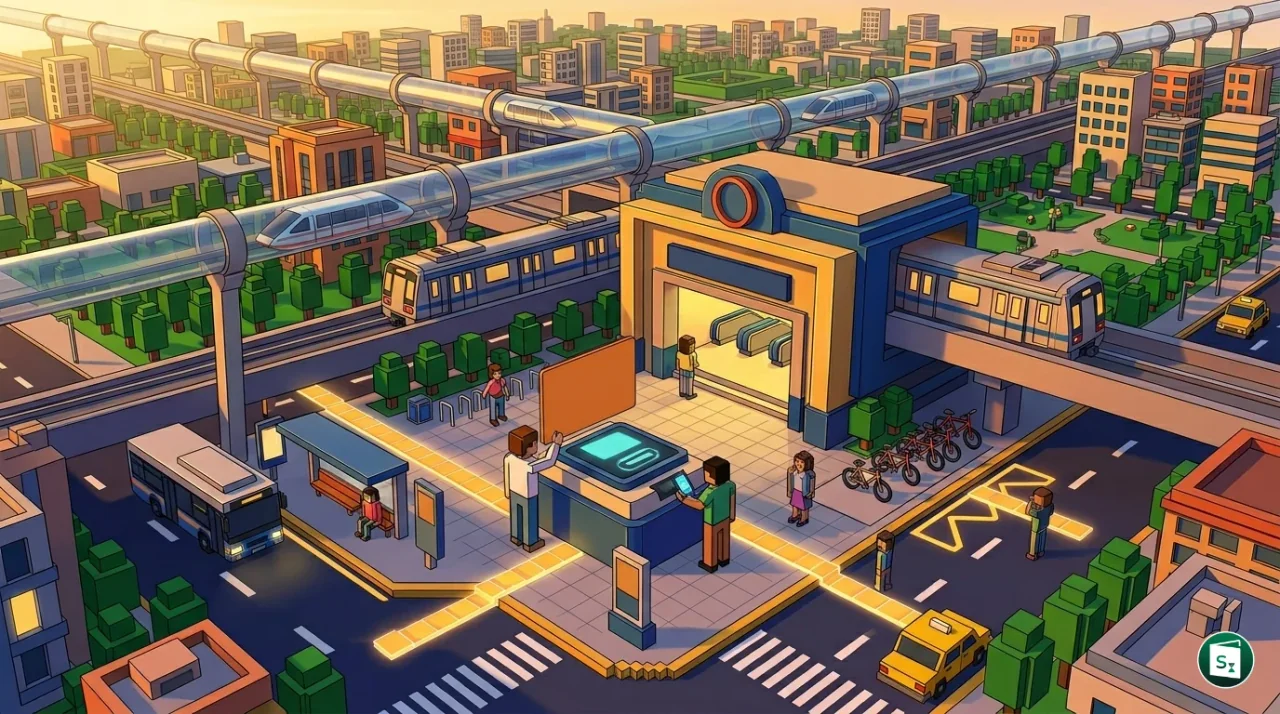
The Delhi Metro Rail Corporation (DMRC) has partnered with Airtel Payments Bank to launch co-branded RuPay ‘On-The-Go’ National Common Mobility Cards (NCMC) to enable seamless, interoperable transit transactions across India. This new open-loop payment instrument allows commuters to travel on various metro systems, buses, and other transit modes nationwide with a single tap-and-go card. By integrating public transportation payments with digital banking, the collaboration supports the central government’s vision of unified national mobility.
Co-Branded RuPay On-The-Go National Common Mobility Cards
On May 10, 2026, the Delhi Metro Rail Corporation (DMRC) and Airtel Payments Bank officially announced their partnership at the DMRC headquarters in New Delhi. The collaboration was unveiled by DMRC Managing Director Dr. Vikas Kumar and Airtel Payments Bank Managing Director and Chief Executive Officer Anubrata Biswas. Under this partnership, the two entities are launching co-branded transit cards that operate on the RuPay card network. These cards are designed to facilitate cashless and contactless travel across various public transport systems throughout India.
The co-branded cards are available to consumers in two distinct formats to suit different payment preferences. The first is a traditional Debit Card linked directly to the user’s bank account, and the second is a specialized Prepaid Payment Instrument for Mass Transit Systems (PPI-MTS) card. Both formats utilize the RuPay On-The-Go technology developed by the National Payments Corporation of India (NPCI). The cards feature a dual-interface design that supports both contact and contactless transactions. They are fully compliant with the global EMV standard, which stands for Europay, Mastercard, and Visa, ensuring high security for electronic payments.
The contactless tap-and-pay feature is enabled by near-field communication technology, allowing users to complete transactions instantly at transit gates. The cards also support offline transactions, which enables the processing of fare payments even without active internet connectivity at the gates. This capability is critical for mass transit systems, where gates must process transactions in less than 300 milliseconds to maintain a smooth flow of passengers during peak hours.
The Evolution of the National Common Mobility Card Initiative
The National Common Mobility Card (NCMC) is an interoperable smart card standard conceived by the Ministry of Housing and Urban Affairs (MoHUA). Launched on March 4, 2019, by Prime Minister Narendra Modi, the initiative addresses the fragmentation of public transit ticketing across India. Before the introduction of this standard, commuters were required to purchase separate tokens or operator-specific cards for different transit systems, such as individual metro networks or state bus services. The NCMC initiative consolidates these requirements under a single system, operating on the theme of One Nation, One Card.
Operating on the indigenous RuPay payment network, which is managed by the National Payments Corporation of India (NPCI), the card is designed as an open-loop system. Unlike closed-loop cards that are restricted to a single transit network, open-loop cards are accepted nationwide across all compatible networks. The technology allows users to pay for metro rides, bus fares, toll charges, parking fees, and even retail shopping using a single card. Over 25 banks in India have been authorized to issue these dual-interface cards, and the inclusion of Airtel Payments Bank expands this network to millions of digital-first consumers.
Infrastructure and Operational Benefits of the Collaboration
The partnership between DMRC and Airtel Payments Bank introduces major operational efficiencies for transit operators and commuters. One of the primary benefits is the integration of digital recharges. Commuters can recharge their co-branded cards online through either the official DMRC mobile application or the Airtel mobile application. By enabling remote digital top-ups, the system reduces the necessity of waiting in queues at physical ticket counters or Automatic Vending Machines (AVMs). This shift decreases crowding at stations, particularly during peak commuting hours, and lowers the operational costs associated with manual cash handling.
To ensure a smooth transition, the DMRC has confirmed that all existing closed-loop Delhi Metro smart cards will continue to function as usual. Commuters are not forced to replace their current cards immediately. Instead, the co-branded NCMC cards serve as an optional upgrade for travelers who seek interoperability across different cities. A single card purchased at a Delhi Metro station can be used to pay fares on the Mumbai Metro, Bengaluru Metro, state transport buses, and national highway toll plazas. This interoperability eliminates the need to purchase multiple local transit passes when traveling between different states.
Institutional Profiles: DMRC and Airtel Payments Bank
The implementation of co-branded transit cards involves two distinct entities operating within India’s infrastructure and financial services sectors. The Delhi Metro Rail Corporation (DMRC) is a joint venture with equal equity participation from the Government of India and the Government of the National Capital Territory of Delhi (GNCTD). Incorporated in May 1995, the DMRC operates one of the largest rapid transit systems in the world. The network spans approximately 416 kilometers and is currently undergoing further expansion under Phase IV. The organization is headquartered at Metro Bhawan in New Delhi.
On the other hand, Airtel Payments Bank is a pioneer in the differentiated banking sector in India. It was the first company to receive a payments bank license from the Reserve Bank of India (RBI) in April 2016 under Section 22 (1) of the Banking Regulation Act, 1949. The bank commenced operations in November 2016 and was granted scheduled bank status by the RBI in January 2022. As a payments bank, it is structured to promote financial inclusion by offering savings accounts and remittance services, although it is restricted from issuing credit cards or loans. The maximum deposit limit for payments banks is ₹2 lakh per customer.
The table below outlines the institutional attributes of both organizations:
| Attribute | Delhi Metro Rail Corporation (DMRC) | Airtel Payments Bank |
|---|---|---|
| Establishment Year | 1995 | 2016 |
| Headquarters | New Delhi | New Delhi |
| Key Leadership | Vikas Kumar (Managing Director) | Anubrata Biswas (MD and CEO) |
| Primary Regulator/Nodal Body | Ministry of Housing and Urban Affairs | Reserve Bank of India |
| Legal/Operating Structure | Joint venture (Government of India and GNCTD) | Scheduled Payments Bank |
Key Takeaways
- The Delhi Metro Rail Corporation (DMRC) and Airtel Payments Bank partnered on May 10, 2026 to launch co-branded RuPay On-The-Go National Common Mobility Cards (NCMC).
- The co-branded cards are available in two formats as Debit Cards and Prepaid Payment Instrument for Mass Transit Systems (PPI-MTS) cards.
- The National Common Mobility Card (NCMC), operating under the theme of One Nation, One Card, was launched on March 4, 2019 by the Ministry of Housing and Urban Affairs.
- The National Payments Corporation of India (NPCI), incorporated in 2008 with headquarters in Mumbai, developed the contactless RuPay On-The-Go card technology.
- Airtel Payments Bank was the first entity in India to receive a payments bank license from the Reserve Bank of India in April 2016 under the Banking Regulation Act, 1949.
- The Delhi Metro Rail Corporation (DMRC), incorporated in May 1995 as a joint venture between the Government of India and the GNCTD, is headquartered in New Delhi.