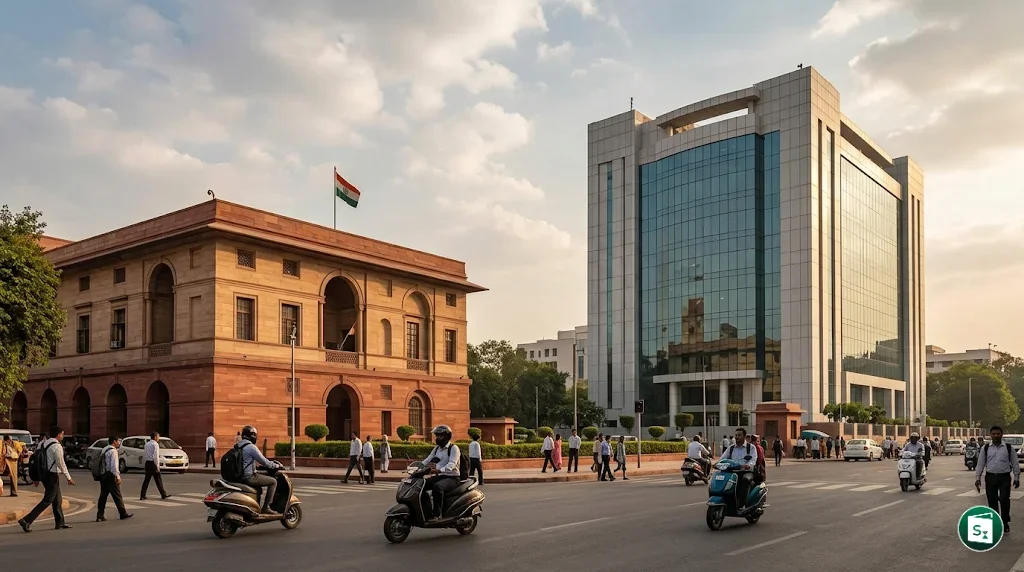
The Department of Telecommunications and the Securities and Exchange Board of India signed a Memorandum of Understanding on April 15, 2026, to strengthen coordination against financial frauds. This strategic partnership focuses on curbing the misuse of telecom resources, such as mobile numbers and messaging services, in securities market scams and investment-related crimes. By integrating telecom intelligence with market surveillance, the two regulators aim to transition from reactive enforcement to a proactive prevention model.
A Strategic Alliance for Secure Financial Markets
The partnership between the Department of Telecommunications and the Securities and Exchange Board of India represents a significant step in securing India’s digital investment landscape. The Memorandum of Understanding establishes a structured framework for the regular and real-time exchange of intelligence between the two regulatory bodies. This collaboration is designed to identify and disrupt the flow of fraudulent communications before they reach potential investors, thereby safeguarding the integrity of the capital markets.
The initiative comes at a time when digital financial crimes have evolved in complexity, often involving the use of untraceable mobile numbers and sophisticated impersonation techniques. By pooling resources, the two agencies can now track the digital footprint of suspected fraudsters across telecom networks and financial accounts simultaneously. This unified approach is expected to reduce the response time for blocking fraudulent resources and investigating financial irregularities.
Leveraging the Digital Intelligence Platform
At the heart of this cooperation is the Digital Intelligence Platform (DIP), a secure portal developed by the telecom department. The platform serves as a common interface for over 1,400 stakeholders, including law enforcement agencies, banks, and other financial regulators. Through the DIP, SEBI and other regulated entities can share and receive actionable data about suspicious telecom activities in real time.
The platform facilitates a seamless flow of information, allowing for the swift identification of “money mule” accounts and the associated mobile connections used in cyber fraud. When a fraud incident is reported, the DIP enables various agencies to take coordinated action, such as freezing bank accounts and deactivating the linked SIM cards. This ecosystem-wide integration ensures that once a threat is identified by one regulator, it can be neutralized across the entire financial and telecom spectrum.
Proactive Fraud Detection: FRI and Chakshu
A key component of this partnership is the sharing of the Financial Fraud Risk Indicator (FRI) by the telecom department. The FRI acts as an early warning system that flags mobile numbers exhibiting suspicious behavior patterns before they can be utilized for large-scale financial scams. This tool uses inputs from the Chakshu facility, which is a dedicated platform under the Sanchar Saathi initiative where citizens can report suspected fraudulent communications received via calls, SMS, or messaging apps.
By utilizing multi-dimensional analysis, the FRI helps SEBI identify potential threats in their early stages. The data from Chakshu is combined with information from financial institutions and law enforcement to create a comprehensive risk profile of telecom resources. This proactive detection mechanism allows the regulators to take action against fraudulent mobile connections before they are used to deceive investors in the securities market.
Securing Investor Accounts via the Revocation List
To further protect the interests of investors, the telecom department will automatically share the Mobile Number Revocation List (MNRL) with SEBI. The MNRL contains details of mobile connections that have been disconnected or revoked for various reasons, including non-compliance with verification norms or involvement in suspicious activities. This data is crucial for SEBI-regulated entities, such as stockbrokers and asset management companies, to ensure the security of investor accounts.
By cross-referencing the MNRL, financial institutions can verify that an investor’s account is linked only to a valid and active mobile connection. If a mobile number associated with a trading account appears on the revocation list, the brokerage or bank can prompt the investor to update their credentials or place a temporary hold on the account to prevent unauthorized access. This automation significantly reduces the risk of account takeover frauds and ensures that sensitive financial information remains accessible only to legitimate users.
Institutional Roles: SEBI and DoT
The Securities and Exchange Board of India (SEBI) is the nodal regulator for the Indian securities market. It was established as a non-statutory body on April 12, 1988, and later gained statutory status through the SEBI Act, 1992. Headquartered in Mumbai, it functions under the administrative control of the Ministry of Finance. SEBI is mandated to protect the interests of investors in securities and to promote the development and regulation of the securities market.
The Department of Telecommunications (DoT), which operates under the Ministry of Communications, is responsible for the policy, licensing, and coordination of matters related to telegraphs, telephones, and wireless communications. Through initiatives like the Sanchar Saathi portal, launched to empower mobile subscribers, the department has been at the forefront of tackling fraudulent activities in the telecom space. The integration of its expertise with SEBI’s market surveillance represents a whole-of-government approach to financial security.
The Way Forward: Curbing Digital Investment Scams
The strategic partnership between SEBI and the telecom department is expected to set a new benchmark for inter-regulatory cooperation in India. By establishing a reciprocal data-sharing mechanism, SEBI will also provide inputs to the DoT regarding telecom resources associated with fraudulent investment schemes and impersonation attempts. This feedback loop will allow the telecom department to take swift action, such as disconnecting fraudulent connections and investigating the underlying SIM procurement processes.
As India continues its rapid digital transformation, the vulnerability of investors to sophisticated online scams has increased. This collaboration aims to create a more resilient financial ecosystem by leveraging cutting-edge technology and real-time intelligence. The shift towards proactive prevention will not only enhance investor confidence but also serve as a deterrent to cybercriminals attempting to exploit telecom resources for financial gain.
Key Takeaways
- The Department of Telecommunications signed an MoU with SEBI on April 15, 2026, to combat the misuse of telecom resources in securities fraud.
- The collaboration utilizes the Digital Intelligence Platform (DIP) to enable real-time intelligence sharing among more than 1,400 stakeholders.
- The Financial Fraud Risk Indicator (FRI) serves as an early warning tool to identify suspicious mobile numbers using data from the Chakshu facility.
- The Mobile Number Revocation List (MNRL) will be shared with brokers and asset management companies to secure investor accounts.
- SEBI was established in 1988 and became a statutory body in 1992, with its headquarters located in Mumbai.
- The Sanchar Saathi initiative, which powers the fraud reporting mechanism, operates under the Ministry of Communications.