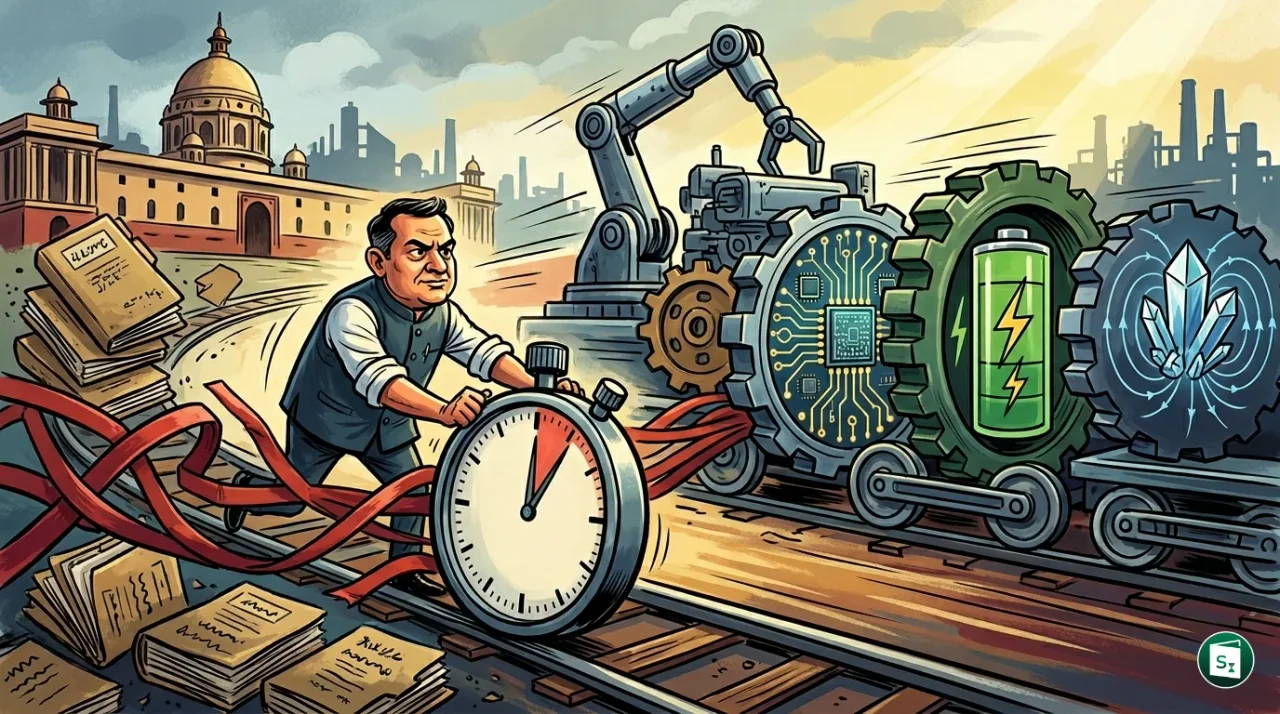
The Department for Promotion of Industry and Internal Trade introduced an updated Standard Operating Procedure on May 14, 2026, to accelerate Foreign Direct Investment (FDI) clearances from countries sharing land borders with India. The new framework identifies 40 specific sub-sectors where investment proposals will be decided within a 60-day timeline, significantly reducing the waiting period for strategic projects. This initiative aims to strengthen India’s manufacturing ecosystem and secure critical supply chains in sectors like electronics and advanced battery components.
Streamlining FDI Clearances: The New Framework
The Department for Promotion of Industry and Internal Trade (DPIIT), which functions under the Ministry of Commerce and Industry, has significantly revised the guidelines for processing foreign investment. The updated Standard Operating Procedure (SOP) mandates that all applications must now be submitted through the Foreign Investment Facilitation (FIF) Portal or the National Single Window System (NSWS). By eliminating physical filing requirements, the government aims to create a fully digital and paperless experience for global investors.
For most FDI proposals requiring government approval, the new SOP sets a standard processing timeline of 12 weeks. This structured approach ensures that applications are routed efficiently to the relevant ministries and departments for review. The DPIIT acts as the nodal body, coordinating with the Ministry of Home Affairs (MHA) for security clearances and the Ministry of External Affairs (MEA) for diplomatic considerations.
Focus on Strategic Manufacturing: The 40 Sub-Sectors
The expedited 60-day clearance window is specifically tailored for 40 sub-sectors that are vital to India’s industrial sovereignty and the Make in India initiative. These sub-sectors are broadly categorized into six primary segments that form the backbone of modern technology and energy infrastructure.
| Primary Segment | Strategic Importance |
|---|---|
| Capital Goods Manufacturing | Focuses on heavy machinery and tools necessary for diverse industrial activities. |
| Electronic Capital Goods | Covers the manufacturing of core components and equipment for the hardware industry. |
| Advanced Battery Components | Critical for developing high-capacity energy storage solutions and electric vehicles. |
| Polysilicon and Wafers | The fundamental building blocks for solar energy panels and semiconductor chips. |
| Rare Earth Processing | Involves the refinement of minerals essential for advanced electronics and green tech. |
| Rare Earth Magnets | Production of permanent magnets used in everything from smartphones to defense systems. |
By prioritizing these areas, the government intends to reduce import dependencies and encourage the domestic production of high-value industrial components.
Facilitating Investments from Bordering Nations
The new SOP specifically addresses investment proposals from countries that share a land border with India. These nations include China, Pakistan, Bangladesh, Nepal, Bhutan, Myanmar, and Afghanistan. This regulatory framework is an extension of the Press Note 3 (2020), which mandated prior government approval for all FDI originating from these neighboring countries to safeguard national interests.
Despite the expedited 60-day timeline, the government remains vigilant regarding the structure of these investments. It is mandatory that the majority ownership and effective control of the Indian entity receiving the investment must remain with resident Indian citizens or Indian-owned and controlled companies. This ensures that while capital and technology flows are fast-tracked, the strategic oversight of the industrial base remains within domestic hands.
Strategic Significance for India’s Industrial Growth
The introduction of an expedited clearance mechanism for these 40 sub-sectors is a strategic move to bolster India’s position in the global supply chain. Sectors like polysilicon, wafers, and rare earth processing are currently dominated by a few global players, and building domestic capacity is essential for India’s energy security and technological advancement. By providing a clear and faster approval route, the government hopes to attract leading global manufacturers to set up their production bases in India.
This policy update also aligns with the broader goal of Atmanirbhar Bharat (Self-Reliant India). By focusing on capital goods and electronic components, India aims to move up the value chain from being a mere consumer to a significant producer of high-tech industrial assets. The 60-day timeline provides much-needed predictability for investors, which is a key factor in long-term capital-intensive projects like battery manufacturing and semiconductor supply chains.
Key Takeaways
- The Department for Promotion of Industry and Internal Trade (DPIIT) issued an updated Standard Operating Procedure (SOP) on May 14, 2026.
- The new framework identifies 40 sub-sectors across six primary segments for expedited Foreign Direct Investment (FDI) clearance.
- FDI proposals from countries sharing land borders with India in these sectors will now be decided within a 60-day timeline.
- The expedited process covers strategic areas such as polysilicon, advanced battery components, and rare earth processing.
- The general processing timeline for other FDI proposals requiring government approval is set at 12 weeks under the new guidelines.
- All FDI applications must be filed digitally through the Foreign Investment Facilitation (FIF) Portal or the National Single Window System (NSWS).