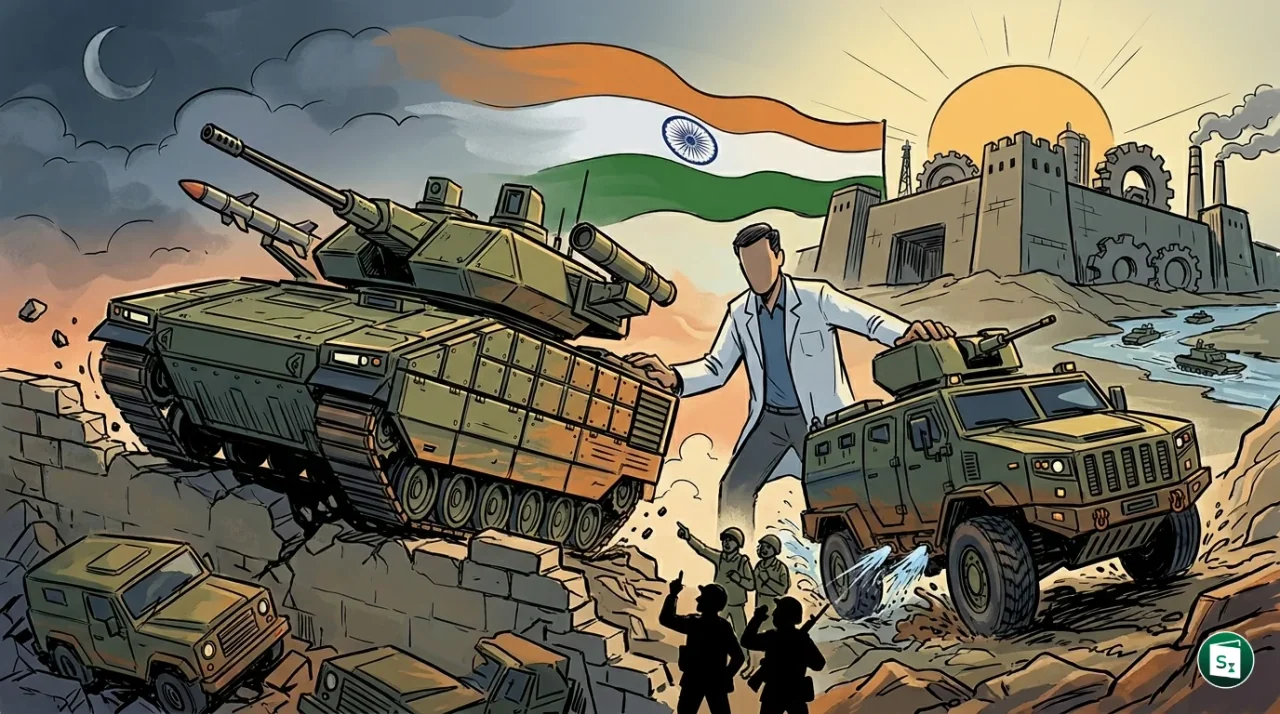
The Defence Research and Development Organisation (DRDO) officially unveiled the tracked and wheeled variants of the Vikram VT-21 next-generation Advanced Armoured Platforms on May 02, 2026. These state-of-the-art combat vehicles, showcased at the Vehicles Research & Development Establishment (VRDE) in Ahilyanagar, Maharashtra, are designed to modernize the Indian Army’s mechanized infantry operations. The unveiling marks a significant milestone in India’s quest for self-reliance in high-end defence manufacturing through strategic private sector partnerships.
What are the Vikram VT-21 Armoured Platforms?
The Vikram VT-21 represents a family of modular Advanced Armoured Platforms (AAP) developed specifically to replace the ageing fleet of Soviet-origin BMP-2 Sarath infantry combat vehicles. The project features two distinct versions: a tracked variant for high-mobility in desert and mountainous terrains, and a wheeled 8x8 variant for rapid deployment and road mobility.
Developed by the Vehicles Research & Development Establishment (VRDE), a premier laboratory of the DRDO established in 1965 and headquartered in Ahilyanagar, the platforms are a result of intense collaboration with private industry. The production is being spearheaded by Tata Advanced Systems Ltd (TASL) and Bharat Forge Ltd (BFL) under the Development cum Production Partner (DcPP) model. This model ensures that the private sector is involved right from the design phase, accelerating the transition from prototype to mass production.
Key Technical Specifications and Capabilities
The Vikram VT-21 platforms are engineered for high survivability and lethal firepower. They are equipped with an indigenously developed 30 mm crewless turret, which allows the crew to operate the main gun from the safety of the hull. This turret is integrated with a 7.62 mm PKT coaxial machine gun and a launcher for Anti-Tank Guided Missiles (ATGM), providing the vehicle with the capability to engage both infantry and heavy armoured targets.
For protection, the platforms adhere to international STANAG 4569 standards. They offer Level 4 and Level 5 protection, which ensures safety against heavy machine gun fire, artillery fragments, and mine blasts. A standout feature is the vehicle’s amphibious capability. Using powerful hydro-jets for water traversal, the Vikram VT-21 can cross rivers and water obstacles without external assistance, a critical requirement for mechanized operations in diverse Indian geographies.
Strategic Importance and Indigenization Goals
The unveiling of the Vikram VT-21 is a critical step in the Indian Army’s broader plan to modernize its mechanized forces. The existing BMP-2 Sarath fleet has been the mainstay of the infantry for decades but requires a more modern successor that can handle modern battlefield threats like anti-tank drones and advanced missiles. The Vikram platforms are designed with an open architecture that allows for future upgrades, including the integration of active protection systems and advanced communication suites.
In line with the Atmanirbhar Bharat initiative, the project emphasizes domestic manufacturing. While the current indigenous content stands at 65%, the DRDO and its partners have set an ambitious target to reach 90% during the full-scale production phase. This high level of indigenization not only reduces reliance on foreign original equipment manufacturers (OEMs) but also creates a robust defence ecosystem involving hundreds of Indian micro, small, and medium enterprises (MSMEs).
Key Takeaways
- The Vikram VT-21 is a next-generation Advanced Armoured Platform developed by the DRDO to modernize the Indian Army’s mechanized infantry.
- The platforms come in two variants: tracked for rough terrain and wheeled (8x8) for high-speed mobility.
- The vehicles were developed by the Vehicles Research & Development Establishment (VRDE), which is headquartered in Ahilyanagar, Maharashtra.
- Key armament includes an indigenous 30 mm crewless turret, a 7.62 mm PKT gun, and Anti-Tank Guided Missile (ATGM) support.
- The platforms offer high protection levels according to STANAG 4569 (Level 4 and 5) and possess amphibious capabilities using hydro-jets.
- The project currently has 65% indigenous content, with a target of 90% for production versions.
- Private sector partners Tata Advanced Systems Ltd (TASL) and Bharat Forge Ltd (BFL) are the primary production partners.