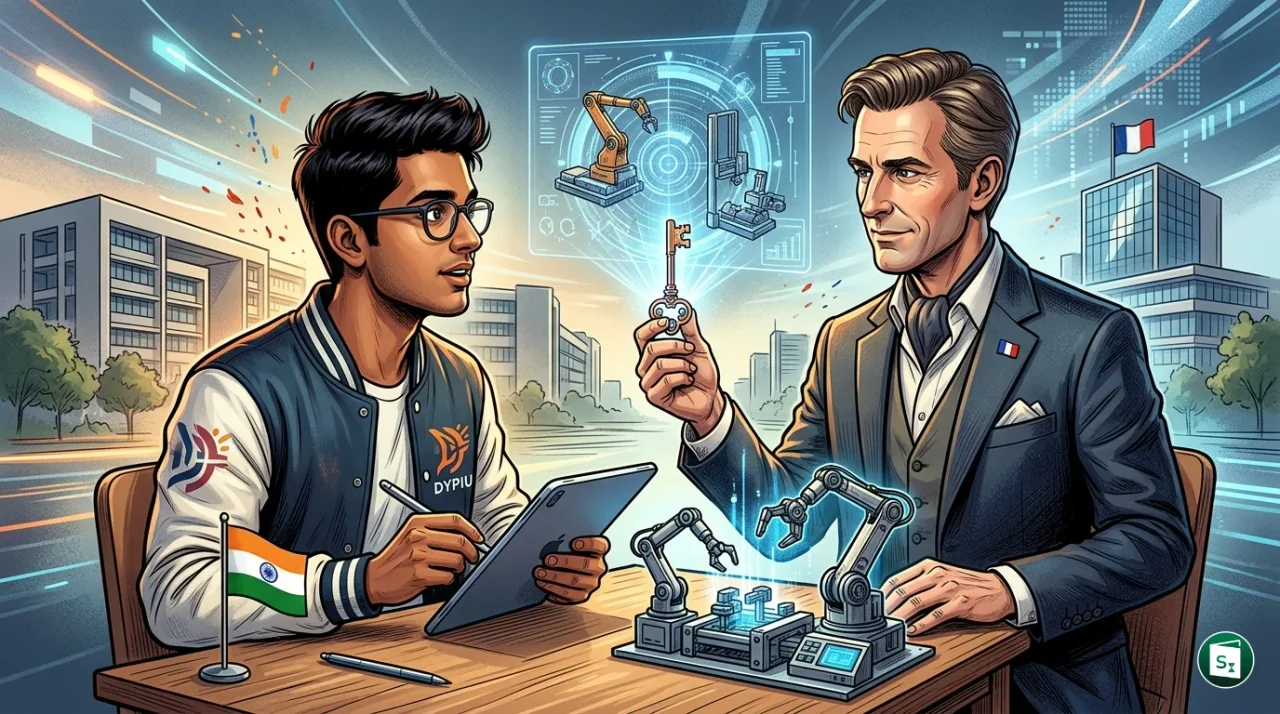
DY Patil International University in Pune, Maharashtra, has entered into a strategic collaboration with French software major Dassault Systèmes to set up a Digital Engineering and Digital Manufacturing Experience Centre on its Akurdi campus. The partnership, announced on May 19, 2026, aims to equip students with hands-on expertise in Industry 4.0 technologies and smart manufacturing solutions. By integrating industry-grade design and simulation tools directly into the academic curriculum, the centre will bridge the gap between classroom learning and modern industrial practices.
The DYPIU-Dassault Systèmes Collaboration
The partnership between D.Y. Patil International University (DYPIU) and Dassault Systèmes establishes a specialized hub for engineering and manufacturing education in Maharashtra. Established in 2018 under the Maharashtra Private Universities (Establishment and Regulation) Act, 2017, DYPIU is located in Akurdi, Pune, and operates under the leadership of Vice Chancellor Prof. (Dr.) Manish Bhalla. The collaboration represents a major initiative to bring advanced tools from the industrial sector directly into the academic domain, allowing students to train on software platforms used by global engineering firms.
Dassault Systèmes, headquartered in Vélizy-Villacoublay, France, was founded in 1981 and is a global leader in product lifecycle management (PLM) software. The French multinational, currently led by Chief Executive Officer Pascal Daloz, is widely known for its 3DEXPERIENCE platform, which integrates design, simulation, and collaboration tools. Through the memorandum of understanding signed by Dassault Systèmes India Managing Director Deepak NG, the university will leverage this platform to provide students with training in advanced design and production workflows.
Inside the Experience Centre: Specialized Labs
The experience centre features three distinct laboratories designed to mirror modern industrial research and development units. These spaces allow students to transition from theoretical concepts to practical, project-based learning.
NextGen Product Innovation Lab
The NextGen Product Innovation Lab concentrates on advanced conceptual design and collaborative engineering. Students in this facility utilize tools for generative design, a methodology where software algorithms generate multiple design options based on input parameters such as weight, strength, and material type. This lab teaches students how to create lighter, stronger, and more sustainable products, reflecting current trends in automotive, aerospace, and consumer goods design.
Intelligent Production System Lab
The Intelligent Production System Lab focuses on the planning, optimization, and management of modern factories. It allows students to design virtual production lines, test manufacturing sequences, and analyze factory layouts for efficiency. By learning to simulate manufacturing workflows, students understand how to minimize waste, optimize resource distribution, and design production systems that meet the requirements of modern industrial standards.
Virtual Twin and Simulation Lab
The Virtual Twin and Simulation Lab is equipped with virtual reality (VR) headsets and simulation hardware. The facility revolves around the concept of a virtual twin, which is a dynamic digital model of a physical object or process that updates in real time. Using this technology, students perform multi-physics simulations to analyze how products behave under different stresses, temperatures, and operational conditions. This virtual testing minimizes the need for physical prototypes, saving time and resources.
Key Features of the Partnership
Beyond establishing physical infrastructure, the agreement outlines a long-term plan to build human capacity and curriculum relevance. The core features of the collaboration include targeted programs for both students and faculty members.
A key component of the partnership is the Training of Trainers (ToT) program, which spans a three-year period. Under this initiative, technical experts from Dassault Systèmes will train university faculty in advanced digital manufacturing workflows and the administration of the 3DEXPERIENCE platform. This training ensures that educators stay current with fast-changing industrial technologies, enabling them to design and deliver course content that matches current corporate standards.
For students, the partnership introduces structured learning pathways that include live projects, industry-recognized certification programs, and internships. These opportunities allow students to solve actual engineering problems under the guidance of industry professionals. In addition, the program facilitates regular interaction with industry experts, giving students practical insights into global manufacturing practices.
Industry 4.0 and India’s Smart Manufacturing Goals
The establishment of the experience centre aligns with India’s national strategies to modernize its manufacturing sector and boost technological self-reliance. Under national campaigns like Make in India and Digital India, the country aims to increase the share of manufacturing in its gross domestic product (GDP) and establish itself as a global production hub. Achieving these goals requires a transition to Industry 4.0, which refers to the fourth industrial revolution characterized by the integration of automation, real-time data exchange, artificial intelligence, and virtual twins into manufacturing systems.
By training students in digital manufacturing, the partnership addresses the critical skill gap in the domestic workforce. Traditional engineering programs often focus on physical production techniques, whereas modern smart factories require workers who can manage complex software systems and interpret digital simulations. Integrating these technologies into the academic curriculum helps build a talent pool capable of operating high-tech manufacturing plants.
The table below compares the distinct differences between traditional manufacturing methods and the digital processes associated with Industry 4.0:
| Parameter | Traditional Manufacturing | Smart Manufacturing (Industry 4.0) |
|---|---|---|
| Core Technology | Mechanical systems and human-operated machinery | Digital twins, automated systems, and connected networks |
| Product Testing | Physical prototyping and physical stress testing | Virtual twin simulations and multi-physics modeling |
| Data Utilization | Post-production inspection and manual logging | Real-time sensor monitoring and predictive analytics |
| Supply Chain | Linear and disconnected communication channels | Integrated, demand-driven digital networks |
| Design Method | Standard computer-aided design systems | Generative design using machine learning algorithms |
Key Takeaways
- D.Y. Patil International University (DYPIU), established in 2018 in Akurdi, Pune, signed an MoU with Dassault Systèmes on May 19, 2026, to establish an advanced experience centre on its campus.
- Dassault Systèmes is a French multinational software corporation founded in 1981 and headquartered in Vélizy-Villacoublay, France, with Pascal Daloz serving as its Chief Executive Officer.
- The newly established centre houses three specialized labs: the NextGen Product Innovation Lab, the Intelligent Production System Lab, and the Virtual Twin and Simulation Lab.
- The partnership includes a three-year Training of Trainers (ToT) program to upskill university faculty members using the 3DEXPERIENCE platform.
- The initiative aims to align engineering and manufacturing education with the requirements of Industry 4.0 and support national programs like Make in India and Digital India.