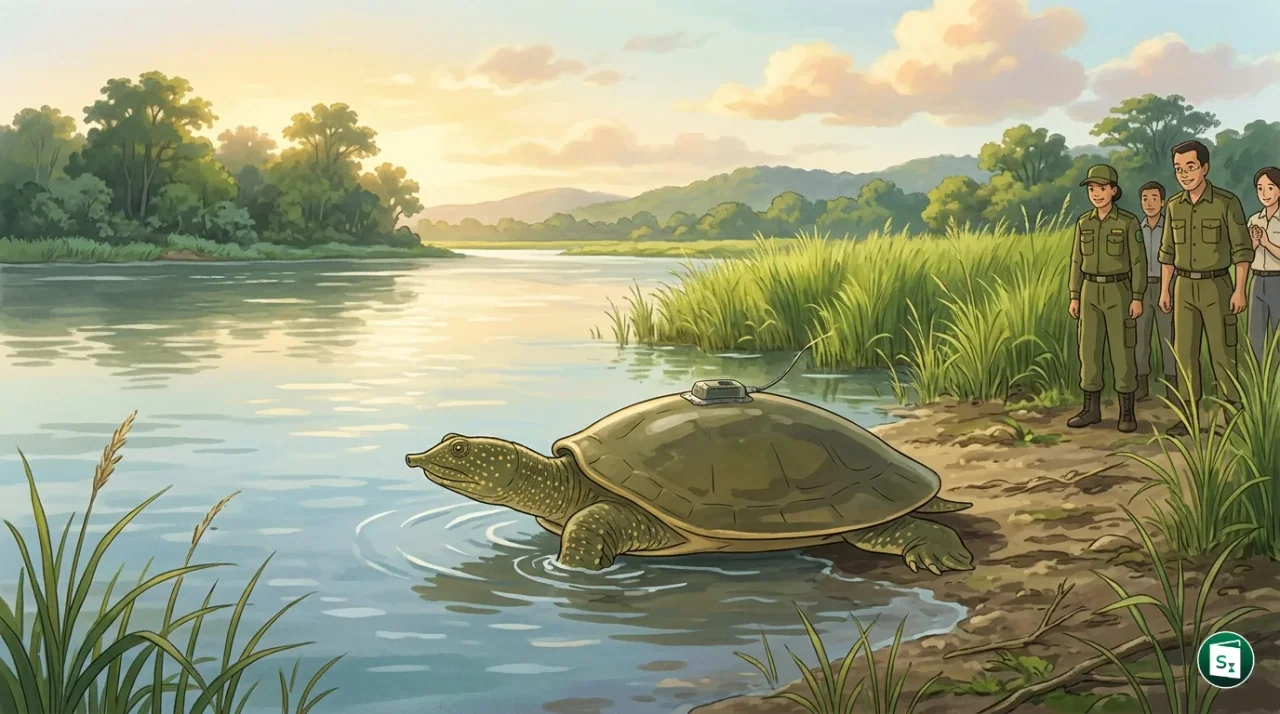
India successfully released its first satellite-tagged Ganges Softshell Turtle (Nilssonia gangetica) at the Kaziranga National Park and Tiger Reserve in Assam on April 28, 2026. Led by the Wildlife Institute of India in collaboration with the Assam Forest Department, this initiative aims to track the migration patterns and habitat use of the species in the Brahmaputra River basin. The landmark project marks a major advancement in the conservation of endangered freshwater reptiles using real-time satellite telemetry.
Overview of the Tagging Initiative
The tagging project is a pioneering effort to monitor the aquatic life of the Brahmaputra River using modern technology. An adult Ganges Softshell Turtle was fitted with a satellite transmitter under veterinary supervision before its release. The transmitter is attached to the turtle’s carapace using specialized, water-resistant epoxy. It transmits location data to orbiting satellites whenever the turtle surfaces to breathe or bask, providing researchers with real-time coordinates.
The telemetry project is designed to address a critical gap in freshwater reptile conservation. Freshwater turtles are difficult to track using traditional methods, such as visual observation or physical recapturing, because they spend most of their lives underwater. The satellite data will help researchers map the home range size, identify critical foraging grounds, study seasonal migration patterns, and pinpoint nesting sites along the sandbanks of the Brahmaputra River.
Ecological and Conservation Profile of the Ganges Softshell Turtle
The Ganges Softshell Turtle (Nilssonia gangetica), also called the Indian Softshell Turtle, is a large freshwater species characterized by a leathery carapace instead of a hard bony shell. As an apex predator and scavenger, it plays an important role in riverine ecosystems by feeding on decaying organic matter, which helps keep freshwater bodies clean and prevents disease outbreaks.
The species is widely distributed across the northern river systems of South India and the subcontinent, including the Ganga, Brahmaputra, Indus, Mahanadi, and Narmada basins. Despite its wide range, the turtle faces severe conservation threats from habitat fragmentation, commercial exploitation for its meat, and illegal trade driven by superstitions regarding its claws and shell.
Conservation Status and Threats
To safeguard the remaining populations, the turtle has been granted the highest levels of legal protection both nationally and internationally.
| Authority / Framework | Listing / Status | Conservation Implication |
|---|---|---|
| IUCN Red List | Endangered | High risk of extinction in the wild |
| Wildlife (Protection) Act, 1972 | Schedule I | Highest domestic protection; severe penalties for poaching |
| CITES | Appendix I | Ban on international commercial trade |
Illegal fishing practices, particularly the use of large-mesh gillnets, represent a major cause of accidental mortality as turtles get entangled and drown. Furthermore, riverbed sand mining destroys the sandy banks that these reptiles depend on for nesting and egg-laying.
Kaziranga as a Global Sanctuary for Freshwater Turtles
The Kaziranga National Park and Tiger Reserve in Assam is renowned globally for its population of the Indian one-horned rhinoceros, but it is also a vital biodiversity hotspot for freshwater reptiles. The Brahmaputra River, which flows along the northern boundary of the park, forms a complex network of channels, sandbars, and wetlands that serve as an ideal habitat. Kaziranga hosts 17 of the 32 freshwater turtle and tortoise species recorded in India, making it a globally recognized Turtle Priority Area.
Key Facts About Kaziranga
The park has a long history of conservation milestones:
- Establishment: Initially proposed as a reserve forest on June 1, 1905, on the recommendation of Mary Curzon, wife of Lord Curzon. It was upgraded to a reserve forest in 1908, a wildlife sanctuary in 1950, and officially declared a National Park on February 11, 1974.
- Global Recognition: It was declared a UNESCO World Heritage Site in 1985.
- Tiger Reserve: The park was declared a Tiger Reserve in 2006 and maintains one of the highest densities of tigers in the world.
Aquatic Survey Data
In January 2026, the fifth annual aquatic reptile survey was conducted across a 174-kilometre stretch of the Brahmaputra River within the park boundaries. The survey recorded 945 individual freshwater turtles representing seven distinct species, including 876 hardshell turtles and 69 softshell turtles. Notably, the sightings included the critically endangered Black Softshell Turtle (Nilssonia nigricans) and the Assam Roofed Turtle (Pangshura sylhetensis), highlighting the park’s critical role in preserving threatened freshwater biodiversity.
Institutional and Funding Collaborations
The successful release and telemetry tracking of the Ganges Softshell Turtle highlights a collaborative model between national scientific bodies, regional forest authorities, and international conservation organizations.
Wildlife Institute of India (WII)
The Wildlife Institute of India served as the executing agency for this project.
- Establishment and Status: Established in 1982, WII functions as an autonomous research institution under the administrative control of the Union Ministry of Environment, Forest and Climate Change (MoEFCC).
- Location: The institute is headquartered in Dehradun, Uttarakhand.
- Mandate: WII is a premier national agency conducting research, training, and advisory services in wildlife conservation and management. Its current director is Dr. Gobind Sagar Bhardwaj.
Implementing Partners and Funding
The project was executed on the ground in close cooperation with the Assam Forest Department and the Kaziranga park authorities, who provided logistics, security, and administrative clearances. Financing for the project was provided by the National Geographic Society, a global non-profit organization based in the United States that funds exploration and scientific research to protect the planet’s diverse ecosystems.
Key Takeaways
- The first satellite-tagged Ganges Softshell Turtle (Nilssonia gangetica) in India was released along the northern bank of the Brahmaputra River on April 28, 2026.
- The tracking project was led by the Wildlife Institute of India (WII) in collaboration with the Assam Forest Department and the Kaziranga National Park and Tiger Reserve authorities.
- The Ganges Softshell Turtle is listed as Endangered on the IUCN Red List, Schedule I under the Indian Wildlife (Protection) Act, 1972, and Appendix I of CITES.
- The Wildlife Institute of India (WII), established in 1982, is an autonomous body under the Ministry of Environment, Forest and Climate Change, with headquarters in Dehradun, Uttarakhand.
- Kaziranga National Park and Tiger Reserve was proposed as a reserve forest on June 1, 1905, designated a UNESCO World Heritage Site in 1985, and declared a Tiger Reserve in 2006.
- Funding for the turtle satellite telemetry project was provided by the National Geographic Society.