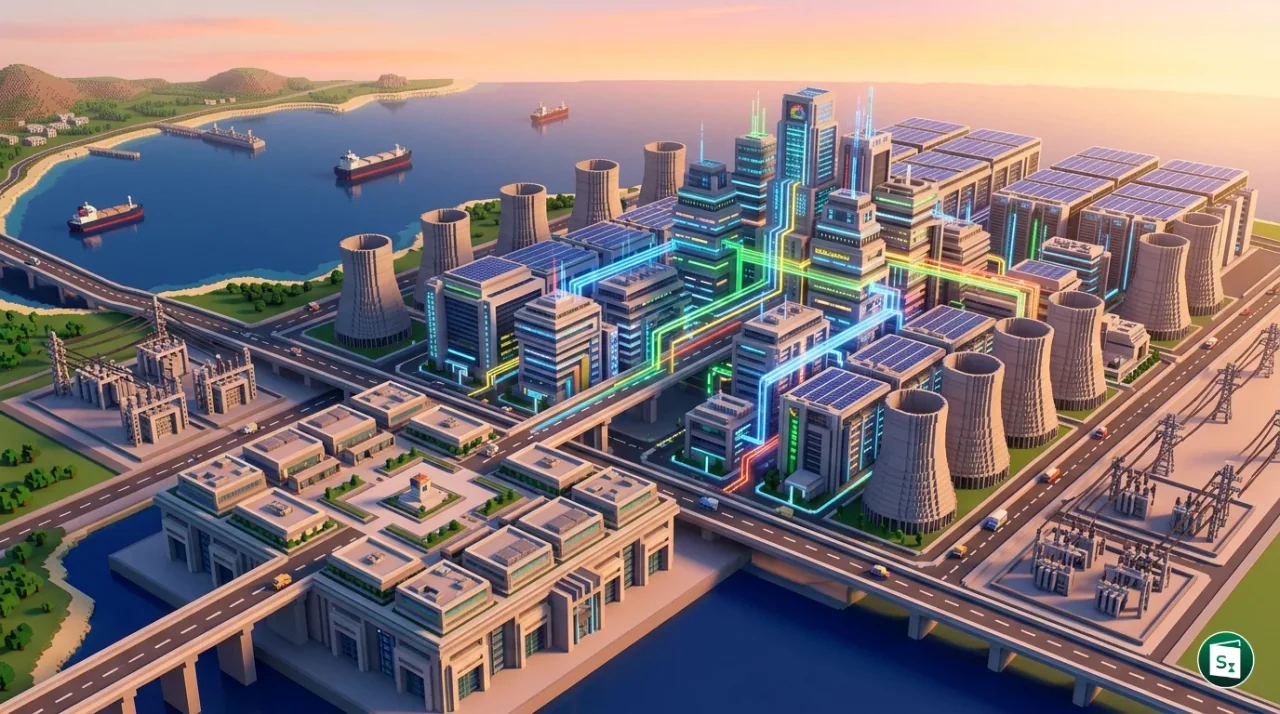
Union IT Minister Ashwini Vaishnaw and Andhra Pradesh Chief Minister N. Chandrababu Naidu laid the foundation stone for the Google Cloud India AI Hub in Tarluvada, Visakhapatnam, on May 5, 2026. This $15 billion (₹1.35 lakh crore) initiative represents the largest single Foreign Direct Investment (FDI) in India’s history, aimed at establishing a world-class AI ecosystem. The 1-gigawatt (GW) facility marks a significant leap in India’s digital infrastructure, positioning Visakhapatnam as a global nerve center for artificial intelligence.
A Multi-Billion Dollar Milestone for India’s Digital Infrastructure
The Google Cloud India AI Hub is designed as a hyperscale ecosystem to support the next generation of artificial intelligence workloads, including large-scale models like Gemini and advanced search algorithms. Spanning a total of 601.4 acres, the project is distributed across three strategic locations in the Visakhapatnam region: Tarluvada, Adavivaram, and Rambilli. The primary site in Tarluvada alone occupies over 266 acres, serving as the anchor for this massive technological development.
This project is a cornerstone of Google’s broader commitment to India’s digital transformation, with an investment of $15 billion slated between 2026 and 2030. With a total planned capacity of 1 gigawatt (GW), the hub will be one of the largest AI-focused data center complexes in the world. The facility is expected to be fully operational within five years, providing the high-performance computing power necessary to drive India’s burgeoning digital economy and AI research.
The Strategic Partnership: Google, Adani, and Airtel
The development and management of the AI hub involve a high-level collaboration between global tech giants and leading Indian infrastructure firms. The facility will be managed by Raiden Infotech India Pvt Ltd, which is a subsidiary of Google. This entity will oversee the technological integration and the deployment of Google’s proprietary hardware and software systems designed specifically for AI processing.
Construction and operational support for the data center infrastructure are being handled through a partnership with AdaniConneX and Nxtra by Airtel. AdaniConneX is a Joint Venture (JV) between Adani Enterprises and the global data center operator EdgeConneX, while Nxtra is the data center arm of Bharti Airtel. This collaboration ensures that the hub has access to massive power resources, robust fiber connectivity, and the specialized cooling systems required for high-density AI computing.
Visakhapatnam: The Emerging AI Hub of India
The selection of Visakhapatnam as the site for this landmark project aligns with the state government’s vision to transform the city into a global technology destination. Chief Minister N. Chandrababu Naidu has articulated a roadmap to brand the city as “AI-Patnam” (AI City), focusing on high-tech industries and digital innovation. The strategic coastal location offers advantages in terms of connectivity and access to international undersea cable networks, which are vital for high-speed data transmission.
The allocation of over 600 acres of land reflects the massive scale of the project. By distributing the facility across Tarluvada, Adavivaram, and Rambilli, the project ensures scalability and redundancy. This infrastructure push is expected to act as a magnet for other global technology firms, fostering a thriving ecosystem of startups, research institutions, and service providers centered around artificial intelligence.
Economic Impact and Technological Significance
At $15 billion, the Google Cloud India AI Hub stands as the largest single Foreign Direct Investment (FDI) project in India to date. This massive capital infusion is expected to create approximately 3,000 direct technical jobs upon completion, ranging from data center engineering to advanced AI research roles. Beyond direct employment, the hub will generate thousands of indirect jobs in construction, maintenance, and the broader tech services sector.
Technologically, the hub will serve as the backbone for Google’s AI services in India and the surrounding region. It will host the computational infrastructure required to train and deploy large language models, significantly reducing latency for Indian users and developers. This localized processing power is crucial for the growth of India’s digital public infrastructure and for enabling indigenous AI solutions in sectors such as healthcare, agriculture, and governance.
Future Outlook and India’s AI Ambition
The project is scheduled for completion in phases over the next five years, with the first phase expected to go live by 2027. This timeline aligns with India’s national AI mission and the broader Viksit Bharat 2047 vision, which emphasizes technological self-reliance and global leadership in digital services. The hub’s 1 GW capacity will provide the foundational layer for India to lead in AI-driven innovation on a global scale.
By integrating the expertise of Google in AI software, Adani’s strength in infrastructure, and Airtel’s connectivity network, the hub sets a new benchmark for collaborative technology projects in India. As the facility scales up, it will likely serve as a blueprint for future hyperscale investments, reinforcing India’s position as a premier global hub for the digital age.
Key Takeaways
- The foundation stone for the Google Cloud India AI Hub was laid on May 5, 2026, at Tarluvada, Visakhapatnam.
- With an investment of $15 billion (₹1.35 lakh crore), it is officially the largest single Foreign Direct Investment (FDI) project in India’s history.
- The facility is being developed by Google in partnership with AdaniConneX (a JV between Adani Enterprises and EdgeConneX) and Nxtra by Airtel.
- The AI-focused data center will have a massive capacity of 1 gigawatt (GW), distributed across 601.4 acres in three locations.
- The project is expected to create 3,000 direct technical jobs and be completed over a timeline of five years.
- The hub will support hyperscale AI workloads, including Google’s Gemini and advanced digital services for the Indian market.