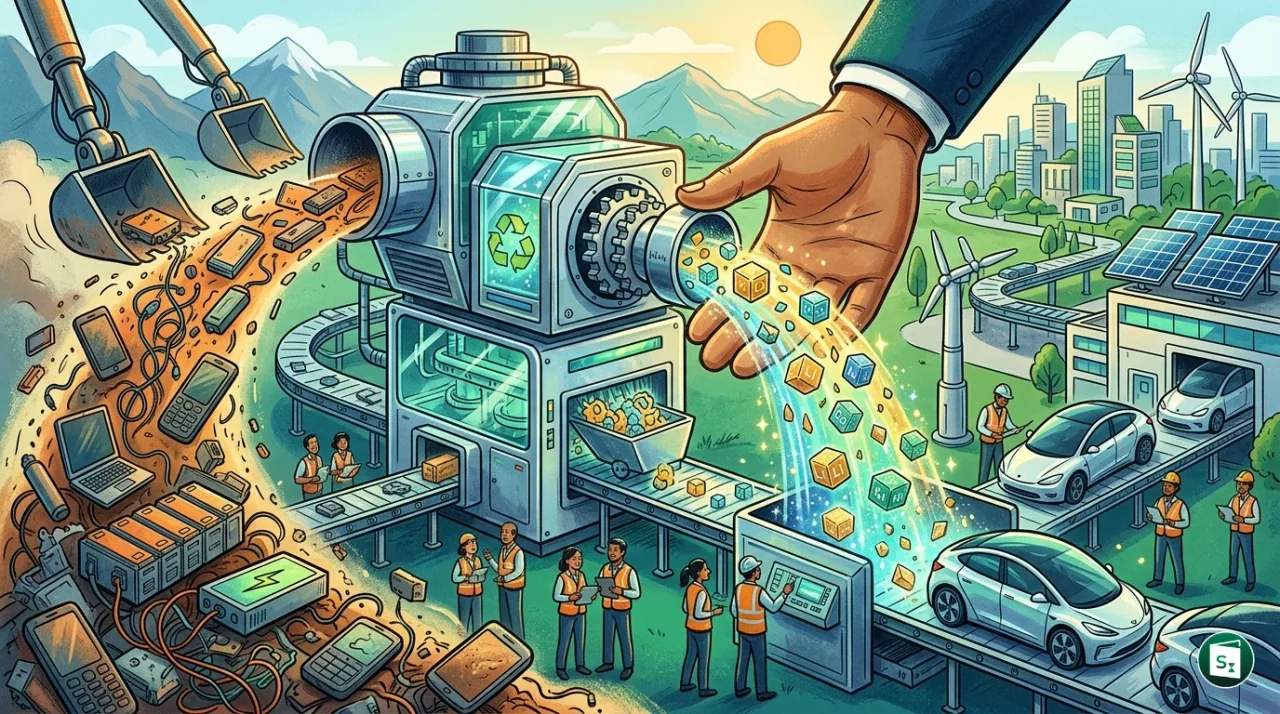
The Ministry of Mines has approved 58 companies as eligible participants under the Incentive Scheme for Promotion of Critical Mineral Recycling (IS-PCMR) to strengthen India’s mineral security. This major initiative, operating under the National Critical Mineral Mission, aims to establish a robust domestic recycling ecosystem for minerals essential to the green energy transition. By incentivizing the recovery of valuable materials from e-waste and spent batteries, the government seeks to reduce import dependency and promote a circular economy.
Strengthening India’s Critical Mineral Ecosystem
The approval of 58 companies marks a significant milestone in India’s strategy to secure a steady supply of critical minerals from secondary sources. These approved entities have collectively pledged an investment of approximately ₹5,000 crore, demonstrating strong industry confidence in the government’s incentive framework. The initiative is designed to build a large-scale recycling infrastructure capable of processing 850 kilotonnes per annum (KTPA) of secondary feedstock by the end of the decade.
The Ministry of Mines, which oversees the national policy for non-ferrous metals and minerals, is the nodal agency for this initiative. To ensure efficient execution and monitoring, the Jawaharlal Nehru Aluminium Research Development and Design Centre (JNARDDC) has been appointed as the Project Management Agency (PMA). Established in 1989 and headquartered in Nagpur, JNARDDC provides technical support and evaluates the progress of projects under the scheme. This structured approach aims to transform India from a net importer into a self-reliant hub for mineral recovery.
Understanding the IS-PCMR Scheme
The Incentive Scheme for Promotion of Critical Mineral Recycling (IS-PCMR) is a central sector scheme with a total financial outlay of ₹1,500 crore. It was officially notified in October 2025 and is set to remain operational for six financial years, spanning from FY 2025-26 to FY 2030-31. The primary goal is to encourage “Urban Mining,” which refers to the process of recovering valuable minerals from products that have reached the end of their life cycle.
The scheme specifically targets the recycling of e-waste, spent lithium-ion batteries, and industrial scrap such as catalytic converters. By focusing on these secondary sources, India aims to recover critical minerals like lithium, cobalt, nickel, and rare earth elements. These materials are vital for manufacturing electric vehicle batteries, renewable energy components, and advanced electronic devices.
Financial Support and Incentives
The financial incentives provided under the scheme are divided into two main categories: capital expenditure (Capex) and operational expenditure (Opex). The structure is designed to reward early movers and high-performing entities.
| Incentive Type | Details |
|---|---|
| Capex Subsidy | Up to 20% subsidy on eligible capital expenditure for projects commencing production on time. |
| Opex Subsidy | Linked to incremental sales over the base year of FY 2025-26. |
| Group A Entities | Large companies with global revenue above ₹200 crore; incentive capped at ₹50 crore. |
| Group B Entities | Smaller entities and startups with revenue below ₹200 crore; incentive capped at ₹25 crore. |
The Capex subsidy is tiered, meaning that projects starting earlier receive a higher percentage of support. This ensures that the domestic recycling capacity is built rapidly to meet the growing demand for clean energy technologies.
The National Critical Mineral Mission: A Broader Vision
The IS-PCMR scheme is a core component of the larger National Critical Mineral Mission (NCMM). Launched in January 2025, the NCMM is a comprehensive seven-year mission designed to build a self-reliant and secure supply chain for minerals essential to India’s national security and economic growth. The mission has a massive total outlay of ₹34,300 crore, which includes direct government spending and investments by Public Sector Undertakings.
India has identified 30 critical minerals that are indispensable for high-tech industries, including semiconductors, defense equipment, and space technology. The mission targets the domestic production of at least 15 critical minerals and encourages Indian companies to acquire 50 mining assets globally. Additionally, the government plans to establish a National Critical Minerals Stockpile to protect the domestic industry from sudden global supply chain disruptions.
Why Critical Mineral Recycling Matters for India
Recycling, often termed as “Urban Mining,” is crucial for India because the country currently has nearly 100% import dependence for several key minerals like lithium and cobalt. Establishing a secondary source of these materials through recycling reduces the vulnerability of Indian industries to geopolitical tensions and international price fluctuations.
From an environmental perspective, recovering metals from recycled waste is significantly more sustainable than primary mining. Studies suggest that recycling can reduce carbon emissions by up to 80% compared to traditional extraction methods. This alignment with the circular economy model is essential for India to achieve its target of Net Zero emissions by 2070. By formalizing the recycling sector, the government not only secures strategic materials but also creates new green jobs and fosters industrial innovation.
Key Takeaways
- The Ministry of Mines has approved 58 companies as eligible participants under the Incentive Scheme for Promotion of Critical Mineral Recycling (IS-PCMR).
- The scheme is a central initiative under the National Critical Mineral Mission (NCMM), which was launched in January 2025.
- The total financial outlay for the recycling scheme is ₹1,500 crore, attracting pledged private investments worth ₹5,000 crore.
- India aims to achieve a recycling capacity of 850 kilotonnes per annum (KTPA) from e-waste, spent batteries, and industrial scrap.
- The Jawaharlal Nehru Aluminium Research Development and Design Centre (JNARDDC), founded in 1989 and based in Nagpur, serves as the Project Management Agency.
- India has identified 30 critical minerals, including lithium and cobalt, as essential for its Net Zero 2070 climate goals.