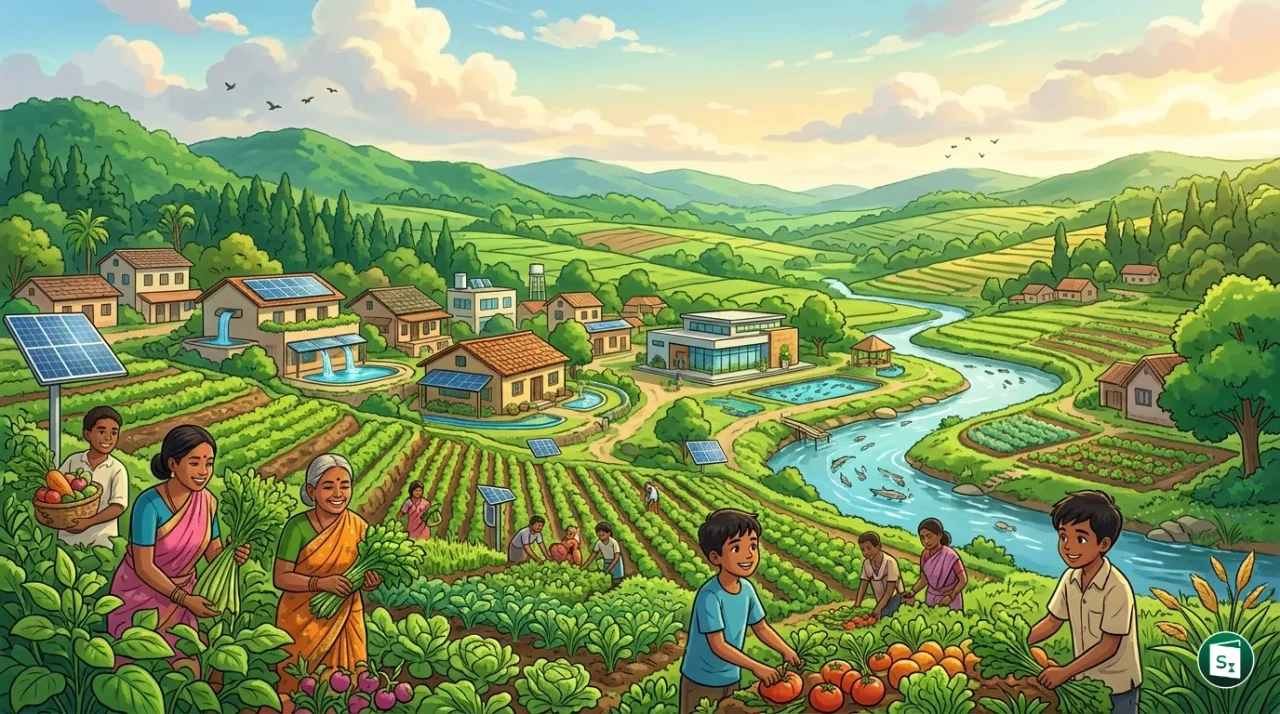
India and the International Fund for Agricultural Development (IFAD) launched an eight-year Country Strategic Opportunities Programme (COSOP) for the 2026-2033 period to bolster the rural economy and foster climate-resilient growth. The joint strategy, unveiled at the ‘IFAD-India Partnership for Rural Prosperity’ event in New Delhi on May 19, 2026, focuses on scaling sustainable farming models and empowering local communities. Alongside the launch, IFAD and the National Bank for Agriculture and Rural Development (NABARD) signed a landmark agreement to strengthen rural financial networks and drive innovation across agriculture.
Understanding the Country Strategic Opportunities Programme (COSOP)
The Country Strategic Opportunities Programme (COSOP) serves as the primary strategic framework guiding the partnership between India and the International Fund for Agricultural Development (IFAD). Established in 1977 following the 1974 World Food Conference, IFAD is a specialized agency of the United Nations (UN) based in Rome, Italy, currently led by President Álvaro Lario. The newly launched COSOP covers an eight-year period from 2026 to 2033, outlining target investments and developmental priorities to enhance rural incomes and climate resilience.
This new strategy marks a shift in focus from basic poverty alleviation to building market-linked, sustainable rural livelihoods. It directly supports India’s Viksit Bharat@2047 vision, which aims to transform the nation into a developed economy by 2047. Under the COSOP framework, the central government and IFAD will work in coordination with the Ministry of Finance and the Ministry of Agriculture and Farmers Welfare to execute targeted rural interventions.
Key Pillars of the COSOP 2026-2033
The eight-year strategy is built around two primary pillars designed to transform India’s rural economy. These pillars focus on strengthening local networks and sharing developmental solutions globally.
Empowering Grassroots Institutions
The COSOP prioritizes the strengthening of local community organisations as the main vehicle for rural transformation. It emphasizes the capacity building of Self-Help Groups (SHGs), Farmer Producer Organisations (FPOs), and cooperative societies. By empowering these grassroots institutions, the program aims to connect smallholder farmers and rural entrepreneurs directly to formal finance channels, modern farming technologies, storage infrastructure, and national market networks. This decentralized approach ensures that the benefits of rural development reach marginal households and women-led enterprises.
Knowledge Sharing and Global South Cooperation
A significant objective of the 2026-2033 strategy is to leverage India’s extensive experience in rural development. The program aims to document successful domestic models in digital agriculture, rural credit, and water management. These models will be shared with other countries in the Global South, particularly across regions in Africa, Southeast Asia, and Latin America. Through this bilateral exchange, India acts as a knowledge hub, helping other developing nations implement scalable solutions for food security and rural prosperity.
IFAD-NABARD Strategic Partnership
On the sidelines of the COSOP launch, IFAD signed a landmark strategic partnership agreement with the National Bank for Agriculture and Rural Development (NABARD). Established on July 12, 1982, under the National Bank for Agriculture and Rural Development Act, 1981, NABARD was set up based on the recommendations of the B. Sivaraman Committee. Headquartered in Mumbai and currently led by Chairman Shaji K.V., NABARD is the apex development bank in India responsible for rural credit and agricultural development.
Enhancing Rural Finance and Innovation
The primary objective of the partnership between IFAD and NABARD is to strengthen rural financial systems and support technological and process innovations in agriculture. The collaboration focuses on designing and implementing blended finance instruments. Blended finance refers to the strategic use of development finance and philanthropic funds to mobilize private capital for sustainable development.
This model will help de-risk private investments in agricultural projects, making it easier for commercial banks and financial institutions to lend to rural borrowers. The target beneficiaries of this initiative include smallholder farmers, cooperative organizations, rural women-led businesses, and small agricultural enterprises that often face difficulties in securing long-term capital.
Historical Context of India-IFAD Cooperation
India is a founding member of IFAD and has played an active role in shaping the agency’s global governance since its inception. The cooperation between India and IFAD began in the late 1970s, with the first projects launching in 1979. Over nearly five decades of partnership, the collaboration has resulted in the implementation of 35 rural development projects across different states. These projects have historically targeted remote, tribal, and drought-prone regions, with a strong focus on watershed development, women’s self-help groups, and sustainable agriculture.
The launch of the COSOP for 2026-2033 represents a significant evolution in this partnership. The focus has shifted from local poverty relief to building resilient, market-oriented ecosystems that can scale up at a national level.
The table below outlines the key differences in focus and strategy between the historic partnership and the new eight-year programme:
| Parameter | Historical Focus (1979-2025) | COSOP Focus (2026-2033) |
|---|---|---|
| Primary Goal | Basic poverty alleviation and local livelihood support | Sustainable, market-linked rural prosperity |
| Key Platforms | State government agencies and local non-governmental organizations | Empowered grassroots institutions like FPOs, SHGs, and cooperatives |
| Financial Strategy | Concessional loans and direct project grants | Blended finance models to mobilize private capital |
| Global Role | Localized domestic project execution | India as a knowledge hub for the Global South |
| Climate Strategy | Traditional farming assistance | Inclusive, climate-resilient adaptation technologies |
Key Takeaways
- The Country Strategic Opportunities Programme (COSOP) is an eight-year strategic plan launched by India and IFAD for the 2026-2033 period to strengthen the rural economy.
- The International Fund for Agricultural Development (IFAD) was established in 1977 as a specialized United Nations agency and is headquartered in Rome, Italy.
- The current President of IFAD is Álvaro Lario, who assumed office in October 2022 for a four-year term.
- The National Bank for Agriculture and Rural Development (NABARD) was established on July 12, 1982, under the National Bank for Agriculture and Rural Development Act, 1981.
- NABARD was founded based on the recommendations of the B. Sivaraman Committee and is headquartered in Mumbai under the chairmanship of Shaji K.V.
- The new IFAD-NABARD strategic partnership focuses on developing blended finance instruments to increase private investment in rural credit and agricultural innovation.