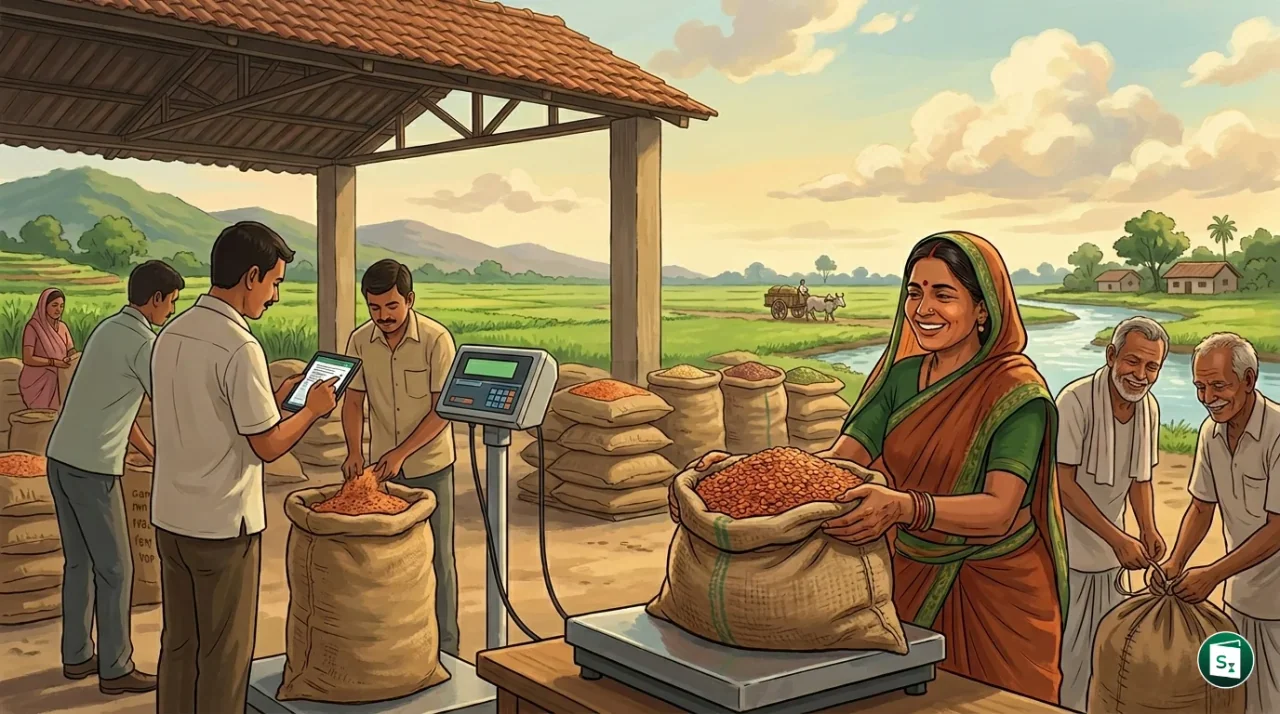
The Ministry of Consumer Affairs, Food and Public Distribution has significantly expanded its pulse procurement operations in Bihar and Chhattisgarh to strengthen India’s food security and farmer income. Through the Atmanirbhar Pulses Mission and PM-AASHA, the government aims to achieve complete self-sufficiency in pulse production by 2027. This latest drive, led by NCCF and NAFED, introduces digitized registration and structured market support to ensure farmers receive the Minimum Support Price for their produce.
Strengthening Pulse Procurement: The Bihar and Chhattisgarh Initiatives
The current procurement drive marks a strategic shift towards organized pulse marketing in eastern and central India. In Bihar, the National Cooperative Consumers’ Federation of India Ltd (NCCF) has initiated the first structured procurement of masoor (lentil) under the Atmanirbhar Pulses Mission. To ensure scientific storage and minimize post-harvest losses, the procurement utilizes warehouses approved by the Warehousing Development and Regulatory Authority (WDRA) in collaboration with the Central Warehousing Corporation (CWC).
In Chhattisgarh, the expansion of procurement operations under PM-AASHA focuses on scaling up the reach of Minimum Support Price (MSP) to pulse-growing farmers. The National Agricultural Cooperative Marketing Federation of India Ltd (NAFED) and NCCF are working through a network of Primary Agricultural Credit Societies (PACS) to facilitate physical procurement. This effort is supported by extensive awareness campaigns to inform farmers about the benefits of selling through government channels.
What Is the Atmanirbhar Pulses Mission?
The Atmanirbhar Pulses Mission (APM), also known as the Dalhan Aatmanirbharta Mission, is a centrally sponsored scheme launched in October 2025 to eliminate India’s dependence on pulse imports. With a budgetary outlay of ₹11,440 crore, the mission is being implemented over a six-year period from 2025–26 to 2030–31.
Goals and Targets of the Mission
The primary objective of the mission is to make India self-reliant in pulses by December 2027. It focuses on three major pulse crops that have historically faced production gaps: Tur (Arhar), Urad, and Masoor. To encourage cultivation, the government has provided a unique guarantee of 100% procurement at MSP for these three pulses for the first four years of the mission. By 2030–31, the mission aims to increase total pulse production to 350 lakh tonnes and expand the cultivation area to 310 lakh hectares.
PM-AASHA: Ensuring Fair Prices for Farmers
The Pradhan Mantri Annadata Aay Sanrakshan Abhiyan (PM-AASHA) is an umbrella scheme launched in September 2018 to ensure that farmers get remunerative prices for their produce. It primarily covers pulses, oilseeds, and copra. The scheme is handled by the Ministry of Agriculture and Farmers Welfare, with procurement for buffer stocks often coordinated through the Ministry of Consumer Affairs.
The scheme consists of several components designed to support farmers when market prices fall below the MSP:
- Price Support Scheme (PSS): Involves physical procurement of crops by central agencies like NAFED and FCI.
- Price Deficiency Payment Scheme (PDPS): Provides direct cash compensation to farmers for the difference between MSP and market price, specifically for oilseeds.
- Private Procurement and Stockist Scheme (PPSS): A pilot initiative to involve private players in procurement operations to increase efficiency.
The government has recently approved the continuation of PM-AASHA until 2025–26 with a financial allocation of ₹35,000 crore, emphasizing its role as a safety net for the farming community.
The Role of E-Samyukti and Digital Infrastructure
To modernize the procurement process, the National Cooperative Consumers’ Federation of India (NCCF) has developed the E-Samyukti portal. This unified digital platform is being extensively used in Chhattisgarh for the digitized registration of farmers. The portal facilitates Aadhaar-based biometric registration, ensuring that only genuine farmers participate in the procurement drive.
The E-Samyukti platform offers several advantages:
- Streamlined Registration: Farmers can register seamlessly through Primary Agricultural Credit Society (PACS) centers.
- Transparency: The system tracks procured lots and maintains real-time dashboards for quality checks and inventory management.
- Direct Benefit Transfer (DBT): It integrates with payment systems to ensure that farmers receive payments directly in their bank accounts, reducing delays and eliminating middleman interference.
By combining digital tools with cooperative networks, the government aims to create a more efficient and transparent ecosystem for agricultural marketing.
Significance for India’s Food Security
India is currently the world’s largest producer and consumer of pulses. Despite this, the country relies on imports to bridge the gap between domestic production and demand. Pulses are a vital source of protein, often called the “poor man’s protein,” making them essential for India’s nutritional security.
Beyond nutrition, pulse cultivation offers significant environmental benefits. As leguminous crops, pulses fix atmospheric nitrogen in the soil, which helps in soil regeneration and reduces the need for synthetic fertilizers. By strengthening procurement through initiatives in Bihar and Chhattisgarh, the government is incentivizing farmers to diversify away from water-intensive crops like paddy and wheat. Achieving the 2027 self-sufficiency target will not only save foreign exchange but also enhance the resilience of India’s agricultural sector.
Key Takeaways
- The Atmanirbhar Pulses Mission aims to achieve self-sufficiency in pulse production in India by December 2027.
- The National Cooperative Consumers’ Federation of India Ltd (NCCF) has launched the first structured procurement of masoor (lentil) in Bihar.
- The E-Samyukti portal facilitates digitized, Aadhaar-based registration for farmers in Chhattisgarh to participate in procurement schemes.
- PM-AASHA, an umbrella scheme launched in 2018, has been extended until 2025–26 with an allocation of ₹35,000 crore.
- The government provides a guarantee of 100% procurement at MSP for Tur, Urad, and Masoor under the Atmanirbhar Pulses Mission.
- NAFED and NCCF are the central nodal agencies leading the pulse procurement drive across the country.