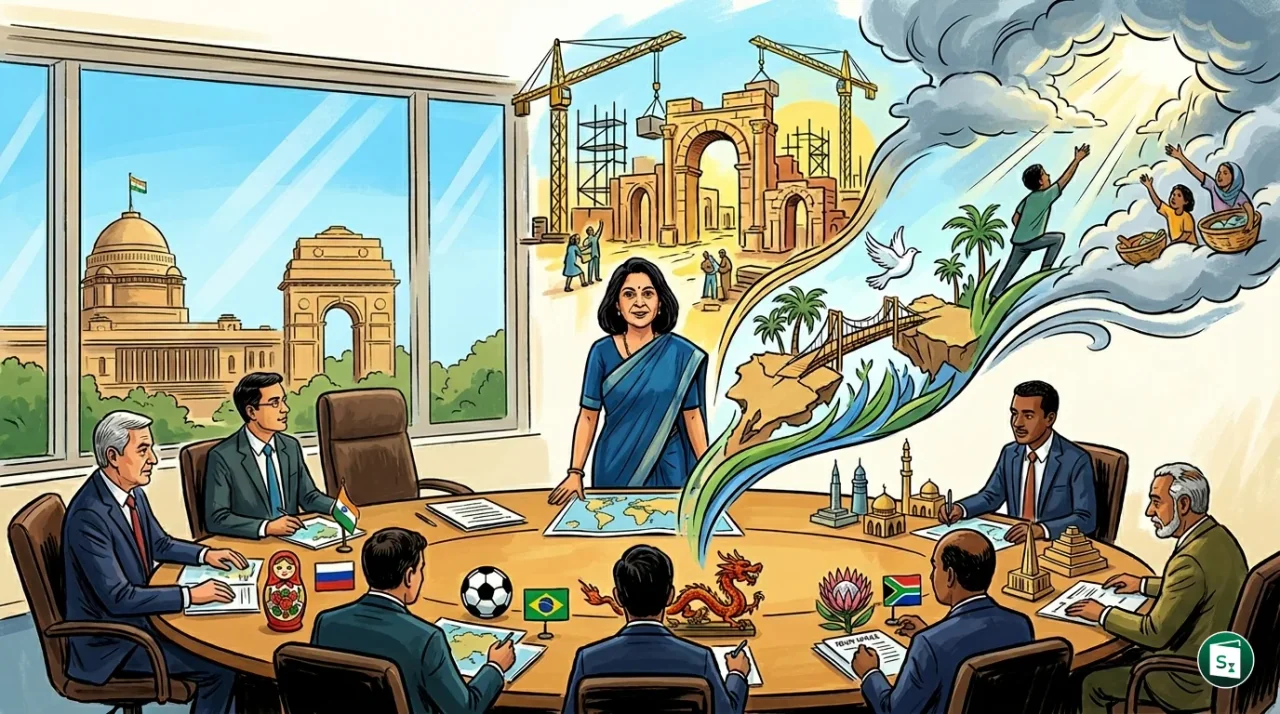
India chaired the BRICS Deputy Foreign Ministers and Special Envoys meeting on the Middle East and North Africa (BRICS MENA) in New Delhi on May 05, 2026. Led by Dr. Neena Malhotra, Secretary (South) in the Ministry of External Affairs, the consultations focused on long-term stability and post-conflict reconstruction across the region. The meeting highlights the bloc’s role as a platform for South-South cooperation amidst shifting geopolitical dynamics in West Asia.
Overview of the BRICS-MENA Consultations
The BRICS-MENA consultative mechanism serves as a specialized platform within the BRICS (Brazil, Russia, India, China, and South Africa) framework. Following the landmark expansion in January 2024, which saw Egypt, Ethiopia, Iran, Saudi Arabia, and the United Arab Emirates (UAE) joining the bloc, the forum has gained significant strategic weight in West Asian and North African affairs.
The New Delhi meeting brought together senior diplomats and special envoys to exchange assessments on regional security and development. Unlike formal ministerial summits, these consultations allow for deep technical and diplomatic exchanges on specific conflict zones. The discussions are particularly relevant given that several new BRICS members are directly situated within the MENA region, making the bloc a central player in regional peace efforts.
Key Regional Issues and Deliberations
The representatives deliberated on a wide range of security and humanitarian challenges, emphasizing the need for political solutions over military interventions. The discussions were categorized into specific national contexts where BRICS members have significant stakes or influence.
Post-Conflict Reconstruction and Political Settlements
A major portion of the meeting was dedicated to the future of Syria and Yemen. Members highlighted the urgency of post-conflict reconstruction in Syria to ensure the safe return of displaced persons and the restoration of national infrastructure. For Yemen, the focus remained on achieving a comprehensive political settlement through an inclusive dialogue process, moving away from years of civil unrest.
In Iraq, the representatives advocated for sustained international support to promote stability and economic development. The political process in Libya was also reviewed, with members expressing support for a Libyan-led and Libyan-owned transition. These deliberations reflect the BRICS consensus on respecting the sovereignty and territorial integrity of nations in the MENA region.
Humanitarian Concerns and Global Challenges
The meeting addressed the deteriorating humanitarian situation in Sudan, where ongoing conflict has led to large-scale displacement and food insecurity. The envoys called for immediate humanitarian access and a cessation of hostilities to protect civilian lives.
Additionally, the role of international agencies like the UNRWA (United Nations Relief and Works Agency for Palestine Refugees in the Near East) was discussed. In the absence of a unified joint statement due to differing views on specific West Asian escalations, the Chair’s Summary issued by India emphasized a “zero-tolerance” approach to terrorism and the unacceptability of attacks on UN peacekeepers, such as the UNIFIL mission in Lebanon.
India’s Role and the Path to 2027
India’s chairship of the BRICS-MENA forum in 2026 comes at a time when its bilateral ties with Middle Eastern nations are at an all-time high. Dr. Neena Malhotra, an experienced diplomat from the 1992 batch of the Indian Foreign Service, steered the New Delhi consultations. Having previously served as India’s Ambassador to Italy and Permanent Representative to the Food and Agriculture Organization (FAO), her leadership reflects India’s multifaceted diplomatic engagement in the “Global South.”
As Secretary (South), Dr. Malhotra oversees the West Asia and North Africa (WANA) division of the Ministry of External Affairs. This role is critical as India seeks to balance its energy security interests with its growing role as a provider of humanitarian aid and developmental assistance in the MENA region. The participating members concluded the session by agreeing to meet again in 2027, where China will take over the chairship of the consultative group.
Key Takeaways
- Dr. Neena Malhotra, Secretary (South) of the MEA, chaired the BRICS-MENA meeting in New Delhi on May 05, 2026.
- The meeting prioritized post-conflict reconstruction in Syria and the restoration of stability in Iraq and Yemen.
- Delegates expressed deep concern over the humanitarian crisis in Sudan and reviewed the political transition in Libya.
- India issued a Chair’s Summary emphasizing a zero-tolerance approach to terrorism and the protection of UNIFIL peacekeepers.
- The BRICS-MENA forum includes members of the expanded bloc, which added Egypt, Ethiopia, Iran, UAE, and Saudi Arabia in 2024.
- The participating members agreed to hold the next round of consultations in 2027 under the chairship of China.