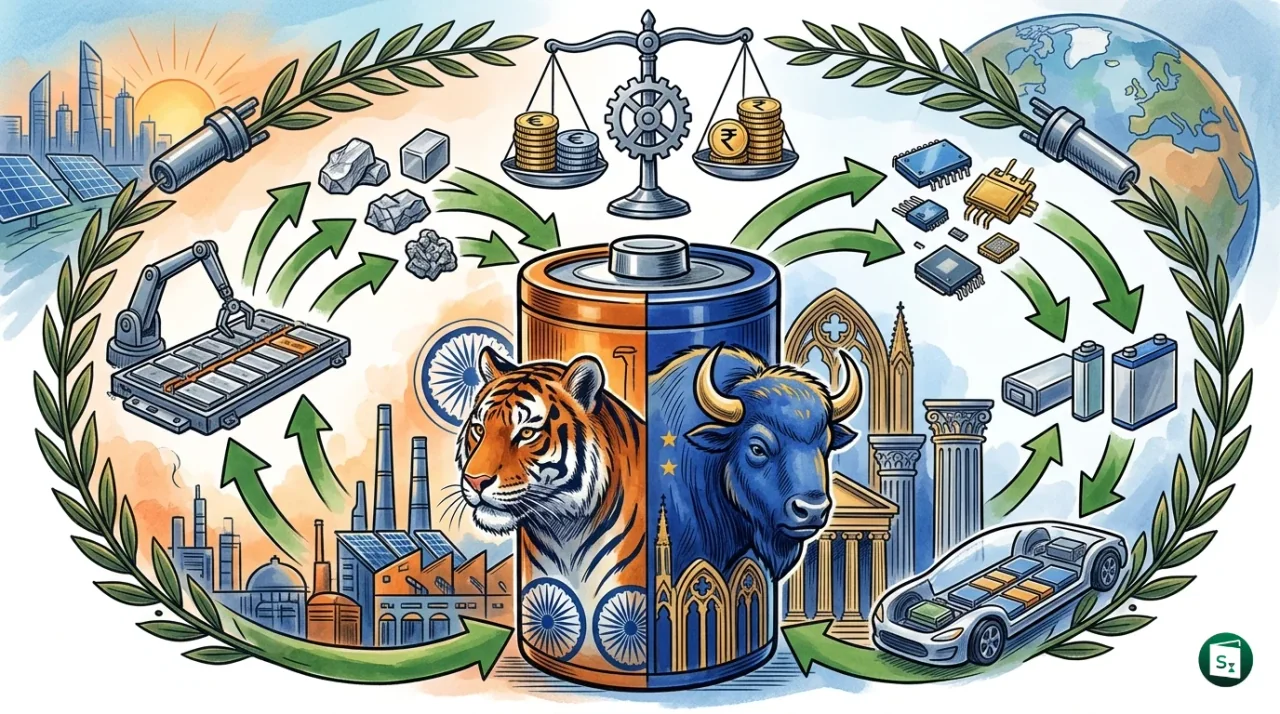
India and the European Union have collaborated to launch a joint initiative aimed at revolutionizing the recycling of Electric Vehicle (EV) batteries under the Trade and Technology Council framework. This partnership, involving a combined investment of €15.2 million, seeks to develop advanced technologies for recovering critical raw materials and fostering a sustainable circular economy. The initiative marks a significant step in securing resilient supply chains for clean energy transitions in both regions.
The Joint Call for EV Battery Recycling
The collaboration takes the form of a third coordinated call for proposals, identified as HORIZON-CL5-2026-09-D2-04, which invites researchers, industries, and startups from both regions to submit innovative projects. The primary goal is to foster a virtual mine by extracting essential minerals from used batteries, thereby reducing the environmental footprint of the automotive industry. Applicants have until September 15, 2026, to submit their joint proposals, which must involve consortia from both India and the EU to ensure a truly bilateral exchange of expertise.
Funding and Collaborative Framework
The initiative is backed by a total funding pool of ₹169 crore (€15.2 million), shared between the two partners. The European Union’s contribution is routed through Horizon Europe, which is the EU’s flagship research and innovation programme for the period 2021 to 2027. On the Indian side, the funding is supported by the Ministry of Heavy Industries (MHI), the nodal ministry for promoting the automotive sector and electric mobility in India. This financial synergy ensures that chosen projects have the necessary resources to transition from theoretical research to industrial-scale application.
Strengthening the Supply Chain for Critical Minerals
A central objective of this initiative is to secure a steady supply of Critical Raw Materials (CRM) such as lithium, cobalt, nickel, and graphite. These minerals are essential for battery manufacturing but are often concentrated in a few geographical regions, leading to supply chain vulnerabilities. By improving recycling efficiencies, India and the EU aim to decrease their reliance on virgin mining and imported materials. This approach aligns with India’s Critical Minerals Mission and the EU’s Critical Raw Materials Act, both of which emphasize resource security and domestic processing capabilities.
Focus on Circular Economy and Technical Innovation
The project specifically targets the development of high-efficiency recovery processes that can handle diverse battery chemistries. A key highlight is the establishment of a joint India-EU pilot line in India, which will serve as a testing ground for real-world validation of recycling technologies. Furthermore, the initiative emphasizes digitalized collection and sorting systems to streamline the logistics of battery waste management. This transition to a circular economy ensures that products and materials are reused or recycled, minimizing waste and promoting environmental sustainability.
The India-EU Trade and Technology Council (TTC) Explained
The India-EU Trade and Technology Council (TTC) is a strategic coordination platform established in April 2022 to deepen the partnership between India and the European Union. It was formally launched in February 2023 during the visit of the President of the European Commission, Ursula von der Leyen, to New Delhi. The TTC serves as a high-level political steering mechanism to tackle challenges at the intersection of trade, trusted technology, and security.
India is only the second partner with whom the EU has established such a council, the first being the United States. The TTC operates through three distinct working groups:
- Working Group 1: Focuses on Strategic Technologies, Digital Governance, and Connectivity.
- Working Group 2: Focuses on Green and Clean Energy Technologies, including research, standards, and circular economy.
- Working Group 3: Focuses on Trade, Investment, and Resilient Value Chains.
This current initiative on battery recycling falls under the mandate of Working Group 2, which aims to promote sustainable industrial growth and climate neutrality through collaborative innovation.
Key Takeaways
- India and the EU have launched a €15.2 million (₹169 crore) joint call for Electric Vehicle (EV) battery recycling proposals.
- The initiative is established under Working Group 2 of the India-EU Trade and Technology Council (TTC).
- Funding is provided by the EU’s Horizon Europe programme and India’s Ministry of Heavy Industries (MHI).
- A central feature of the project is the establishment of a joint India-EU pilot line in India for technology validation.
- The program aims to recover Critical Raw Materials such as lithium, cobalt, and graphite to create a virtual mine.
- The India-EU TTC was announced in April 2022 and is the first such forum for India and the second for the EU.
- The deadline for submitting joint project proposals under this call is September 15, 2026.