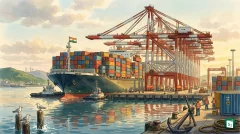
India’s foreign trade commenced the fiscal year 2026-27 on a strong note, with total exports of merchandise and services surging by 13.59% year-on-year to an estimated $80.80 billion in April 2026. This expansion was driven by a robust recovery in merchandise exports alongside double-digit growth in services. The overall performance highlights the resilience of India’s trade sector in the face of ongoing global macroeconomic challenges and supply chain disruptions.
India’s Foreign Trade Matrix in April 2026: An Overview
The monthly trade estimates released by the Ministry of Commerce and Industry present a positive outlook for India’s external sector at the start of the new financial year. In April 2026, the country’s combined exports of merchandise and services reached an estimated $80.80 billion, representing a double-digit growth of 13.59% compared to the $71.13 billion recorded in April 2025. This acceleration reflects a broader economic recovery and sustained global demand for Indian high-value goods and specialized professional services.
On the import side, the overall value of merchandise and services in April 2026 is estimated at $88.61 billion, growing by 7.67% compared to the $82.29 billion registered in the same month of the previous year. Because export growth outpaced import growth by nearly six percentage points, India’s overall trade deficit narrowed significantly. The net trade deficit for April 2026 stood at $7.81 billion, down by more than 30% from the $11.16 billion deficit recorded in April 2025.
| Trade Indicator | Value in April 2025 ($ Billion) | Value in April 2026 ($ Billion) | Year-on-Year Growth Rate (%) |
|---|---|---|---|
| Merchandise Exports | 38.28 | 43.56 | +13.78% |
| Services Exports | 32.85 | 37.24 | +13.36% |
| Total Exports | 71.13 | 80.80 | +13.59% |
| Merchandise Imports | 65.38 | 71.94 | +10.03% |
| Services Imports | 16.91 | 16.66 | -1.48% |
| Total Imports | 82.29 | 88.61 | +7.67% |
| Overall Trade Deficit | 11.16 | 7.81 | -30.02% |
Merchandise Trade Performance: Drivers and Disruption
India’s merchandise trade in April 2026 demonstrated robust growth but also reflected structural vulnerabilities. Merchandise exports rose by 13.78% to reach $43.56 billion, up from $38.28 billion in April 2025. Conversely, merchandise imports increased by 10.03% to $71.94 billion, up from $65.38 billion in the previous year. Consequently, the merchandise trade deficit, representing the difference between physical goods imported and exported, widened slightly to $28.38 billion from $27.10 billion in April 2025.
Primary Export Growth Drivers
The growth in outbound shipments of goods was led by manufacturing and processing sectors. Petroleum products remained India’s largest export commodity group, surging by 34.66% year-on-year to value at $9.59 billion. This increase was driven by rising global demand and higher refining capacity utilization domestically. Electronic goods registered the fastest manufacturing expansion, jumping by 40.31% to reach $5.18 billion in April 2026. This surge indicates that government manufacturing incentive schemes are successfully integrating Indian electronic assembly into global supply chains.
Engineering goods, which represent the largest segment of manufactured exports, maintained steady growth by rising 8.76% to $10.35 billion. In the agricultural and pharmaceutical sectors, meat, dairy, and poultry products surged by 48.03%, while drugs and pharmaceuticals grew by 7.12% to support national export revenue. Crucially, the category of other cereals recorded the highest individual commodity growth rate of 210.19%, indicating robust demand for Indian food grains in international markets.
Import Dynamics and Global Supply Pressures
India’s import basket during the month was heavily influenced by rising global commodity prices and geopolitical tensions in West Asia. Imports of gold surged by 81.69% year-on-year to hit $5.63 billion, up from $3.10 billion in the same period last year. This increase was driven by elevated global bullion prices rather than a massive surge in volume. To curb this non-essential import surge and stabilize the national currency, the government raised the basic customs duty on gold, silver, and platinum from 6% to 15%, effective May 13, 2026.
| Import Commodity | April 2026 Import Value | Year-on-Year Change | Key Underlying Factor |
|---|---|---|---|
| Gold | $5.63 Billion | +81.69% | Elevated international prices; triggered duty hikes to 15% in May 2026 |
| Silver | $411 Million | +157.16% | High speculative demand and manufacturing applications |
| Petroleum & Crude | $18.63 Billion | -10.00% | Shipping route disruptions in West Asia and domestic refinery maintenance |
| Coking Coal | 5.33 Million Tonnes | -5.83% | Subdued coal imports due to record domestic production of over 1 billion tonnes |
Imports of petroleum, crude, and related products declined by 10% to $18.63 billion, primarily due to geopolitical conflicts in West Asia. This shipping disruption forced vessels to take longer routes, and scheduled maintenance in domestic refineries further reduced crude imports. Conversely, imports of coking coal through major ports fell by 5.83% to 5.33 million metric tonnes. This cooling import trend is the direct outcome of India’s domestic coal production crossing the historic threshold of 1 billion tonnes for two consecutive years, reducing dependence on foreign energy inputs.
Services Sector Resilience and Trade Balance Optimization
India’s services sector continued to act as a crucial pillar of macroeconomic stability. In April 2026, services exports rose by 13.36% to reach an estimated $37.24 billion, compared to $32.85 billion in April 2025. Conversely, services imports registered a slight decline of 1.48%, falling to $16.66 billion from $16.91 billion in the previous year. As a result, the net services trade surplus, which represents the net earnings from services exports over imports, increased by 29.11% to $20.58 billion from $15.94 billion in April 2025.
This expanding surplus in the services sector played a vital role in balancing India’s overall trade. While the merchandise trade deficit stood at $28.38 billion, the $20.58 billion services surplus absorbed nearly 73% of this gap. Consequently, the net national trade deficit was optimized to just $7.81 billion, demonstrating how India’s strong competitiveness in knowledge-based exports acts as a buffer against volatile global commodity import bills.
These services trade estimates are provisional and subject to adjustment. Because the official services transaction registry from the Reserve Bank of India is released with a 30-day lag, the Ministry of Commerce and Industry uses recent banking trends and industrial surveys to formulate these quick estimates. The sustained growth of services exports highlights India’s global leadership in Information Technology (IT) services, Business Process Management (BPM), and professional consultancies.
Policy Context: Infrastructure and Institutions Fueling Trade Growth
The double-digit trade expansion observed in April 2026 is not an accidental spike. Instead, it represents the cumulative outcome of structural reforms and institutional frameworks engineered by the Ministry of Commerce and Industry, headquartered in New Delhi. Operating under the leadership of the Union Minister, the ministry’s executive wing, the Directorate General of Foreign Trade (DGFT), has transitioned from a traditional regulatory body to a specialized trade facilitator. DGFT administers the dynamic Foreign Trade Policy (FTP) 2023, a landmark policy framework that replaced the historic five-year policy cycles with a perpetual, open-ended structure designed to scale India’s total exports to $2 trillion by 2030.
A key institutional driver behind the surge in electronic and engineering exports is the Production Linked Incentive (PLI) scheme, which was first approved by the Union Cabinet in March 2020. By providing financial incentives ranging from 4% to 6% on incremental sales of domestically manufactured products, the PLI scheme has attracted massive private capital and integrated Indian manufacturers into global supply chains. Alongside this, the Districts as Export Hubs (DEH) initiative, managed by DGFT, has decentralized trade promotion by identifying and packaging distinct export-worthy products from each of India’s 750-plus districts, directly empowering small and medium enterprises.
These policy initiatives are supported by heavy infrastructure investments that have reduced logistics transaction costs. The physical movement of outbound cargo has been accelerated by the operationalization of the Dedicated Freight Corridors (DFCs), which are specialized rail routes built exclusively for container transport, and the port-led development projects under the Sagarmala Programme, launched in 2015. By linking industrial manufacturing clusters directly to major maritime gateways, these infrastructure stakes have drastically shortened domestic transit times, ensuring that Indian exports can compete effectively on a global stage.
Key Takeaways
- India’s total exports, encompassing both merchandise and services, reached an estimated $80.80 billion in April 2026, registering a growth of 13.59% year-on-year.
- Merchandise exports rose by 13.78% to reach $43.56 billion, led by substantial growth in petroleum products and electronic goods.
- Gold imports rose by 81.69% to hit $5.63 billion due to high global prices, triggering a basic customs duty hike on precious metals to 15% in May 2026.
- The provisional services trade surplus grew by 29.11% to $20.58 billion, which absorbed nearly three-quarters of the merchandise trade deficit.
- The Directorate General of Foreign Trade (DGFT) administers the Foreign Trade Policy (FTP) 2023, which aims to scale India’s total exports to $2 trillion by 2030.
- The Production Linked Incentive (PLI) scheme, launched in March 2020, provides financial incentives between 4% and 6% to boost domestic manufacturing.