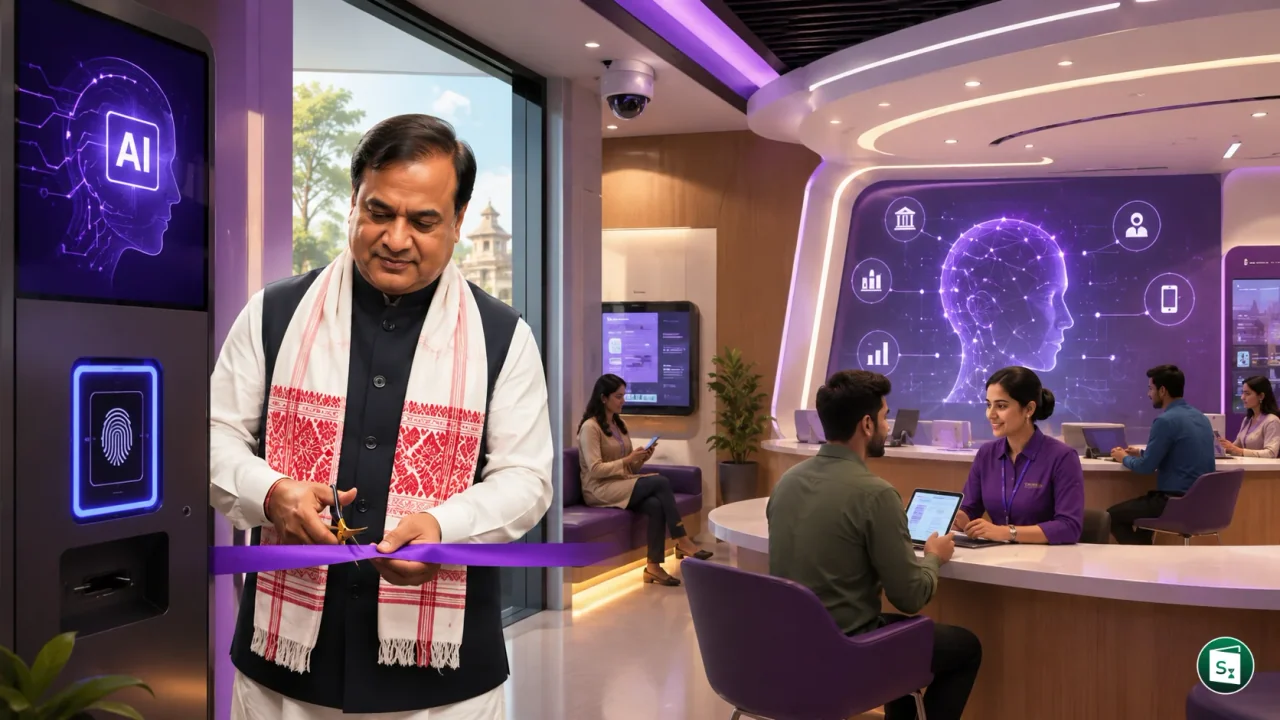
Assam Chief Minister Himanta Biswa Sarma inaugurated India’s first AI-powered phygital banking branch of Slice Small Finance Bank in Guwahati on May 22, 2026. This launch represents a significant milestone in the integration of traditional banking with advanced Artificial Intelligence, aimed at enhancing financial services in Northeast India. By combining physical presence with digital agility, the branch seeks to simplify complex banking processes for a diverse range of customers.
What Is the ‘Phygital’ Banking Model?
The term phygital is a combination of physical and digital, representing a hybrid service model that provides the best of both worlds. In the context of banking, a phygital branch maintains a traditional brick-and-mortar presence where customers can interact with bank staff, but the core operations are powered by sophisticated digital tools.
This model is particularly effective in regions with varying levels of digital literacy. While tech-savvy users can utilize AI-driven kiosks for instant account opening and automated KYC (Know Your Customer) procedures, others can still rely on human assistance for complex financial advice. The use of Artificial Intelligence in this branch enables real-time data processing, allowing for faster credit approvals and personalized service recommendations based on individual transaction histories.
The Evolution of Slice Small Finance Bank
The establishment of Slice Small Finance Bank is the result of a landmark merger in the Indian financial landscape. Originally a prominent fintech unicorn known for its credit products, Slice (operated by Garagepreneurs Internet Private Limited) sought to transition into a full-scale banking entity to offer more comprehensive services.
The Strategic Merger of Slice and NESFB
The merger between Slice and the Guwahati-based North East Small Finance Bank (NESFB) was officially completed in October 2024, following a “no-objection certificate” from the Reserve Bank of India (RBI). This union was strategic for both parties. For Slice, it provided a banking license required to accept deposits and issue credit directly. For NESFB, which had a deep-rooted presence in the Northeast region, the merger brought in much-needed capital and cutting-edge technology. The merged entity was rebranded as Slice Small Finance Bank in May 2025, with Rajan Bajaj serving as the Managing Director and CEO.
Harnessing AI for Enhanced Financial Services
The Guwahati branch stands out as India’s first to be fully AI-powered at its core. Artificial Intelligence is not just a customer-facing tool in this model; it is deeply embedded in the bank’s internal risk assessment and operational framework. By leveraging machine learning algorithms, the bank can perform highly accurate credit scoring for individuals who may not have a traditional credit history, thereby promoting financial inclusion.
The branch utilizes facial recognition technology for secure, password-less authentication at kiosks and natural language processing (NLP) to power multi-lingual digital assistants. These assistants help customers navigate banking services in local languages, making the technology accessible to a broader demographic in Assam and surrounding states. Additionally, AI systems monitor transactions in real-time to detect and prevent fraudulent activities, ensuring a high level of security for digital-first users.
Small Finance Banks: Objectives and Regulatory Framework
Small Finance Banks (SFBs) were introduced by the RBI to further the objective of financial inclusion by providing basic banking activities to underserved sections of the population. These sections include small business units, small and marginal farmers, and micro and small industries.
As of 2026, the regulatory requirements for SFBs have been updated to reflect the growing scale of these institutions. The following table highlights the key operational and financial norms governed by the RBI:
| Requirement | Current Guideline (2026) |
|---|---|
| Minimum Net Worth | ₹300 crore |
| Capital Adequacy Ratio (CRAR) | 15% of risk-weighted assets |
| Priority Sector Lending (PSL) | 60% of Adjusted Net Bank Credit |
| Loan Portfolio Mix | At least 50% of loans must be up to ₹25 lakh |
| Branch Distribution | At least 25% branches in Unbanked Rural Centers |
These banks are registered under the Companies Act, 2013, and are governed by the Banking Regulation Act, 1949, and the Reserve Bank of India Act, 1934. The reduction of the PSL target from 75% to 60% in April 2026 has allowed SFBs like Slice to diversify their lending portfolios while still maintaining a focus on core priority sectors like agriculture and micro-enterprises.
Key Takeaways
- Assam Chief Minister Himanta Biswa Sarma inaugurated India’s first AI-powered phygital branch of Slice Small Finance Bank in Guwahati.
- The phygital model is a hybrid approach that integrates physical infrastructure with advanced digital technologies like Artificial Intelligence.
- Slice Small Finance Bank was formed through the merger of the fintech company Slice and the North East Small Finance Bank (NESFB).
- The merger received final regulatory approval from the RBI and was completed in October 2024, with rebranding finalized in May 2025.
- Rajan Bajaj serves as the Managing Director and CEO of Slice Small Finance Bank, which is headquartered in Guwahati.
- Under updated RBI guidelines, Small Finance Banks must maintain a minimum net worth of ₹300 crore and a CRAR of 15%.