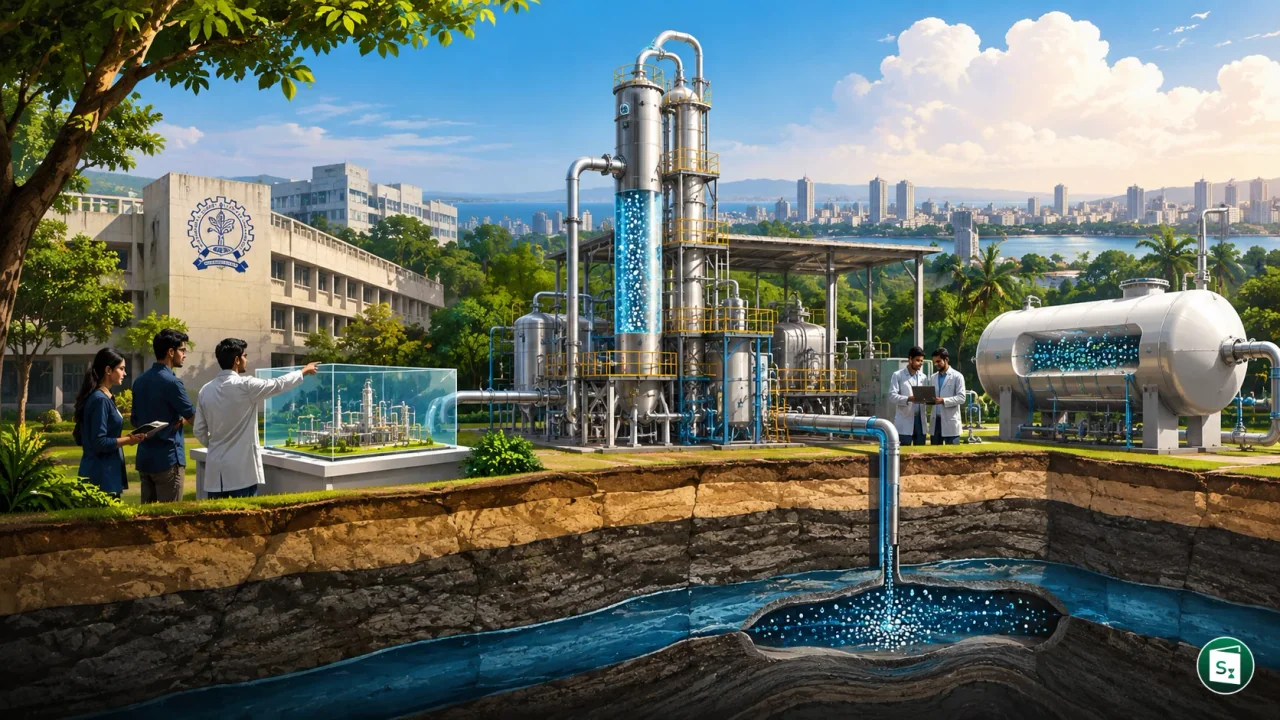
Union Education Minister Dharmendra Pradhan recently inaugurated India’s first integrated Carbon Capture, Utilisation and Storage (CCUS) field laboratory facility at the Indian Institute of Technology (IIT) Bombay in Mumbai, Maharashtra. Established under the flagship Bharat Innovates 2026 initiative, the end-to-end pilot-scale platform is designed to capture carbon dioxide and convert it into industrial-grade minerals. Powered by technology from the deep-tech startup UrjanovaC, this facility marks a vital milestone in scaling indigenous carbon management solutions to meet India’s climate goals.
Understanding Carbon Capture, Utilisation and Storage
The Carbon Capture, Utilisation and Storage (CCUS) framework represents a suite of technologies designed to prevent carbon dioxide from entering the atmosphere. This system works by capturing carbon dioxide emissions at the source, such as factory flue gas pipes, or directly from the air. Once captured, the gas is either compressed and transported for permanent geological storage or recycled to create useful industrial products.
For industries that are traditionally hard to abate, such as steel, cement, and chemical manufacturing, CCUS offers a realistic pathway to decarbonization. These sectors cannot rely solely on switching to renewable electricity because their primary emissions often stem from the chemical processes of manufacturing itself. By capturing and handling carbon dioxide at the point of generation, CCUS helps bridge the gap between heavy industrial activity and climate safety.
Inside India’s First Integrated CCUS Field Laboratory
The new facility at IIT Bombay serves as India’s premier end-to-end testing platform for carbon management. With a daily capture capacity of up to three tonnes of carbon dioxide, the laboratory represents a significant step up from laboratory-scale experiments to real-world industrial application. It functions as a national testbed where technologies can be refined and proven before being deployed in massive industrial complexes.
One of the most notable features of this facility is its versatility in handling different sources of emission. The system can capture carbon dioxide directly from the air, a process known as Direct Air Capture (DAC), as well as from concentrated point sources like industrial flue gases. To ensure the process remains environmentally sustainable, the system is designed to run on non-potable water sources, such as seawater or industrial wastewater, preserving precious freshwater resources.
| Facility Feature | Technical Details |
|---|---|
| Location | Indian Institute of Technology (IIT) Bombay, Mumbai, Maharashtra |
| Daily Capture Capacity | Up to three tonnes of carbon dioxide |
| Input Sources | Industrial flue gas (point source) and ambient air |
| Water Utilisation | Seawater, industrial effluents, and wastewater |
| Primary End Products | Industrial-grade carbonate and bicarbonate salts |
| Developing Entity | UrjanovaC (Deep-tech startup incubated at IIT Bombay) |
The laboratory does not just capture carbon. It actively demonstrates the concept of a circular carbon economy. The captured carbon dioxide undergoes chemical transformation inside the facility to yield high-purity carbonate and bicarbonate salts. These salts are valuable industrial minerals used in manufacturing, water treatment, and construction, effectively converting a gaseous pollutant into a solid, market-ready resource.
The Science and Technology Behind the Breakthrough
The technology driving the field laboratory was developed by UrjanovaC, a deep-tech climate startup incubated at the Society for Innovation and Entrepreneurship (SINE) at IIT Bombay. SINE, established as the flagship business incubator of the institute, serves as a bridge between academic research and commercial entrepreneurship. The startup was founded in 2023 by Prof. Vikram Vishal of the Department of Earth Sciences and Prof. Arnab Dutta of the Department of Chemistry, both faculty members at IIT Bombay.
At the core of UrjanovaC’s technology is an aqueous-based catalytic capture method. It utilizes a patented catalyst made from earth-abundant materials, ensuring that the process remains cost-effective and scalable. Unlike traditional carbon capture systems that require high operational temperatures and consume expensive materials, this catalytic process runs efficiently at ambient temperatures. The catalyst itself is not consumed during the reaction, which lowers the long-term operational costs of the facility.
Analogy · Understanding Carbon Mineralization Expand analogy
Think of geological carbon storage as locking fizzy water inside a volcanic rock until it turns into solid stone. Instead of storing carbon dioxide as a temporary gas that could leak, it is dissolved in water and injected deep into basalt formations. The basalt acts as a natural reactor, chemically binding the carbon dioxide with minerals to permanently transform it into harmless, solid rock.
In addition to capture and storage, the project is breaking new ground in permanent geological carbon storage. The laboratory is linked to India’s first scientific drilling initiative designed to study carbon dioxide storage in basalt rock formations. Specifically, the researchers are focusing on the Deccan Traps, a massive volcanic rock formation in western India. Basalt rock contains high concentrations of calcium, magnesium, and iron, which react with dissolved carbon dioxide to form stable carbonate minerals, ensuring that the captured greenhouse gas can never escape back into the atmosphere.
The Bharat Innovates 2026 Initiative
The CCUS field laboratory at IIT Bombay has been established under the Bharat Innovates 2026 initiative. This program is a flagship scheme of the Ministry of Education, Government of India, designed to identify, mentor, and showcase the country’s most promising deep-tech and research-driven innovations. The initiative is executed under the strategic guidance of the Office of the Principal Scientific Adviser (PSA) to the Government of India.
Prime Minister Narendra Modi announced the initiative on February 17, 2026, during the launch of the India–France Year of Innovation. The central mission of Bharat Innovates 2026 is to bridge the gap between academic research and commercial viability. By taking cutting-edge research from laboratory test tubes to commercial markets, the program connects deep-tech startups with international corporate partners, global universities, and institutional investors.
The program focuses on thirteen key frontier technology sectors, including energy, sustainability, and climate change. Over one hundred promising ventures with high technology readiness levels have been selected from Higher Education Institutions (HEIs) and Centrally Funded Technical Institutes (CFTIs) nationwide. Following a competitive domestic pre-summit, UrjanovaC was chosen to represent India at the prestigious Bharat Innovates 2026 international showcase, which will take place in Nice, France, in June 2026.
Strategic Significance for India’s Net-Zero Commitments
India is currently the third-largest emitter of greenhouse gases globally. Under its Panchamrit climate commitments announced at the United Nations COP26 summit, India pledged to achieve Net-Zero carbon emissions by 2070. Achieving this goal requires a massive overhaul of the industrial sector, especially as the nation continues its rapid infrastructure expansion under the Make in India campaign and targets a developed nation status by 2047 under the Viksit Bharat vision. Indigenously developed CCUS systems are vital to decarbonizing heavy industries without sacrificing economic growth.
The successful launch of the laboratory also highlights the role of dedicated national research centres. SINE and the National Centre of Excellence in Carbon Capture and Utilisation (NCoE-CCU) at IIT Bombay served as the critical foundational platform for this breakthrough. Sanctioned by the Department of Science and Technology (DST) in December 2021, this centre was established as the first centrally funded hub of its kind in India. By providing the resources and infrastructure for faculty research to mature, the centre allowed the core technologies of UrjanovaC to be developed and successfully transitioned from laboratory concepts to active industrial pilots.
Key Takeaways
- India’s first integrated Carbon Capture, Utilisation and Storage (CCUS) field laboratory facility was inaugurated recently at IIT Bombay by Union Minister Dharmendra Pradhan.
- The laboratory is established under the flagship Bharat Innovates 2026 initiative launched by the Ministry of Education to scale deep-tech research from laboratories to commercial markets.
- The facility utilizes an advanced aqueous-based catalytic carbon capture technology developed and scaled by the incubated startup UrjanovaC.
- The deep-tech startup UrjanovaC was founded in 2023 by IIT Bombay faculty members Prof. Vikram Vishal and Prof. Arnab Dutta.
- The project incorporates India’s first scientific drilling initiative to study permanent geological carbon sequestration in the basalt rock formations of the Deccan Traps.
- The National Centre of Excellence in Carbon Capture and Utilisation (NCoE-CCU) at IIT Bombay was formally sanctioned in December 2021 with support and funding from the Department of Science and Technology (DST).