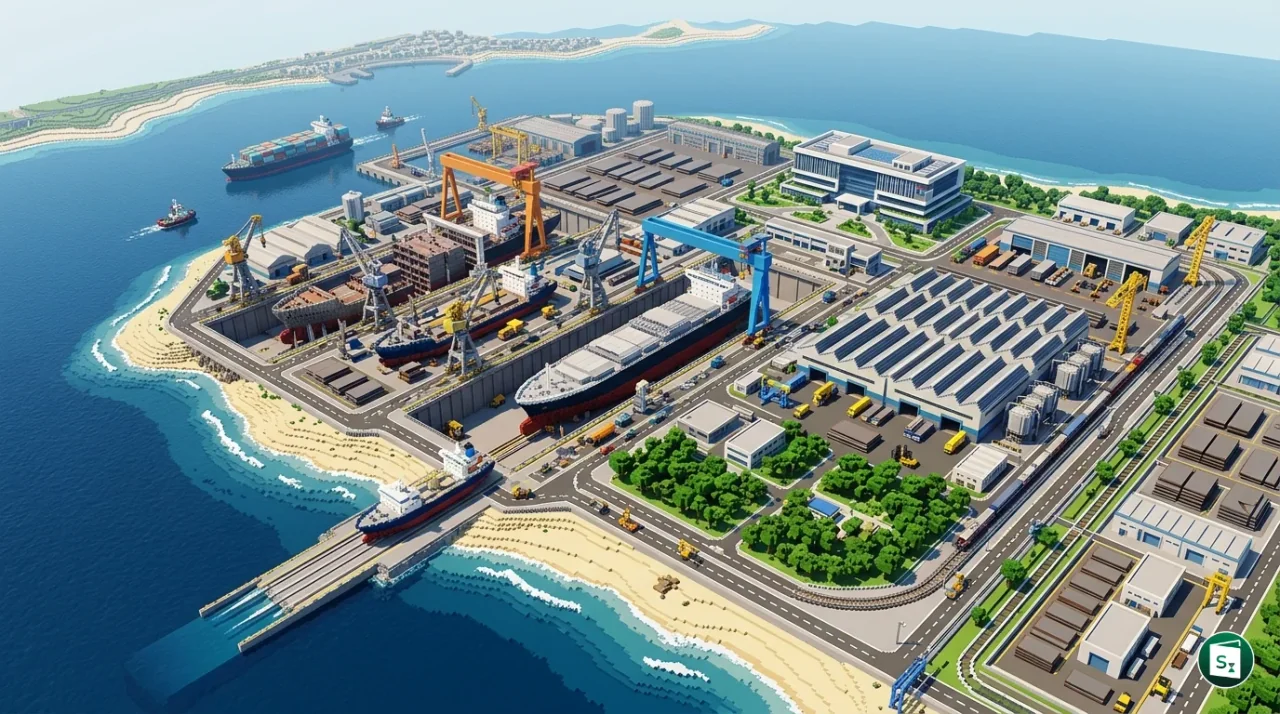
The Ministry of Ports, Shipping and Waterways signed a tripartite Memorandum of Understanding on May 16, 2026, to develop India’s first mega greenfield shipyard at Thoothukudi, Tamil Nadu. The landmark agreement was exchanged during the state visit of South Korean President Lee Jae Myung under the bilateral VOYAGES framework. Designed with an annual capacity of 2.5 million Gross Tonnage, the project is poised to elevate India’s domestic maritime manufacturing capabilities and position the country as a leading force in global shipbuilding.
India’s First Mega Greenfield Shipyard: The Tripartite Pact
The landmark agreement marks a historic shift in India’s maritime infrastructure strategy. The Ministry of Ports, Shipping and Waterways (MoPSW), under the leadership of Union Minister Sarbananda Sonowal, finalized a tripartite Memorandum of Understanding (MoU) with three key industrial and financial entities. These partners include HD Korea Shipbuilding & Offshore Engineering Co Ltd (HD KSOE), National Shipbuilding & Heavy Industries Park Tamil Nadu Ltd (NSHIP-TN), and Sagarmala Finance Corporation Ltd (SMFCL).
The primary objective of the tripartite alliance is to construct and operate India’s first mega greenfield shipyard in Thoothukudi, Tamil Nadu. Designed with an annual manufacturing capacity of 2.5 million Gross Tonnage (GT), the facility will serve as the anchor development for a larger regional shipbuilding cluster. The agreement was officially exchanged during the high-profile state visit of the President of the Republic of Korea (ROK), Lee Jae Myung, to New Delhi, underscoring the deep geopolitical and economic ties between the two nations.
NSHIP-TN and Nodal Entities: Understanding the Stakeholders
The execution of a massive capital-intensive infrastructure project worth billions of dollars requires a robust organizational and financial matrix. The tripartite partnership brings together a specialized industrial development body, a dedicated state-backed financial institution, and a global manufacturing pioneer to divide operations, funding, and land development roles.
Roles and Institutional Status of Project Partners
| Stakeholder | Institutional Status | Primary Responsibility in Project |
|---|---|---|
| HD KSOE | Intermediate holding company of South Korea’s HD Hyundai Group (world’s largest shipbuilder) | Lead technology partner, anchor shipbuilder, and technical operations manager |
| NSHIP-TN | Special Purpose Vehicle joint venture between V.O. Chidambaranar Port Authority and SIPCOT | Land acquisition, local infrastructure provisioning, and regulatory clearances |
| SMFCL | Mini Ratna (Category-I) Central Public Sector Enterprise and maritime NBFC under MoPSW | Lead financial syndication, capital structuring, and long-term debt financing |
Special Purpose Vehicle: NSHIP-TN
The local development and facilitation of the shipyard will be managed by National Shipbuilding & Heavy Industries Park Tamil Nadu Ltd (NSHIP-TN). This Special Purpose Vehicle operates as a strategic joint venture between the V.O. Chidambaranar Port Authority, a Union government-owned port in Thoothukudi, and the State Industries Promotion Corporation of Tamil Nadu (SIPCOT).
By combining the maritime resources of a major central port with the industrial land mobilization capabilities of SIPCOT, NSHIP-TN provides a seamless single-window mechanism for the shipyard. It is responsible for organizing the massive land tract, spanning approximately 2,000 to 3,000 acres, required for the shipyard and its ancillary manufacturing zones.
Financing Backbone: Sagarmala Finance Corporation Ltd
The financial syndication and capital support for this landmark mega-project are anchored by Sagarmala Finance Corporation Ltd (SMFCL). Established to bridge crucial funding gaps in India’s maritime sector, SMFCL operates as a Mini Ratna (Category-I) Central Public Sector Enterprise under the administrative control of the Ministry of Ports, Shipping and Waterways.
The entity has a unique institutional history. It was originally incorporated on August 31, 2016, as Sagarmala Development Company Limited (SDCL). Recognizing the need for a dedicated, capital-intensive financial arm for port-led development, the Reserve Bank of India approved its transformation into a specialized Non-Banking Financial Company (NBFC). The corporation received its RBI registration certificate on June 19, 2025, and was officially launched as Sagarmala Finance Corporation Ltd on June 26, 2025. SMFCL offers tailored short, medium, and long-term financing to port authorities, private developers, and shipping lines, making it uniquely suited to structure the debt and equity requirements for the Thoothukudi shipyard.
Technological Synergy: The ‘VOYAGES’ Framework and South Korean Expertise
The shipyard project is not a standalone transaction. It is the flagship initiative under the newly established India-ROK Comprehensive Framework known as VOYAGES, which stands for Shared Vision for Operation of Yard Assisted Growth with Efficiency and Scale. Formalized on April 20, 2026, during the state visit of President Lee Jae Myung, the framework establishes a long-term roadmap to align India’s expanding vessel procurement pipeline with South Korea’s world-leading maritime engineering.
Infusion of Advanced South Korean Shipbuilding Methods
South Korea stands as a global leader in commercial shipbuilding, controlling a dominant share of high-value vessel manufacturing such as Liquefied Natural Gas (LNG) carriers and ultra-large container ships. Through HD KSOE, the Thoothukudi shipyard will integrate advanced production methods that have never been deployed at scale in India:
- Modular Block Fabrication: Instead of building ships from the keel up in a single dock, the shipyard will construct huge modular blocks in indoor, climate-controlled workshops. These blocks are then transported and welded together in the dry dock, dramatically cutting construction times and improving hull structural integrity.
- Digital Twin and Smart Yard Operations: The facility will deploy South Korea’s digital twins technology to simulate the entire assembly process in real-time. This helps engineers identify bottleneck zones, predict maintenance cycles, and automate parts inventory.
- Green Shipping Technologies: The yard will be designed to build vessels powered by non-conventional and green fuels, specifically focusing on Ammonia-fuelled and Hydrogen-ready bulk carriers, aligning with international carbon reduction mandates.
Human Capital and Technology Cooperation
The VOYAGES framework places great emphasis on skill transfer and workforce development to ensure long-term operational self-reliance. As part of the tripartite pact, Indian marine engineers and shipyard technicians will undergo specialized training at HD KSOE’s flagship yards in Ulsan and Gunsan, South Korea.
Further, the partners plan to establish a dedicated Shipbuilding Workforce Development and Technology Cooperation Center in India. This center will serve as an academy to train local workforces in high-precision welding, automated block assembly, and digital logistics management, creating a highly skilled local ecosystem.
Strategic Imperative: Why Thoothukudi Matters for India’s Maritime Strategy
The choice of Thoothukudi in Tamil Nadu as the site for India’s first mega greenfield shipyard is driven by critical geographic, infrastructural, and strategic advantages. Establishing a world-class shipbuilding yard requires more than just a large capital investment. It depends heavily on natural coastal features and access to global commerce.
Geographic and Hydrographic Advantages
Thoothukudi is home to the V.O. Chidambaranar Port Authority (VOCPA), formerly known as Tuticorin Port. The port features unique hydrographic and geographical benefits that make it an ideal shipbuilding destination:
- Deep Natural Draft: Large modern vessels require a deep draft for assembly and launching. The deep-water basin at VOCPA allows for the construction and launch of massive ships of up to 2.5 million Gross Tonnage (GT) capacity without the risk of grounding.
- Proximity to International Shipping Corridors: Thoothukudi is situated close to the East-West international shipping route that links East Asia to Europe and the Middle East. This proximity allows the shipyard to capture international ship repair and retrofitting contracts, as vessels will not have to deviate far from their trade lanes.
- Stable Weather and Shelter: Unlike the eastern coast of India, which is frequently hit by severe cyclones, the Gulf of Mannar region around Thoothukudi offers relatively sheltered waters. This enables year-round open-air assembly operations and dock work.
The Economic Multiplying Effect
A mega shipyard serves as a massive economic engine. Beyond the primary shipyard facility, the project will anchor the broader Thoothukudi Shipbuilding Cluster, which is projected to generate substantial economic activity across the region:
- Direct and Indirect Employment: Once operations stabilize, the greenfield shipyard is expected to generate approximately 15,000 direct, high-skilled industrial jobs.
- Ancillary Ecosystem Development: The NSHIP-TN park will host hundreds of ancillary units, including marine valve manufacturers, specialized steel fabricators, electrical fitters, and marine paint makers. This localized supply chain reduces the import dependency of Indian shipbuilders.
- Coastal Economy Boost: The industrial influx will drive infrastructural growth in Thoothukudi and surrounding districts, upgrading local highways, power grids, and vocational training schools.
The Bigger Picture: Aligning with Maritime Amrit Kaal Vision 2047
The establishment of the Thoothukudi shipyard is a critical milestone in India’s long-term maritime roadmap. Currently, India’s domestic shipbuilding capacity is relatively small on a global scale. Despite having a vast coastline and a large volume of sea trade, India accounts for less than 1 percent of the global shipbuilding market and ranks approximately 20th globally in active shipbuilding tonnage.
National Shipbuilding Targets
To address this dependency, the Union Government launched the Maritime Amrit Kaal Vision 2047 as a comprehensive blueprint to revitalize the nation’s maritime sector. The initiative sets ambitious milestones to elevate India’s status in global shipbuilding:
| Milestone Target | Goal Timeline | Quantifiable Objective |
|---|---|---|
| Top 10 Global Rank | By 2030 | India aims to enter the top ten shipbuilding nations in the world |
| Top 5 Global Rank | By 2047 | India aims to rank among the top five global shipbuilding powers |
| Market Share Expansion | By 2030 | Achieve a 5 percent share of the global shipbuilding market |
| Annual Tonnage Capacity | By 2047 | Scale total domestic shipbuilding capacity to 3 million Gross Tonnage (GT) annually |
A Massive Leap for Domestic Capacity
The Thoothukudi Mega Greenfield Shipyard, with its designed annual capacity of 2.5 million GT, represents a major leap toward these goals. It will single-handedly provide the scale required to make Indian-made commercial vessels globally competitive.
By manufacturing large-scale merchant vessels domestically, India can significantly reduce its dependence on foreign shipyards. It also helps conserve foreign exchange reserves, as Indian shipping firms currently spend billions of dollars purchasing or leasing commercial vessels from foreign yards. The project operates alongside the Union government’s existing Shipbuilding Financial Assistance Scheme (SBFAS), which provides financial incentives and subsidies to domestic shipyards to encourage high-value vessel manufacturing.
Key Takeaways
- The Ministry of Ports, Shipping and Waterways signed a tripartite Memorandum of Understanding on May 16, 2026, to develop India’s first mega greenfield shipyard at Thoothukudi, Tamil Nadu.
- The shipyard has an envisaged annual shipbuilding capacity of 2.5 million Gross Tonnage and will serve as the anchor for the broader Thoothukudi Shipbuilding Cluster.
- The agreement was exchanged under the bilateral VOYAGES framework, which stands for Shared Vision for Operation of Yard Assisted Growth with Efficiency and Scale, during the state visit of South Korean President Lee Jae Myung.
- The project is spearheaded by National Shipbuilding & Heavy Industries Park Tamil Nadu Ltd, a Special Purpose Vehicle joint venture between the V.O. Chidambaranar Port Authority and the State Industries Promotion Corporation of Tamil Nadu.
- Sagarmala Finance Corporation Ltd, India’s first specialized maritime Non-Banking Financial Company, was officially launched on June 26, 2025, under the administrative control of the port ministry.
- The initiative aligns with the Maritime Amrit Kaal Vision 2047, which seeks to elevate India to the top five shipbuilding nations globally and expand national capacity to 3 million Gross Tonnage annually by 2047.