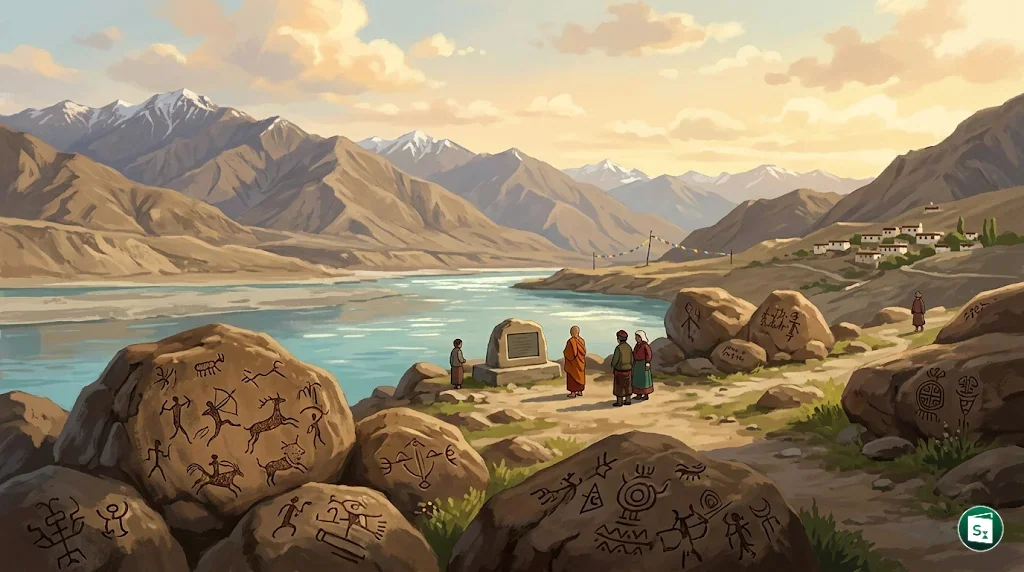
The Lieutenant Governor of Ladakh, Vinai Kumar Saxena, laid the foundation stone for India’s first Petroglyph Conservation Park at Sindhu Ghat in Leh on April 18, 2026. This landmark initiative, launched on World Heritage Day, aims to scientifically preserve the region’s prehistoric rock art that dates back thousands of years. The park will serve as a central hub for the conservation, research, and public display of endangered petroglyphs collected from vulnerable sites across the high-altitude landscape.
Establishing India’s First Petroglyph Conservation Park
The Petroglyph Conservation Park at Sindhu Ghat represents a pioneering effort to create a dedicated sanctuary for Ladakh’s ancient rock carvings. Designed as an open-air museum, the park will house petroglyphs that are currently at risk due to rapid infrastructure growth, road construction, and environmental degradation in remote valleys. By centralising these artifacts in a protected environment, the administration ensures that they remain accessible for academic study and public appreciation while safeguarding them from further damage.
The project involves the systematic relocation of vulnerable carvings from isolated sites along the Indus and Zanskar river basins. Each artifact will undergo a rigorous process of scientific documentation, which includes high-resolution photography, 3D scanning, and detailed cataloging. This approach not only preserves the physical rocks but also creates a digital archive that can be used by researchers worldwide to understand the early human history of the Trans-Himalayan region.
A Strategic Partnership for Heritage Protection
The successful implementation of the conservation park is supported by a significant Memorandum of Understanding (MoU) signed between the Department of Archives, Archaeology and Museums of the Union Territory of Ladakh and the Archaeological Survey of India (ASI). This partnership is designed to foster institutional collaboration, allowing the local administration to leverage the ASI’s extensive technical expertise in heritage management. The ASI, which was established in 1861 and is headquartered in New Delhi, will provide the necessary scientific guidance to ensure that the conservation efforts meet international standards.
This collaboration extends beyond the physical relocation of rocks. It encompasses the training of local staff in modern archaeological techniques and the development of a comprehensive management plan for the site. By integrating the ASI’s technical resources with the local department’s regional knowledge, the initiative aims to create a sustainable model for heritage protection in high-altitude environments. This institutional synergy is crucial for managing the nearly 400 identified petroglyph sites that are scattered across Ladakh’s rugged terrain.
Ladakh’s Ancient Canvas: The Significance of Petroglyphs
Ladakh is often referred to as a global hotspot for rock art, with a heritage that spans from the Neolithic and Bronze Age to the later historical periods. These carvings, etched into the dark varnish of river boulders, serve as a visual record of the people who inhabited and traversed this region over millennia. The themes depicted in the petroglyphs are remarkably diverse, ranging from native fauna like the ibex, snow leopard, and yaks to complex human activities such as hunting, ritual dancing, and ancient migration patterns.
What makes Ladakh’s rock art particularly significant is its role as a linguistic and cultural archive. Many sites feature inscriptions in ancient scripts such as Sanskrit, Brahmi, Arabic, and Chinese. These inscriptions provide vital clues about Ladakh’s historical identity as a pivotal junction on the Silk Road, where diverse civilizations met and exchanged ideas. The presence of Buddhist symbols, such as chortens and the swastika, alongside Central Asian hunting motifs highlights the region’s unique status as a melting pot of Indian, Tibetan, and Central Asian cultures.
Conservation Challenges in the High-Altitude Region
The preservation of rock art in Ladakh faces unique challenges due to the region’s harsh climatic conditions and accelerating pace of development. Many petroglyph sites are located on the banks of the Indus and Zanskar rivers, areas that are now seeing significant infrastructure projects, including the construction of hydroelectric dams and highways. These developmental activities often pose a direct threat to the survival of ancient carvings. Unregulated tourism also adds to the risk, as increased human footprint in remote areas can lead to accidental damage or vandalism of these unprotected sites.
Relocation of the carvings to the Sindhu Ghat park is considered a vital conservation strategy for artifacts that cannot be protected in their original locations. While in-situ conservation is generally preferred in archaeology, the extreme vulnerability of these specific rocks makes the creation of a dedicated conservation park a necessary intervention. This effort aligns with broader national goals of balancing modern development with the preservation of cultural heritage, especially in sensitive regions like Ladakh, which was established as a Union Territory on October 31, 2019.
The Cultural and Educational Vision of Sindhu Ghat
Beyond its primary role in conservation, the park at Sindhu Ghat is envisioned as a major educational and cultural landmark. By transforming the site into an interactive museum, the administration aims to sensitise both locals and tourists about the prehistoric foundations of Ladakhi culture. The selection of Sindhu Ghat, located on the banks of the Indus River, is symbolic, as the river has been the lifeline of the region’s civilizations for thousands of years. The park will feature interpretive signage and guided tours, helping visitors understand the deep history of the rock art and the importance of its preservation.
The laying of the foundation stone on World Heritage Day (April 18) underscores India’s commitment to protecting its diverse cultural landscape. This global observance, established by ICOMOS and approved by UNESCO in 1983, serves as a reminder of the shared responsibility to safeguard heritage for future generations. For Ladakh, the Petroglyph Conservation Park is not just a scientific project but a means of reclaiming and celebrating its role as a crossroad of ancient human ingenuity.
Key Takeaways
- India’s first Petroglyph Conservation Park is being established at Sindhu Ghat in Leh, Ladakh.
- The foundation stone for the park was laid on April 18, 2026, coinciding with World Heritage Day.
- A Memorandum of Understanding (MoU) was signed between the Department of Archives, Archaeology and Museums (Ladakh) and the Archaeological Survey of India (ASI) for scientific conservation.
- The park will function as an open-air museum to relocate and preserve ancient rock carvings threatened by infrastructure development and environmental factors.
- Ladakh was officially established as a Union Territory on October 31, 2019, following the reorganization of Jammu and Kashmir.
- The Archaeological Survey of India (ASI), the premier body for archaeological research in India, was founded in 1861 by Alexander Cunningham.
- World Heritage Day, also known as the International Day for Monuments and Sites, was established by ICOMOS in 1982 and approved by UNESCO in 1983.