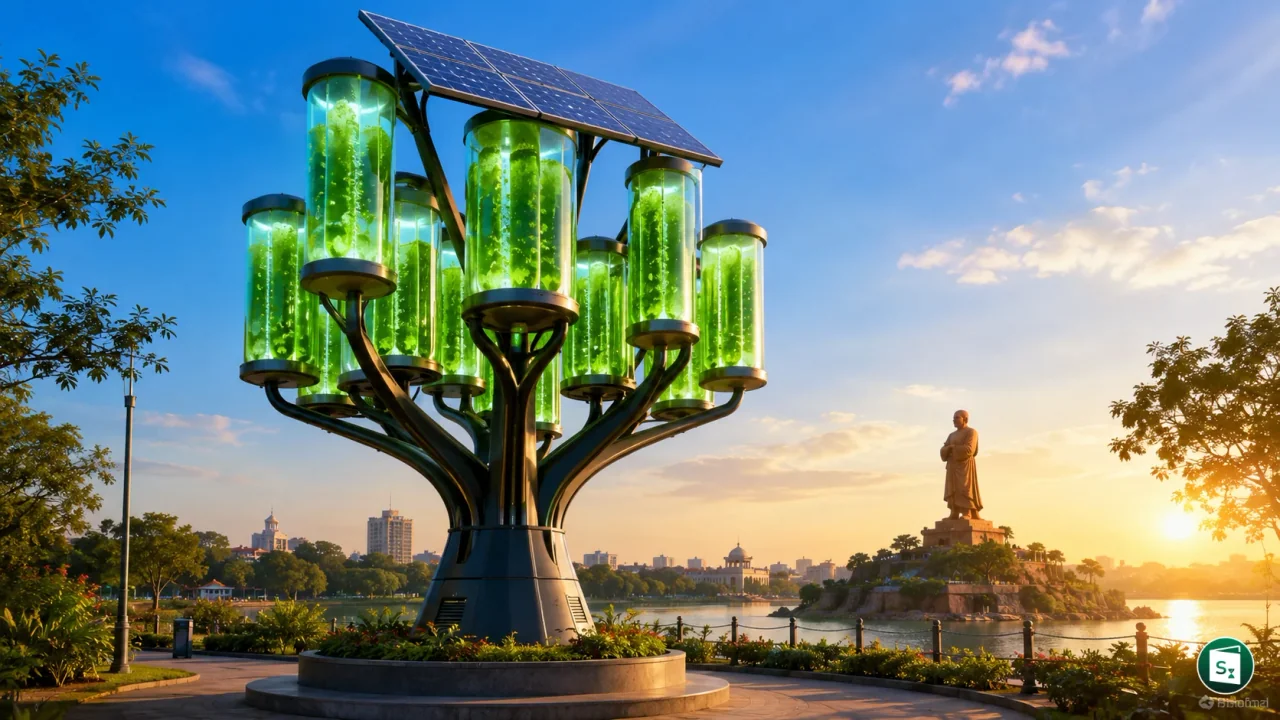
Bhopal has inaugurated India’s first solar-powered Algae Tree at Swami Vivekananda Park, introducing a futuristic solution to the city’s urban air pollution challenges. Developed as an artificial lung, this three-metre-tall climate-tech device uses microalgae-based photobioreactor technology to purify the air in high-traffic zones. This installation marks a significant step under the Bhopal Smart City initiative, aligning with India’s broader environmental goal of achieving Net Zero emissions by 2070.
Understanding the Algae Tree: India’s First Urban Artificial Lung
The Algae Tree is a state-of-the-art climate-tech device designed to address the unique challenges of “concrete jungles” where traditional tree plantation is often impossible due to space constraints. Standing three metres tall, the unit installed at Swami Vivekananda Park (near Roshanpura Square) is a vertical, transparent structure that integrates nature with engineering. Unlike real trees that take decades to mature, this device provides immediate and maximum air purification from the moment it is activated.
The structure is fully solar-powered, featuring integrated panels that supply energy to its internal pumps, sensors, and LED lighting systems. This makes the device self-sustaining and independent of the city’s power grid. It is specifically built for high-pollution corridors, such as road dividers, metro stations, and congested market areas, where vehicular emissions are most concentrated. By mimicking the respiratory functions of a biological forest, it serves as a localized air filter that traps pollutants and releases fresh oxygen back into the atmosphere.
The Science Behind Microalgae Photobioreactors
At the core of the Algae Tree is a Photobioreactor (PBR), a specialized vessel filled with water and specific strains of microalgae such as Chlorella or Spirulina. These microscopic organisms are among the most efficient photosynthesizers on Earth. When air is bubbled through the reactor, the microalgae absorb sunlight and carbon dioxide to grow, and in the process, they release pure oxygen.
Scientific research indicates that microalgae can capture carbon at a rate 10 to 50 times faster than terrestrial plants. This high efficiency is due to their simple structure and lack of roots, stems, or leaves, allowing them to dedicate almost all their energy to photosynthesis. The Algae Tree functions through a continuous biological cycle:
- Carbon Capture: The device draws in ambient air, allowing the algae to “breathe” in the $CO_2$.
- Biomass Production: As the algae grow, they produce biomass which can eventually be harvested and used as organic fertilizer or biofuel.
- Oxygen Release: Pure oxygen is released back into the surrounding environment, creating a localized “bubble” of clean air.
The technology is particularly effective because it works in real-time. While a sapling might take ten years to become an effective carbon sink, a microalgae-based photobioreactor achieves peak performance within days of inoculation.
Impact on Urban Air Quality and Carbon Sequestration
The environmental performance of the Algae Tree is quantifiable and significant. A single unit has the carbon sequestration capacity equivalent to approximately 25 mature trees. In dense urban pockets where planting 25 trees is physically impossible, one Algae Tree provides a powerful alternative.
Beyond carbon capture, the device acts as a heavy-duty air filter. As air passes through the liquid medium, the microalgae and the water trap harmful Particulate Matter (PM), which is a major health concern in Indian cities. The unit reduces PM2.5 levels by 45 to 55 percent and PM10 levels by 60 to 70 percent within a 15-metre radius.
| Feature | Performance (Annual per Unit) |
|---|---|
| Carbon Dioxide ($CO_2$) Absorption | 1.5 Tonnes |
| Pure Oxygen Generation | ~1 Tonne |
| PM2.5 Reduction | 45-55% (within 15m) |
| PM10 Reduction | 60-70% (within 15m) |
The integration of AI-driven sensors allows the device to monitor air quality in real-time. This data is transmitted to a central dashboard, enabling the city administration to track the device’s performance and the local air quality index (AQI) improvements. The Algae Tree thus serves both as a purification unit and a data-gathering tool for urban planning.
Bhopal’s Smart City Initiative and National Clean Air Goals
The installation of the Algae Tree is a flagship project under the Bhopal Smart City mission. Managed by the Bhopal Smart City Development Corporation Limited (BSCDCL), the project reflects a shift toward using biotechnology to solve urban infrastructure problems. This initiative aligns with the National Clean Air Programme (NCAP), which was launched by the Ministry of Environment, Forest and Climate Change in 2019. NCAP aims to reduce particulate matter concentration in over 130 “non-attainment” cities in India.
The project was developed by the Mushroom World Group, a Bhopal-based conglomerate that has expanded from mushroom cultivation into climate-tech and green energy. The group conducted nearly two years of intensive research to perfect the Algae Tree design. This local innovation supports the Make in India vision while providing a scalable model for other Indian cities struggling with severe air pollution.
By integrating such technologies, Bhopal is positioning itself as a leader in sustainable urban development. These efforts are crucial for India to meet its international commitments under the Paris Agreement and its domestic target of achieving Net Zero emissions by 2070. As the first city in India to deploy this technology, Bhopal sets a precedent for how bio-engineering can be used to create healthier urban living spaces.
Key Takeaways
- India’s first solar-powered Algae Tree has been installed at Swami Vivekananda Park in Bhopal, Madhya Pradesh.
- Developed by the Mushroom World Group, the three-metre-tall device uses microalgae-based photobioreactor technology to purify urban air.
- A single Algae Tree can absorb 1.5 tonnes of carbon dioxide ($CO_2$) and generate 1 tonne of oxygen annually, performing the work of 25 mature trees.
- The device reduces PM2.5 and PM10 levels by up to 55 percent and 70 percent respectively within a 15-metre radius.
- The project is part of the Bhopal Smart City mission and aligns with India’s National Clean Air Programme (NCAP) launched in 2019.
- India has committed to achieving Net Zero carbon emissions by the year 2070 under its climate action plan.