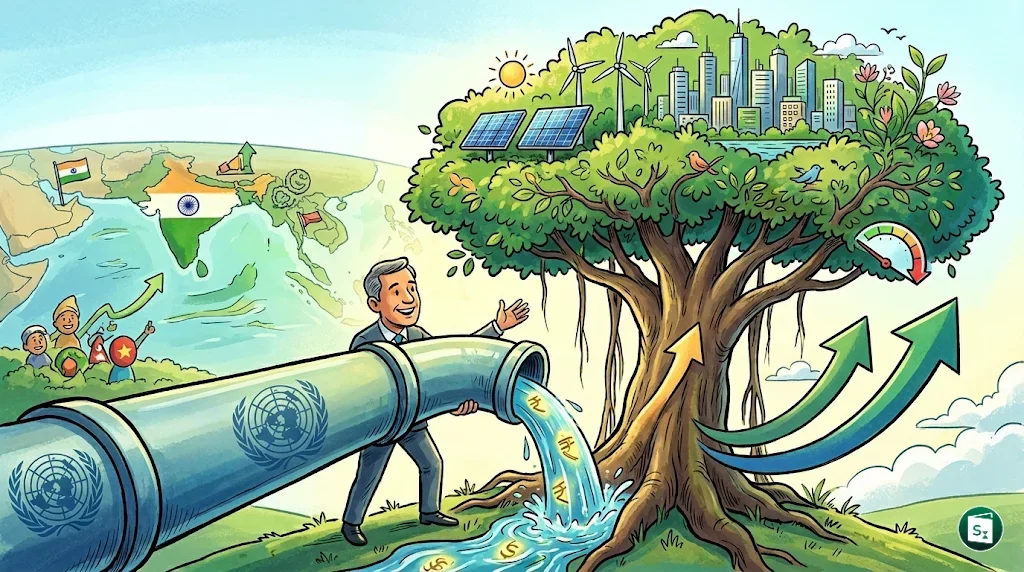
The United Nations Economic and Social Commission for Asia and the Pacific (UN ESCAP) has projected India’s economy to grow at 6.4% in 2026, according to its latest annual report released on April 24, 2026. The findings highlight India’s resilience as a major regional driver, with growth expected to accelerate further to 6.6% in 2027. This economic stability is complemented by India’s emergence as the leading destination for greenfield foreign investments in the Asia-Pacific region.
Forecast for India: Growth and Inflation Outlook
The Economic and Social Survey of Asia and the Pacific 2026 provides a positive outlook for India, driven by robust domestic demand and a steady services sector. While the growth rate is pegged at 6.4% for the Calendar Year 2026 (CY26), it is expected to pick up momentum to reach 6.6% in CY27. This trajectory suggests a resilient recovery path despite global economic uncertainties and shifting trade dynamics.
Inflation management remains a key priority for the Indian economy. The report estimates that India’s inflation will reach 4.4% in CY26, before slightly easing to 4.3% in CY27. These projections indicate a period of relative price stability, which is essential for maintaining consumer purchasing power and encouraging long-term investments. The moderation in inflation aligns with the Reserve Bank of India’s (RBI) target range, reflecting effective monetary policy monitoring.
India Emerges as Greenfield FDI Hub
A standout achievement highlighted in the ESCAP report is India’s dominance in attracting greenfield Foreign Direct Investment (FDI). Greenfield FDI refers to a type of foreign investment where a parent company starts a new venture in a foreign country by constructing new operational facilities from the ground up. This is often viewed as a sign of strong investor confidence in the long-term growth potential and business environment of the host nation.
During the first three quarters of CY26, India attracted the largest share of greenfield FDI in the Asia-Pacific region, totaling $50 billion. This puts India significantly ahead of other major economies in the region. The report notes that India is followed by Australia, the Republic of Korea, and Kazakhstan in this indicator. The sustained inflow of such capital is crucial for infrastructure development, job creation, and technological advancement within the country.
| Country | Greenfield FDI (First 3 Qtrs CY26) |
|---|---|
| India | $50 Billion |
| Australia | $30 Billion |
| Republic of Korea | $25 Billion |
| Kazakhstan | $21 Billion |
Regional Trends in South and South-West Asia
The broader economic landscape of South and South-West Asia also shows signs of improvement. The region is estimated to grow at a rate of 5.4% in CY25, marking a steady increase from the 5.2% recorded in CY24. India continues to be the primary engine of growth for this sub-region, significantly influencing overall regional performance.
However, the report also cautions that the region remains vulnerable to external shocks. Geopolitical tensions in West Asia and fluctuations in global commodity prices pose potential risks to the supply chain and trade stability. The Survey emphasizes the need for regional cooperation to build economic resilience and navigate the complexities of the global financial environment.
Sustainable Prosperity: The Survey’s Core Theme
The 2026 edition of the Survey, titled “Socioeconomic Prosperity Amid the Transition to an Environmentally Sustainable Economy,” focuses on the dual challenge of achieving high growth while transitioning to a greener economy. It advocates for policies that integrate climate action with social and economic development goals.
For countries like India, the transition involves significant shifts in energy production, industrial processes, and urban development. The Survey suggests that while the transition requires substantial upfront investment, it offers long-term benefits such as energy security, reduced health costs related to pollution, and the creation of new “green” jobs. India’s progress in renewable energy and its commitment to the Net Zero 2070 target are mentioned as critical steps in this direction.
What is UN ESCAP?
The United Nations Economic and Social Commission for Asia and the Pacific (UN ESCAP) is the regional development arm of the United Nations for the Asia-Pacific region. Established in 1947 as the Economic Commission for Asia and the Far East (ECAFE), it was later renamed in 1974 to reflect its broader mandate.
Headquartered in Bangkok, Thailand, ESCAP is the largest of the five UN regional commissions. It comprises 53 member states and 9 associate members, covering a vast geographic area from Turkey in the west to Kiribati in the east. Its primary role is to foster regional cooperation and sustainable development, providing a platform for policy dialogue and knowledge sharing among its member nations. ESCAP operates under the UN Economic and Social Council (ECOSOC).
Key Takeaways
- India’s economy is projected to grow at 6.4% in 2026 and 6.6% in 2027, according to the UN ESCAP report.
- India leads the Asia-Pacific region in attracting greenfield Foreign Direct Investment (FDI), worth $50 billion in the first three quarters of CY26.
- The country’s inflation rate is forecast to be 4.4% in 2026 and 4.3% in 2027.
- The growth rate of the South and South-West Asia region is estimated at 5.4% in 2025, an increase from 5.2% in 2024.
- UN ESCAP was established in 1947 and is headquartered in Bangkok, Thailand.
- Greenfield FDI refers to foreign investment in entirely new projects and facilities, as opposed to acquiring existing ones.