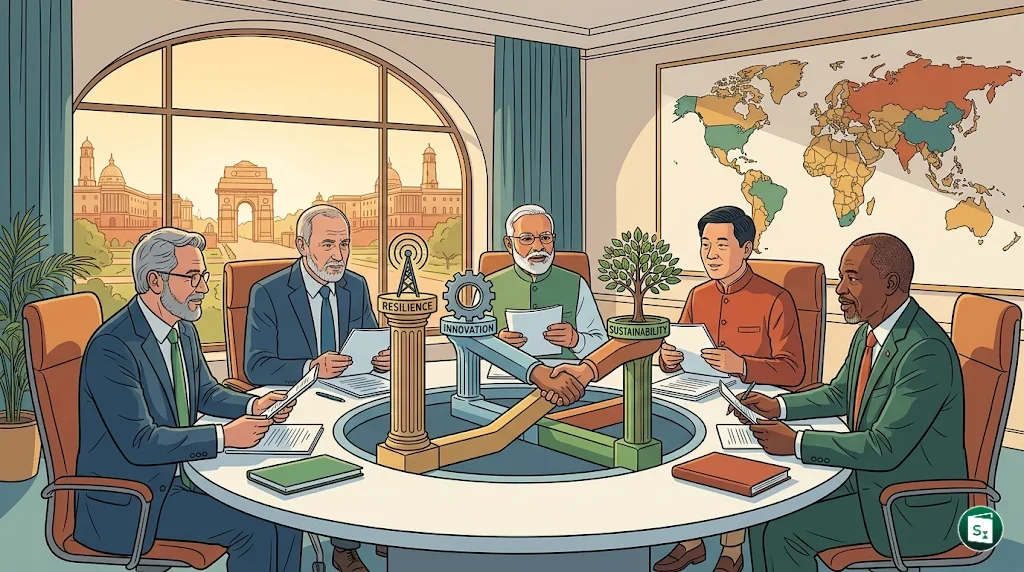
India’s capital, New Delhi, hosted the inaugural BRICS Academic Forum on 27 April 2026, a key preparatory event under India’s fourth BRICS Chairship. Organized by the Observer Research Foundation (ORF) and the Research and Information System for Developing Countries (RIS), the forum functions as a Track II diplomacy platform to generate policy recommendations for the 18th BRICS Summit. The gathering focuses on the central theme of “Building for Resilience, Innovation, Cooperation and Sustainability,” aligning with India’s strategic priorities for the expanded bloc.
The BRICS Academic Forum: A Track II Initiative
The BRICS Academic Forum serves as a vital Track II diplomacy platform, facilitating informal dialogue among scholars, policy experts, and research institutions from all member nations. Unlike Track I diplomacy, which involves official government negotiations, Track II initiatives allow for a more candid exchange of ideas to explore complex geopolitical and economic challenges. For the 2026 edition, the forum has brought together 13 international speakers to deliberate on issues that will shape the future of the expanded bloc.
This advisory platform is specifically designed to support the host nation in its summit preparations. By convening experts early in the chairship year, the forum generates well-researched policy recommendations that reflect the shared interests and diverse perspectives of the BRICS members. These recommendations are then funneled into the official diplomatic process to inform the agenda of the upcoming leaders’ summit.
Core Pillars: Resilience, Innovation, Cooperation, and Sustainability
The 2026 BRICS Academic Forum is structured around four foundational pillars that reflect the priorities of India’s chairship. These pillars are designed to address the most pressing global concerns while fostering deeper integration among member states.
- Resilience: This pillar focuses on building robust economic and institutional frameworks to withstand global shocks, including supply chain disruptions and financial volatility.
- Innovation: It highlights the importance of technological advancement, digital transformation, and research collaboration in driving future growth.
- Cooperation: This theme emphasizes the need for multilateral engagement and collective action on issues such as climate change, healthcare, and security.
- Sustainability: It prioritizes environmentally conscious development and the achievement of Sustainable Development Goals (SDGs) across the bloc.
These discussions are not confined to New Delhi alone. A series of meetings are being conducted across various locations in India and abroad to develop comprehensive recommendations. This broad engagement ensures that the final proposals presented to the leaders are inclusive of diverse regional perspectives.
Institutional Support: Role of ORF and RIS
The Observer Research Foundation (ORF) and the Research and Information System for Developing Countries (RIS) are the principal institutions organizing the academic forum. Established in 1990, ORF is one of India’s leading independent think tanks, focused on providing non-partisan analyses on global and domestic policy issues. It is headquartered in New Delhi.
The Research and Information System for Developing Countries (RIS) was established in 1983 and is also based in New Delhi. As an autonomous policy research institution, RIS specializes in international economic development, trade, and technology cooperation. By partnering for this initiative, these two organizations bridge the gap between academic research and diplomatic strategy, ensuring that India’s chairship is supported by rigorous intellectual frameworks.
Historical Context: India’s Role in BRICS
India has been a pivotal member of BRICS since its inception as BRIC (Brazil, Russia, India, and China) in 2006. South Africa joined the group in 2010, transforming it into BRICS. India previously hosted BRICS Summits in 2012 (New Delhi), 2016 (Goa), and 2021. The 2026 chairship marks the fourth time India has led the group, highlighting its consistent commitment to multilateralism and the interests of the Global South.
Over the years, India has championed significant initiatives within the bloc, most notably the establishment of the New Development Bank (NDB) and the Contingent Reserve Arrangement (CRA). The current chairship is especially critical as it serves the expanded bloc, which now includes members such as Egypt, Ethiopia, Iran, and the United Arab Emirates (UAE) who joined in 2024.
Key Takeaways
- The inaugural BRICS Academic Forum was hosted in New Delhi on 27 April 2026 as part of India’s fourth chairship.
- The Observer Research Foundation (ORF) and the Research and Information System for Developing Countries (RIS) are the nodal organizers of the event.
- The forum serves as a Track II diplomacy platform to generate policy recommendations for the 18th BRICS Summit.
- The theme of the 2026 chairship is “Building for Resilience, Innovation, Cooperation and Sustainability.”
- Discussions are centered on four core pillars: Resilience, Innovation, Cooperation, and Sustainability.
- The initiative involves 13 international speakers and a series of meetings conducted across both India and abroad.