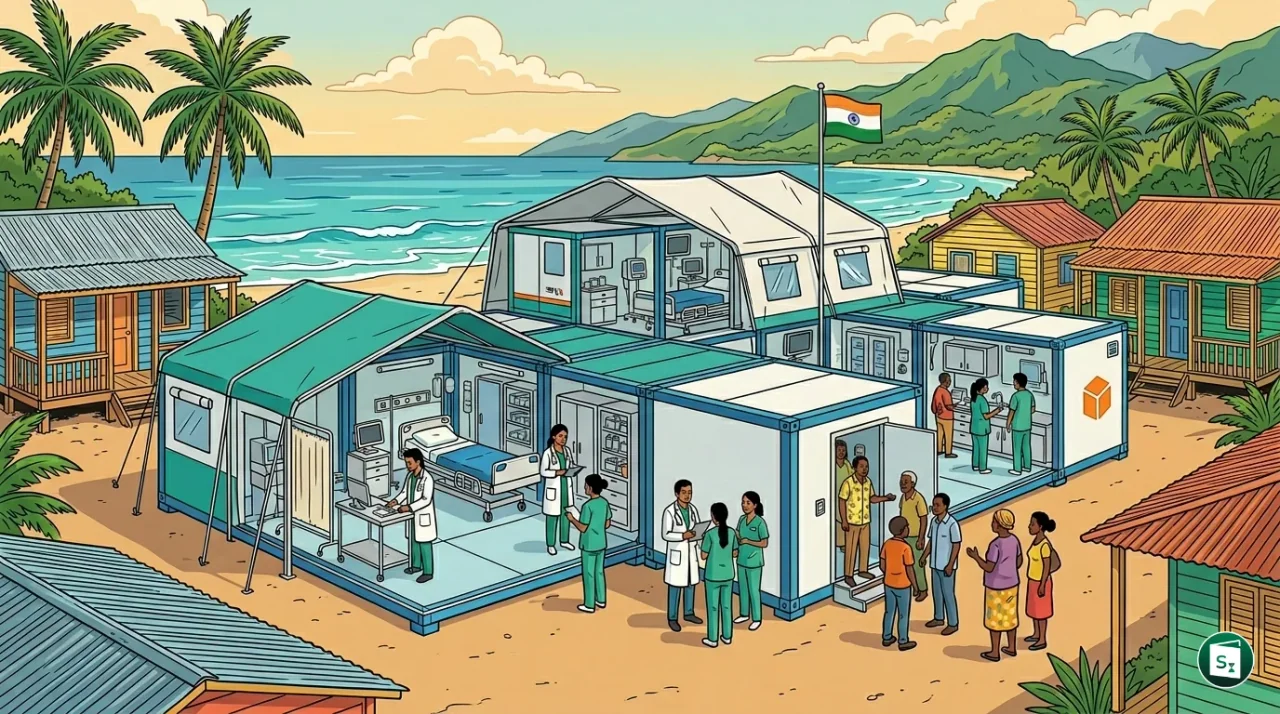
India deployed the Aarogya Maitri (BHISHM Cube), the world’s first portable and modular hospital system, in Jamaica on May 8, 2026, to bolster health cooperation in the Caribbean region. This strategic move is part of the Humanitarian Assistance and Disaster Relief (HADR) framework aimed at strengthening bilateral ties with CARICOM nations. By providing this advanced medical infrastructure, India reaffirms its role as a reliable first responder and a leader in medical diplomacy within the Global South.
Strengthening India-Jamaica Health Cooperation
The deployment of the BHISHM Cube in Jamaica marks a significant milestone in the medical diplomacy between the two nations. Jamaica, a key member of the Caribbean Community (CARICOM), has been a close partner for India in the region. This initiative operationalizes the “Medicine” pillar of the seven-pillar cooperation framework proposed by Prime Minister Narendra Modi during the India-CARICOM Summit. The framework, represented by the acronym CARICOM, emphasizes enhancing regional health security through affordable and accessible medical solutions.
This move follows previous humanitarian efforts by India in the Caribbean, including disaster relief provided after major hurricanes. By gifting this portable healthcare infrastructure, India is helping Jamaica bridge the gap between primary care and definitive hospital treatment, especially during the “golden hour” of emergencies. The Ministry of External Affairs (MEA) and the National Security Council Secretariat (NSCS) coordinated the deployment, reflecting a comprehensive approach to international humanitarian aid.
Technical Capabilities of the BHISHM Cube
The BHISHM Cube, which stands for Bharat Health Initiative for Sahyog, Hita, and Maitri, is a marvel of indigenous innovation. It is designed to be a fully functional, mobile hospital that can be transported via air, sea, or land, including airdrops in remote regions. The system is highly scalable and consists of 72 mini-cubes, each weighing approximately 20 kg. These mini-cubes are water-resistant and can be carried by a single person, or even transported via drones and bicycles.
The internal architecture of the system is divided into two “Mother Cubes.” Each Mother Cube contains 36 mini-cubes, and together they form a comprehensive medical unit. The system is equipped with RFID (Radio Frequency Identification) technology for real-time tracking of medical inventory and expiry dates. A dedicated tablet-based application, supporting 180 languages, provides step-by-step instructions for assembly and operation, ensuring that local medical teams can deploy the unit in less than 12 minutes.
| Feature | Specification |
|---|---|
| Number of Mini-Cubes | 72 |
| Deployment Time | Less than 12 minutes |
| Patient Capacity | 200 emergency cases |
| Operating Duration | 48 hours (self-sufficient) |
| Medical Scope | Trauma, surgery, fractures, burns, and ICU care |
The BHISHM Cube is not just a collection of medical supplies; it includes advanced diagnostic tools such as portable X-ray machines, ultrasound scanners, and mini-ICU equipment. It can handle complex medical emergencies including gunshot wounds, chest injuries, and spinal cord trauma. Additionally, one of the Mother Cubes is designed to support the medical crew with food, water, and power generation for two days.
Strategic Importance of Project Aarogya Maitri
The BHISHM Cube is a central component of Project Aarogya Maitri, an ambitious initiative announced by Prime Minister Modi during the Voice of Global South Summit in January 2023. This project aims to provide essential medical supplies and healthcare infrastructure to developing nations facing natural disasters or humanitarian crises. It reflects India’s philosophy of Vasudhaiva Kutumbakam (The World is One Family) and its commitment to being a “First Responder” in the Global South.
By deploying such innovative technology, India is moving beyond traditional aid and offering high-tech, sustainable solutions that address the specific vulnerabilities of small island developing states (SIDS) like Jamaica. These nations often face logistical challenges in reaching remote populations during disasters. The modular and portable nature of the BHISHM system allows it to reach areas where traditional hospitals cannot be built or have been destroyed. This “strategic altruism” helps India build deep, long-term trust and strengthens its soft power globally.
The India-CARICOM Partnership Framework
India’s relationship with the Caribbean Community (CARICOM) has evolved into a structured partnership focused on trade, technology, and disaster resilience. Established in 1973 via the Treaty of Chaguaramas, CARICOM is a regional intergovernmental organization comprising 15 member states, including Jamaica, Guyana, and Barbados. The organization is headquartered in Georgetown, Guyana.
The current cooperation is guided by the seven pillars proposed by India, which include Capacity Building, Agriculture, Renewable Energy, Infrastructure, Culture, Oceanic Economy, and Medicine (CARICOM). The deployment of medical infrastructure like the BHISHM Cube in Jamaica is a direct application of the “Medicine” pillar. This regional approach allows India to engage with multiple nations simultaneously, addressing common challenges such as climate change, healthcare access, and economic sustainability. By positioning itself as a partner in the Caribbean’s development, India is securing its presence in a geopolitically sensitive region.
Jamaica: A Snapshot of the Caribbean Nation
Jamaica is an island nation located in the Caribbean Sea, south of Cuba. It is a unitary parliamentary constitutional monarchy and a member of the Commonwealth of Nations, with its capital city in Kingston. The nation’s official language is English, and its currency is the Jamaican dollar (JMD).
| Category | Detail |
|---|---|
| Capital | Kingston |
| Prime Minister | Andrew Holness |
| Official Language | English |
| Currency | Jamaican Dollar (JMD) |
| Independence | August 6, 1962 (from the UK) |
The country is the third-largest island in the Caribbean and is known for its diverse geography, including the Blue Mountains, which reach an elevation of 2,256 meters. Jamaica’s economy is heavily dependent on tourism and agriculture, making it particularly vulnerable to climate-related disasters like hurricanes. India’s support through Project Aarogya Maitri is therefore highly relevant to Jamaica’s national resilience strategy.
Key Takeaways
- India deployed the BHISHM Cube portable hospital in Jamaica on May 8, 2026, as part of the Aarogya Maitri initiative.
- The BHISHM Cube (Bharat Health Initiative for Sahyog, Hita, and Maitri) consists of 72 modular mini-cubes and can be set up in less than 12 minutes.
- A full BHISHM system is capable of treating approximately 200 emergency cases for a duration of 48 hours.
- This deployment strengthens India’s relations with the Caribbean Community (CARICOM), which was established in 1973 via the Treaty of Chaguaramas.
- The CARICOM organization is headquartered in Georgetown, Guyana, and comprises 15 member states.
- The initiative is a core part of India’s Humanitarian Assistance and Disaster Relief (HADR) framework and its commitment to the Global South.