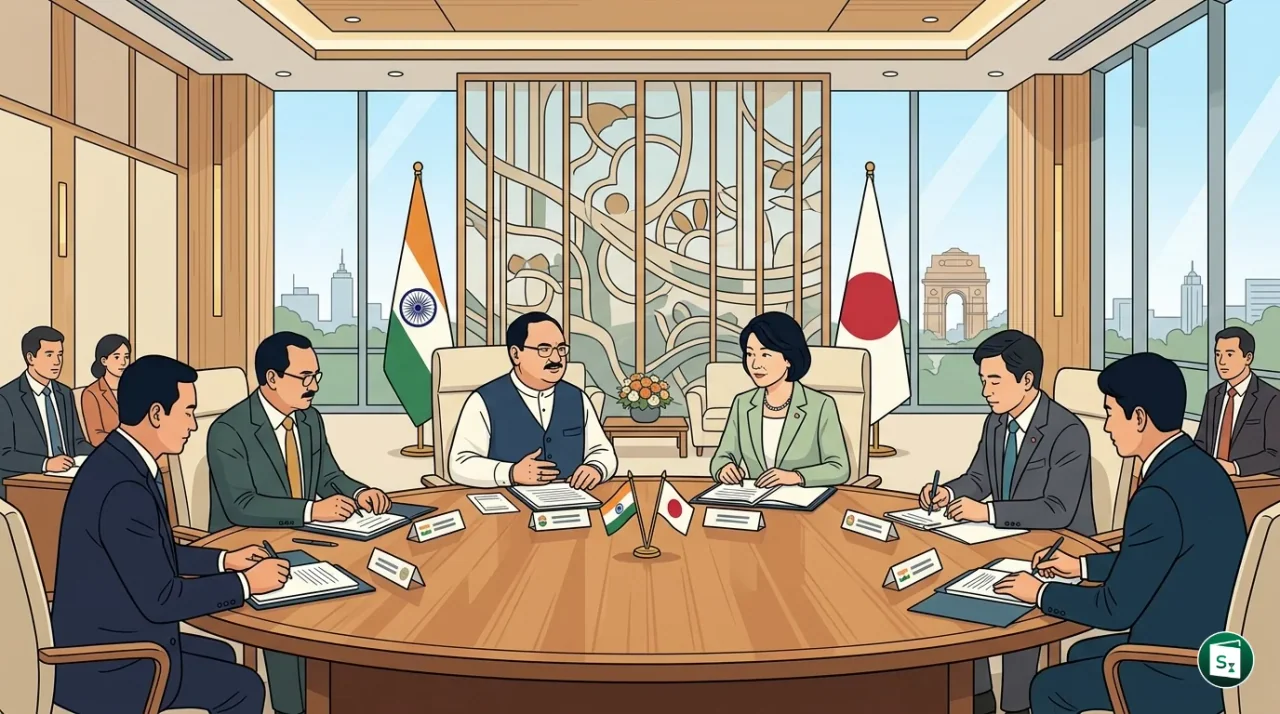
The 3rd India-Japan Joint Committee Meeting on Healthcare was held at Bharat Mandapam in New Delhi on May 5, 2026, to strengthen the bilateral partnership in medical innovation and research. Union Minister for Health and Family Welfare, Jagat Prakash Nadda, and the Japanese Minister in charge of Healthcare Policy, Kimi Onoda, co-chaired the session. The dialogue focused on leveraging technology to address shared health challenges and enhance the accessibility of healthcare services across both nations.
Deepening the India-Japan Healthcare Partnership
The 3rd Joint Committee Meeting (JCM) marks a significant milestone in the healthcare cooperation between India and Japan, which is anchored in the Memorandum of Cooperation (MoC) signed in October 2018. This memorandum established a robust framework for collaboration in areas such as healthcare infrastructure, research, and human resource development. During the meeting at Bharat Mandapam, both ministers reaffirmed their commitment to achieving Universal Health Coverage (UHC) and promoting the Asia Health and Wellbeing Initiative (AHWIN).
The discussions underscored the importance of bilateral synergy in addressing global health priorities. India highlighted its progress in expanding healthcare access through national schemes, while Japan shared its expertise in geriatric care and advanced medical technologies. The meeting served as a consultative platform to review the progress of ongoing projects and identify new avenues for strategic partnership in the post-pandemic era.
Strategic Cooperation in Innovation and Medical Technology
A primary focus of the 3rd JCM was the promotion of innovation and the adoption of cutting-edge technology in the healthcare sector. Both nations explored opportunities for joint research and development in medical devices, particularly in areas like diagnostic imaging and therapeutic equipment. Japan, a global leader in high-end medical technology, expressed interest in collaborating with Indian manufacturers to develop affordable and high-quality medical products under the Make in India initiative.
The meeting also highlighted the successful collaboration between the Japan Agency for Medical Research and Development (AMED) and the Indian Council of Medical Research (ICMR). These premier research institutions are working together on several projects related to genomics, regenerative medicine, and infectious disease control. By combining Japan’s advanced research capabilities with India’s large-scale clinical data and manufacturing prowess, the partnership aims to accelerate the development of innovative solutions for global health issues.
Strengthening Global Supply Chains and Digital Health
Both sides emphasized the need for resilient and diversified medical supply chains to prevent future disruptions. India, often referred to as the “pharmacy of the world,” showcased its potential to provide cost-effective pharmaceutical products to Japan. The discussion also included the integration of digital health solutions, with India presenting the achievements of the Ayushman Bharat Digital Mission (ABDM). This mission aims to create a digital health ecosystem through health IDs and electronic records, facilitating seamless healthcare delivery.
Japan shared its experience in implementing AI-enabled health monitoring systems and digital tools for managing chronic conditions. The meeting specifically addressed the rising burden of Non-Communicable Diseases (NCDs), such as diabetes and cardiovascular ailments. Both countries agreed to collaborate on prevention, early screening, and community-based management of NCDs, leveraging digital infrastructure to improve patient outcomes and reduce healthcare costs.
Human Resource Development and Research Collaboration
The 3rd JCM also focused on enhancing human resource cooperation, particularly in the nursing and caregiving sectors. The Specified Skilled Workers (SSW) program remains a key pillar of this cooperation, allowing Indian healthcare professionals to work in Japan after undergoing specialized training and language certification. This initiative addresses Japan’s growing need for healthcare workers while providing valuable international experience to Indian professionals.
Furthermore, the ministers reviewed the activities under the India-Japan Memorandum of Cooperation (MoC), which serves as the overarching framework for bilateral health relations. The committee discussed expanding the scope of the MoC to include traditional medicine, such as Ayurveda and Kampo, to promote holistic wellbeing. By fostering a multi-dimensional partnership, India and Japan aim to build more resilient health systems that can withstand future global health crises.
Key Takeaways
- The 3rd India-Japan Joint Committee Meeting (JCM) on Healthcare was held on May 5, 2026, at Bharat Mandapam in New Delhi.
- The meeting was co-chaired by Union Minister of Health and Family Welfare Jagat Prakash Nadda and Japanese Minister Kimi Onoda.
- The bilateral healthcare partnership is governed by the Memorandum of Cooperation (MoC) signed in October 2018.
- Key areas of cooperation include innovation, medical technology, digital health, and human resource development.
- The Asia Health and Wellbeing Initiative (AHWIN) and the Specified Skilled Workers (SSW) program are central to this collaboration.
- Research institutions like ICMR (India) and AMED (Japan) are collaborating on genomics and regenerative medicine.