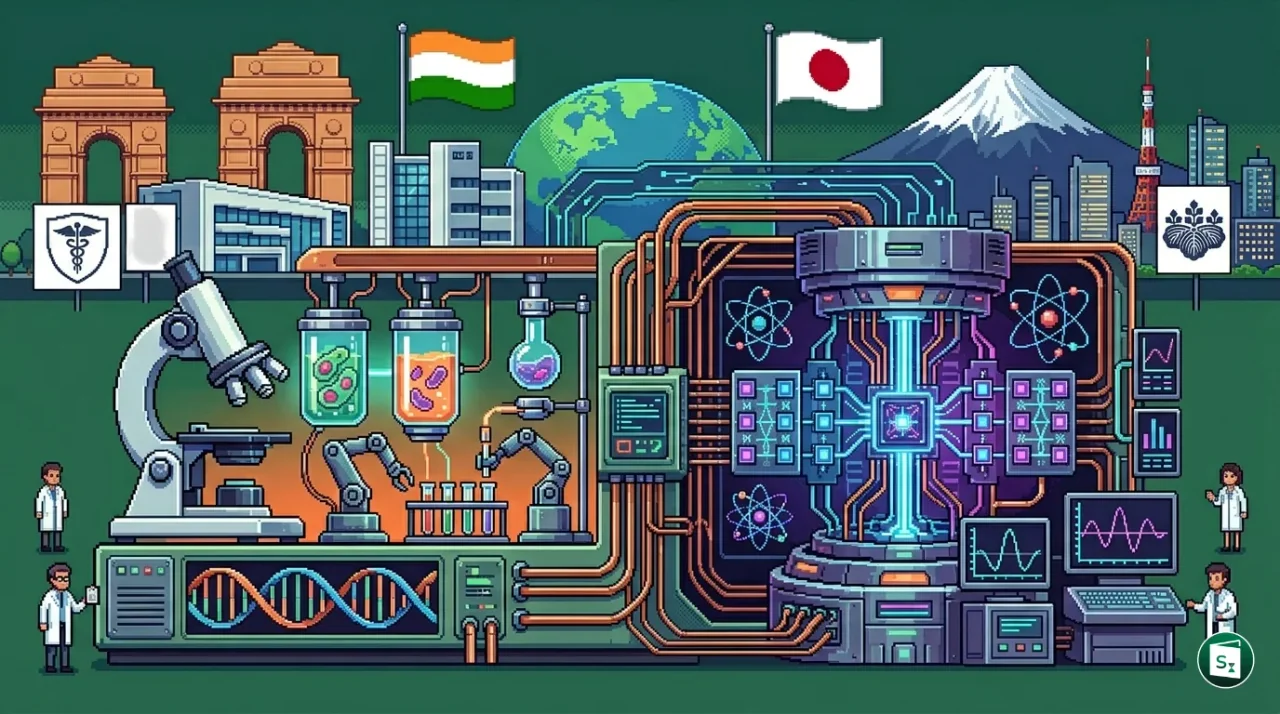
India and Japan have formalised two landmark agreements to deepen bilateral ties in healthcare research and quantum technology during a high-level meeting in New Delhi on May 13, 2026. The collaboration involves the exchange of a Memorandum of Cooperation (MoC) for biomedical research and a Letter of Intent (LoI) to advance quantum science. This partnership marks a significant step in aligning India’s research talent with Japan’s technological expertise to address global challenges.
India and Japan Ink Key Agreements in Health and Technology
The bilateral meeting held in New Delhi featured the participation of India’s Minister of State for Science and Technology, Dr. Jitendra Singh, and Japan’s Minister for Science and Technology Policy, Kimi Onoda. The discussions underscored the growing synergy between the two nations under the India-Japan Science, Technology and Innovation Partnership, which was originally expanded during Prime Minister Narendra Modi’s visit to Japan in August 2025.
The agreements aim to translate high-level scientific research into tangible societal benefits. By combining Japan’s advanced technological infrastructure with India’s vast scientific talent pool and data resources, both countries intend to accelerate the development of affordable and innovative solutions. This engagement reflects a mutual commitment to leveraging emerging technologies for human-centric development.
Strengthening Bilateral Health Research: The ICMR-AMED-DST MoC
The Memorandum of Cooperation signed between the Japan Agency for Medical Research and Development (AMED), the Indian Council of Medical Research (ICMR), and India’s Department of Science and Technology (DST) focuses on biomedical research and the development of medical devices. This trilateral partnership is designed to foster joint research projects, capacity building for scientists, and the creation of structured funding mechanisms for healthcare innovation.
| Agency | Country | Primary Role |
|---|---|---|
| ICMR | India | Apex body for formulating and coordinating biomedical research. |
| DST | India | Nodal department for promoting scientific and technological activities. |
| AMED | Japan | Central agency for funding medical research and development. |
The Indian Council of Medical Research (ICMR), headquartered in New Delhi, was established in 1911 and is one of the oldest medical research bodies in the world. Similarly, the Department of Science and Technology (DST), founded in 1971, serves as the backbone for India’s scientific policy and research support. Japan’s AMED, established in 2015 in Tokyo, acts as a bridge between basic research and clinical application, ensuring that scientific discoveries reach patients faster. Through this MoC, the agencies will collaborate on addressing diseases of mutual concern and enhancing the self-reliance of both nations in medical technology.
Advancing the Frontiers: LoI for Quantum Science and Technology
The Letter of Intent (LoI) signed between the Cabinet Office of Japan and India’s Department of Science and Technology (DST) targets the rapidly evolving field of Quantum Science and Technology. This agreement covers critical sub-domains including quantum computing, quantum sensing, secure communication systems, and the development of advanced quantum materials.
India has already taken significant strides in this domain with the National Quantum Mission (NQM), which was approved with a budget of ₹6,003.65 crore for the period 2023 to 2031. The NQM aims to develop intermediate-scale quantum computers with 50 to 1,000 physical qubits and establish secure quantum communication networks over long distances. The LoI with Japan provides a strategic international framework for India to collaborate with one of the global leaders in high-precision engineering and semiconductor technology, which are essential for quantum hardware.
Analogy · Understanding Quantum Computing Expand analogy
If classical computers are like finding the way through a maze by trying every path one after another, a quantum computer is like a fog that fills the entire maze at once to find the exit instantly. It uses the unique properties of subatomic particles to perform calculations at speeds unimaginable for today’s supercomputers.
Both nations will now work toward establishing joint research labs and exchange programmes for doctoral and post-doctoral researchers. This collaboration is expected to lead to breakthroughs in secure financial transactions, drug discovery, and climate modelling.
Strategic Significance: Expanding the India-Japan S&T Partnership
The latest agreements are part of the broader India-Japan Special Strategic and Global Partnership. Science and technology have emerged as a core pillar of this relationship, particularly in the context of the Quad (Quadrilateral Security Dialogue) cooperation on critical and emerging technologies. Both India and Japan share a vision for a “Free and Open Indo-Pacific,” where technological self-reliance and secure supply chains are paramount.
For India, Japan is a key partner in its journey to become a global hub for Deep Tech and high-end manufacturing. Japan, in turn, views India as a critical partner for diversifying its research and development base and accessing a young, skilled workforce. The focus on healthcare research is also timely, given the lessons learned from global health crises, emphasizing the need for robust medical supply chains and innovative diagnostic tools.
By formalising these partnerships, both nations are not only strengthening their bilateral bond but also contributing to the creation of a more resilient and technologically advanced global ecosystem. The collaboration in quantum technology, in particular, ensures that both countries remain at the forefront of the next industrial revolution.
Key Takeaways
- India and Japan signed a Memorandum of Cooperation (MoC) and a Letter of Intent (LoI) on May 13, 2026, to boost health research and quantum technology.
- The trilateral MoC for health involves India’s ICMR, DST, and Japan’s AMED for biomedical research and medical device innovation.
- The LoI for Quantum Science and Technology was signed between India’s DST and the Cabinet Office of Japan.
- The Indian Council of Medical Research (ICMR) was established in 1911 and is headquartered in New Delhi.
- India’s National Quantum Mission (NQM) has a total outlay of ₹6,003.65 crore for the period 2023 to 2031.
- Japan’s AMED was founded in 2015 and acts as the central agency for funding medical R&D in Japan.