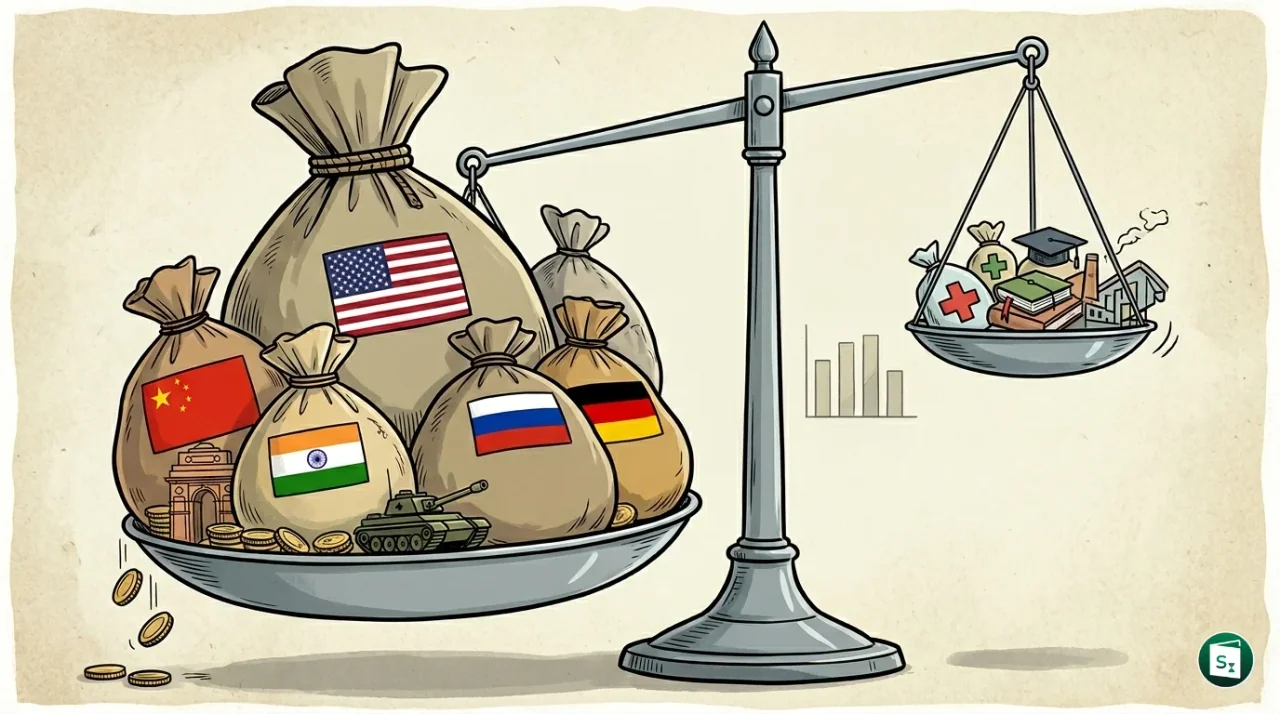
India has retained its position as one of the world’s most significant defense spenders, ranking fifth globally in 2025 with an expenditure of $92.1 billion. According to the latest report from the Stockholm International Peace Research Institute (SIPRI), this represents an 8.9% increase over the previous year, accounting for 3.2% of the total global military outlay. This surge reflects India’s dual focus on addressing persistent border tensions and accelerating the indigenization of its military hardware.
Global Military Expenditure Reaches Record High in 2025
The total global military expenditure reached an unprecedented $2,887 billion in 2025, marking the eleventh consecutive year of growth. This record-breaking figure represents a 2.9% increase in real terms compared to 2024. Despite a notable 7.5% decline in the military spending of the United States, the global total continued its upward trajectory, primarily driven by massive rearmament drives in Europe and steady increases in Asia.
Military spending now accounts for 2.5% of the global Gross Domestic Product (GDP), the highest level recorded since 2009. The concentration of global spending remains high, with the top 15 countries accounting for nearly 80% of the total world expenditure.
| Rank | Country | Expenditure ($ Billion) | Global Share (%) |
|---|---|---|---|
| 1 | United States | 954 | 33% |
| 2 | China | 336 | 12% |
| 3 | Russia | 190 | 6.6% |
| 4 | Germany | 114 | 3.9% |
| 5 | India | 92.1 | 3.2% |
India’s Standing in the Global Defense Rankings
India has consistently remained among the top military spenders globally. With an outlay of $92.1 billion, India accounts for roughly 3.2% of the global defense budget. In the Indo-Pacific region, India remains the second-largest spender, trailing only China, which spent $336 billion in 2025.
The growth in India’s spending (8.9%) is notably higher than the global average growth rate of 2.9%. This underlines a sustained commitment to modernizing the armed forces and maintaining a credible deterrent in a complex geopolitical environment.
Strategic Factors Driving India’s Defense Spending
The surge in India’s military expenditure is largely attributed to the ongoing security challenges along the Line of Actual Control (LAC) with China and the Line of Control (LoC) with Pakistan. These tensions have necessitated enhanced troop presence, infrastructure development in border areas, and the procurement of advanced surveillance and combat systems.
Focus on Self-Reliance and Indigenization
A significant portion of the defense budget is now directed toward domestic procurement under the Atmanirbhar Bharat (Self-Reliant India) initiative. In the 2024-2025 fiscal year, approximately 75% of the capital acquisition budget was earmarked for the domestic defense industry. This policy aims to reduce dependence on foreign imports and foster a robust local defense manufacturing ecosystem.
Modernization and Infrastructure
Key investments have been made in the following areas:
- Naval Expansion: Strengthening the carrier battle groups and submarine fleet to secure the Indian Ocean Region.
- Air Superiority: Procurement and local assembly of multi-role fighter aircraft and advanced drone systems.
- Border Infrastructure: Development of all-weather roads, tunnels, and strategic outposts in high-altitude regions to improve logistics and response times.
Regional Shifts: European Rearmament and NATO Trends
The year 2025 saw a massive shift in military spending within Europe, largely driven by the ongoing conflict in Ukraine and the resulting security anxieties among NATO members. Germany rose to the 4th position globally, reflecting its significant commitment to the Zeitenwende (historic turning point) policy, which involves a massive modernization of its armed forces.
The 32 members of NATO (North Atlantic Treaty Organization) collectively spent $1,581 billion, representing 55% of the global total. Notably, 23 NATO members met or exceeded the target of spending at least 2% of their GDP on defense, a significant increase from previous years. In Asia, spending grew by 8.1%, reaching $681 billion, as countries responded to the growing military capabilities of China.
About the Stockholm International Peace Research Institute (SIPRI)
The Stockholm International Peace Research Institute (SIPRI) is an independent international institute dedicated to research into conflict, armaments, arms control, and disarmament. Established in 1966, SIPRI provides data, analysis, and recommendations, based on open sources, to policymakers, researchers, media, and the interested public.
Headquartered in Solna, Sweden, SIPRI is widely considered one of the most authoritative sources for global military expenditure data. Its annual Yearbooks and Fact Sheets are used as primary benchmarks for analyzing global security trends.
Key Takeaways
- India is ranked as the 5th largest military spender in the world for 2025, according to the latest SIPRI report.
- India’s military expenditure reached $92.1 billion, accounting for 3.2% of the total global defense spending.
- Global military spending hit a record high of $2,887 billion in 2025, representing a 2.9% real-term increase.
- The United States remains the largest spender at $954 billion, followed by China, Russia, and Germany.
- Approximately 75% of India’s capital acquisition budget for 2024-25 was reserved for the domestic defense industry under the Atmanirbhar Bharat initiative.
- The Stockholm International Peace Research Institute (SIPRI), founded in 1966, is headquartered in Solna, Sweden.