India’s retail inflation increased slightly to 3.48% in April 2026, up from 3.4% in March, according to official data released by the Ministry of Statistics and Programme Implementation (MoSPI). The rise was largely attributed to a jump in food inflation, which reached 4.2% during the month. Despite this marginal uptick, headline inflation remains within the Reserve Bank of India’s (RBI) comfort zone of 2% to 6%.
Analysis of Retail Inflation Trends in April 2026
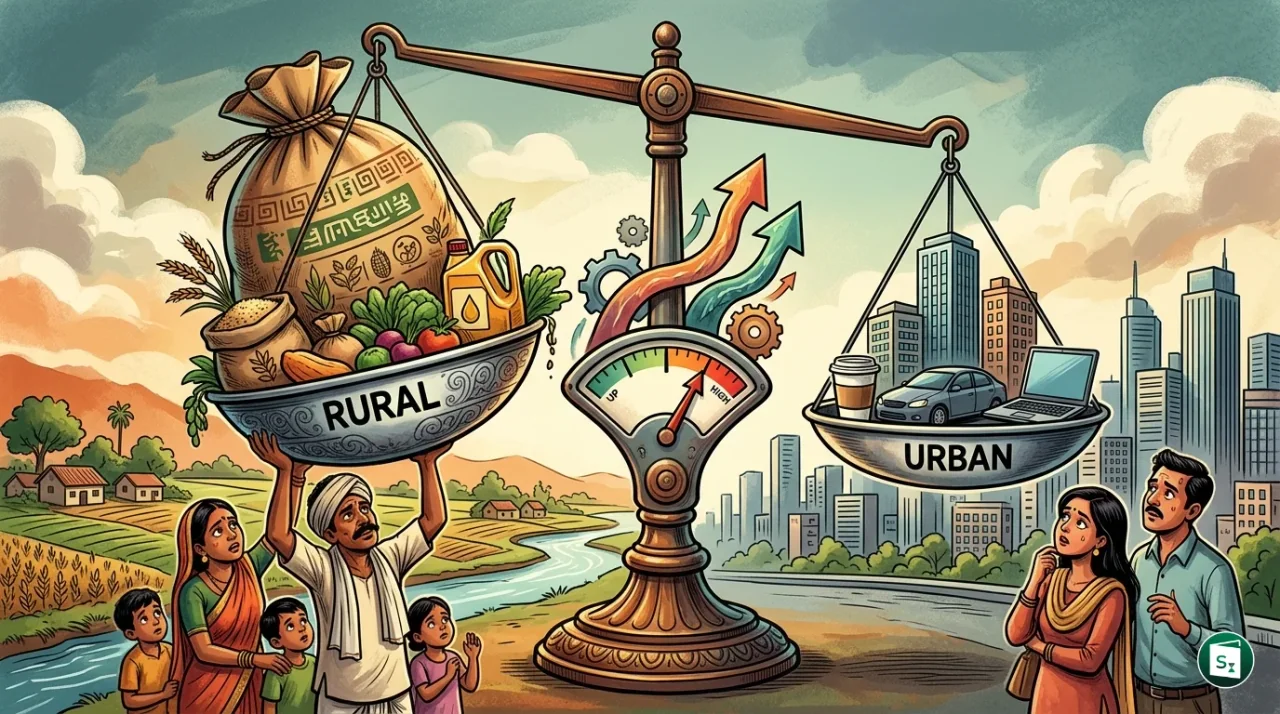
The latest figures indicate a divergent trend between rural and urban sectors. While rural inflation was recorded at 3.74%, urban inflation stood lower at 3.16%. Both segments saw a slight increase compared to March 2026, where rural and urban rates were 3.63% and 3.11% respectively. This variation highlights the differing consumption baskets and price pressures experienced in various parts of the country.
| Sector | March 2026 Inflation (%) | April 2026 Inflation (%) |
|---|---|---|
| Rural | 3.63 | 3.74 |
| Urban | 3.11 | 3.16 |
| Combined | 3.40 | 3.48 |
The data shows that inflationary pressure continues to be relatively higher in rural areas compared to urban centers. This is often linked to the higher weight of food items in the rural consumption basket, making it more sensitive to fluctuations in agricultural commodity prices.
Dynamics of Food and Commodity Prices
The Consumer Food Price Index (CFPI), which measures the change in retail prices of food items, climbed to 4.2% in April 2026 from 3.87% in the previous month. Food inflation remains a critical component of the overall inflation trajectory in India. According to the report, the rise in food prices was specifically driven by a surge in the cost of tomatoes. Conversely, some essential vegetables provided relief, with potatoes and onions witnessing significant deflation of 23.69% and 17.67% respectively.
Beyond food, the price of jewelry also contributed to the inflationary trend. Categories including silver, gold, diamond, and platinum saw increased costs during the month. Housing inflation for April was recorded at 2.15%, indicating a moderate increase in rental and maintenance costs.
Institutional Mechanism for Inflation Tracking
The Ministry of Statistics and Programme Implementation (MoSPI) is the nodal ministry responsible for releasing retail inflation data through the National Statistical Office (NSO). In early 2026, the government updated the Consumer Price Index (CPI) series to a new base year of 2024=100, replacing the decade-old 2012 series. This revision was necessary to capture contemporary consumption patterns, including the increased share of services and digital economy components.
The weights for various items in the new index are derived from the Household Consumption Expenditure Survey (HCES) 2023–24. This comprehensive survey provides a realistic picture of where Indian households spend their money, allowing for a more accurate measurement of the cost of living. MoSPI, which was established as an independent ministry on October 15, 1999, is headquartered at Khurshid Lal Bhawan in New Delhi.
Monetary Policy Implications and RBI Targets
Retail inflation serves as the primary anchor for India’s monetary policy. The Reserve Bank of India (RBI) follows a flexible inflation targeting framework, recommended by the Urjit Patel Committee in 2014. Under this mandate, the central bank aims to maintain a target inflation rate of 4%, with a tolerance band of plus or minus 2% (giving a range of 2% to 6%).
The Monetary Policy Committee (MPC), a statutory body established under the RBI Act, 1934, meets bi-monthly to review economic conditions and adjust the repo rate. Despite the slight rise in April 2026, the current inflation level of 3.48% remains well below the medium-term target of 4%. This provides the central bank with significant policy room to support economic growth while maintaining price stability.
Key Takeaways
- India’s headline retail inflation increased to 3.48% in April 2026, up from 3.40% in the previous month.
- Food inflation, as measured by the Consumer Food Price Index (CFPI), rose to 4.20% from 3.87% in March.
- Rural inflation for the month stood at 3.74%, while urban inflation was recorded at 3.16%.
- The Ministry of Statistics and Programme Implementation (MoSPI) utilizes a new base year of 2024=100 for calculating the Consumer Price Index (CPI).
- The Reserve Bank of India (RBI) target for retail inflation is 4%, with a tolerance band of 2% to 6%, as recommended by the Urjit Patel Committee.
- The National Statistical Office (NSO), under MoSPI, is responsible for compiling and releasing the monthly inflation data.