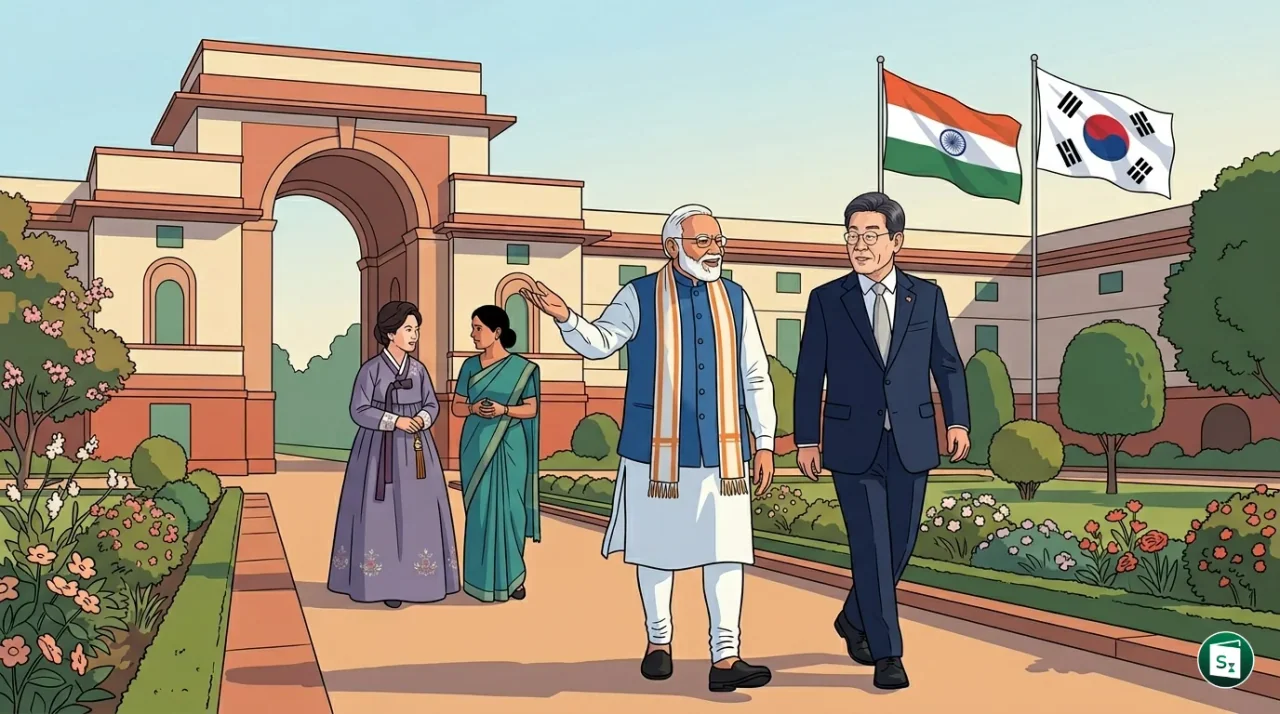
India and the Republic of Korea launched a comprehensive Joint Strategic Vision for the 2026-2030 period during the state visit of President Lee Jae Myung to New Delhi on May 01, 2026. The bilateral summit at Hyderabad House focused on elevating the Special Strategic Partnership through deep collaboration in critical technologies and industrial synergy. This landmark visit signifies a shift towards a futuristic partnership aimed at securing digital supply chains and doubling bilateral trade to 50 billion dollars by 2030.
Advancing the Special Strategic Partnership: Vision 2026-2030
The core outcome of the summit was the adoption of the Joint Strategic Vision, which serves as a roadmap to transform bilateral relations into a futuristic partnership. The Special Strategic Partnership (SSP), originally established in 2015, has been expanded to cover new frontiers in economic security and maritime cooperation. This vision emphasizes a “Chips to Ships” philosophy, indicating a broad spectrum of collaboration ranging from high-end electronics to massive maritime infrastructure.
A primary goal under this framework is to nearly double the annual bilateral trade, aiming for 50 billion dollars by 2030. To achieve this, both nations have agreed to institutionalize regular high-level dialogues, including the inaugural Foreign and Defence Affairs 2+2 Dialogue at the Vice Minister level. This move aligns with India’s Act East Policy and South Korea’s interest in diversifying its strategic and economic footprints in South Asia.
Launching the India-Korea Industrial Cooperation Committee
To streamline economic engagement, both nations established the Industrial Cooperation Committee (ICC), the first ministerial-level platform dedicated specifically to industrial ties. This committee will be chaired by the industry ministers of both countries and is tasked with coordinating policies across strategic sectors. The ICC will focus on unlocking new opportunities in advanced manufacturing, including automobiles, electronics, and precision engineering.
The committee will operate through four dedicated working groups:
- Trade and Commerce: Focused on market access and removal of non-tariff barriers.
- Industry and Investment: Aimed at facilitating joint ventures and industrial townships.
- Strategic Resources: Coordinating the supply of critical minerals and rare earths.
- Clean Energy: Collaborating on green hydrogen and sustainable power projects.
This institutional framework is expected to provide a stable environment for South Korean small and medium enterprises (SMEs) to establish a manufacturing presence in India, supporting the Make in India initiative.
The Digital Bridge: Collaborative Push for AI and Semiconductors
A centerpiece of the visit was the formulation of the India–Korea Digital Bridge, a long-term framework designed to deepen cooperation in critical technologies. This initiative aims to create a synergy between India’s vast pool of AI software engineers and South Korea’s world-class semiconductor fabrication capabilities. By combining India’s Digital Public Infrastructure (DPI) with South Korea’s precision manufacturing, both nations seek to build a more resilient technology ecosystem.
To safeguard these technological interests, the two countries have also initiated an Economic Security Dialogue. This dialogue will focus on securing supply chains for semiconductors and critical minerals, which are essential for modern electronics and electric vehicles. The partnership aims to reduce dependence on single-source suppliers and foster joint research and development in next-generation technologies like Artificial Intelligence and Quantum Computing.
Revitalising Trade Through the CEPA Upgrade
The summit marked a significant step in trade relations with the agreement to resume and expedite negotiations for upgrading the Comprehensive Economic Partnership Agreement (CEPA). The original CEPA, which came into effect in 2010, has been a cornerstone of bilateral trade, but India has long sought a review to address the growing trade deficit. The upgrade aims to provide better market access for Indian products and services while removing structural bottlenecks like non-tariff barriers.
Negotiations are expected to be fast-tracked, with both sides aiming for a final agreement by the first half of 2027. The upgraded pact will move beyond traditional goods trade to include modern domains such as digital trade and the green economy. By modernizing the CEPA, the two nations hope to create a more balanced and equitable economic partnership that reflects current global trade dynamics.
Geopolitical Convergence in the Indo-Pacific
Beyond economic ties, the summit highlighted a growing convergence on regional and global issues. South Korea officially joined the Indo-Pacific Oceans Initiative (IPOI) and the International Solar Alliance (ISA), reinforcing its commitment to India’s vision for a free, open, and inclusive Indo-Pacific. In return, India has joined the Global Green Growth Institute (GGGI), which is headquartered in Seoul. These mutual memberships signify a joint effort to address climate change and maritime security.
To foster stronger people-to-people ties, the period of 2028–2029 has been designated as the Year of India–Korea Friendship. This celebration will be supported by a new cultural exchange programme spanning from 2026 to 2030, aimed at promoting collaboration in the arts, cinema, and sports. The two leaders also discussed deepening defense cooperation, particularly in shipbuilding and the manufacturing of advanced defense equipment, further solidifying the strategic nature of their relationship.
Key Takeaways
- India and South Korea adopted the Joint Strategic Vision 2026-2030 to elevate their Special Strategic Partnership, originally established in 2015.
- The two nations established the Industrial Cooperation Committee (ICC), a ministerial-level platform to coordinate policies in advanced manufacturing and energy.
- The India-Korea Digital Bridge framework was launched to facilitate collaboration in Artificial Intelligence, semiconductors, and Information Technology.
- Negotiations to upgrade the Comprehensive Economic Partnership Agreement (CEPA), which came into effect in 2010, have been resumed with a target completion date of 2027.
- South Korea has officially joined the International Solar Alliance (ISA) and the Indo-Pacific Oceans Initiative (IPOI) during the summit.
- The period of 2028-2029 has been designated as the Year of India-Korea Friendship to mark deepening cultural and diplomatic ties.